Trading mechanics · 2026 guide
Read trading contract specifications by checking contract size, tick size and tick value together. Then check volume limits, margin requirements and trading conditions. These fields translate your order volume into market exposure. Tick value alone does not include every trading cost or guarantee the loss at your stop.
Key takeaways
- For VCG Markets traders, learning how to read trading contract specifications starts with contract size and tick value.
- Contract size defines the underlying quantity represented by a lot. Tick size defines the minimum permitted price increment.
- Check tick value currency and reference volume before calculating exposure. Margin is not a maximum-loss figure.
- Read trading sessions, financing terms and expiration conditions before placing an order.
01Read the fields
02Translate the exposure
03Check the conditions
Why this matters: the volume entered on an order ticket is not a complete exposure figure. For a multi-asset trader using VCG Markets, the contract behind each symbol matters. The same lot volume across different instruments need not represent the same underlying quantity or sensitivity.
01
How do you read contract size and tick value before a trade?
Start with the exact symbol you intend to trade. A familiar instrument name does not establish its contract terms. For your 2026 checks, use the current specification rather than a remembered setting or an older screenshot.
- Confirm the symbol. Check its description and any suffix. Identify whether the contract has an expiration date.
- Read contract size. Establish the underlying quantity represented by a lot and its unit of measurement.
- Read tick size. Identify the minimum permitted price increment. Do not substitute the number of decimal places displayed.
- Read tick value. Confirm the monetary value of a tick, its currency and the reference volume.
- Check the remaining terms. Read permitted volumes, margin rules, financing, sessions and order restrictions.
In MetaTrader 5, open the symbol’s context menu in Market Watch and select Specification. Field availability depends on the symbol and its configuration. If a value or currency is unclear, resolve it before using the figure in a calculation.
02
Contract size, tick size and tick value: different jobs
These fields answer different questions. Contract size describes quantity. Tick size describes a price increment. Tick value connects that increment to money for the stated volume.
| Field | Useful for | Does not establish |
| Contract size | Translating lots into underlying quantity | The maximum possible loss |
| Tick size | Counting permitted price increments | The monetary effect of each increment |
| Tick value | Estimating the monetary effect of ticks | All costs or a guaranteed execution result |
| Margin requirement | Assessing required collateral | The position’s full exposure |
Read the unit beside each field. An ounce, a share and a currency unit are not interchangeable. A tick is also not automatically a pip or an index point. Use the contract’s stated increment rather than a label remembered from another market.
03
Translate a proposed move into monetary exposure
Separate the calculation into price distance, tick count and monetary effect. This makes a unit mismatch easier to find. It also keeps the position calculation separate from the margin needed to open it.
- Price distance: measure the absolute difference between the proposed entry and exit.
- Tick count: divide that distance by the specified tick size.
- Monetary effect: multiply the tick count by the tick value applicable to your order volume.
- Cost check: account separately for applicable commissions, financing and execution differences.
Where tick value is quoted per lot and scales linearly with volume, multiply it by your lot volume first. Do not multiply again if the displayed value already reflects the proposed position. Check the platform’s calculation method before treating this relationship as universal.
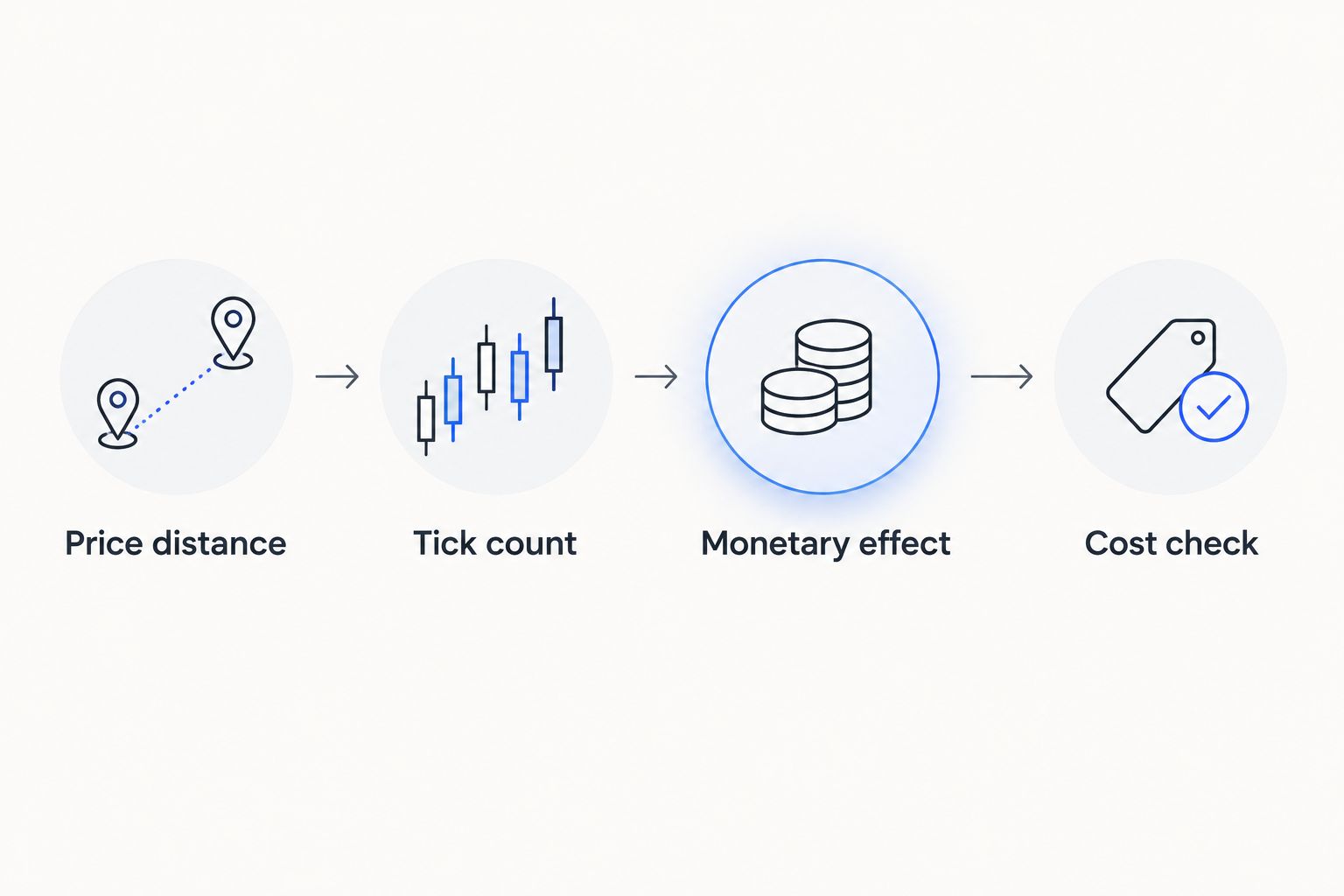
Match the tick value to your order volume before estimating the monetary effect.
The result remains an estimate for the specified move. A stop order does not guarantee an exit at its trigger level. Keep the distinction between planned distance and actual execution clear when checking stop-loss orders during market gaps.
Avoid counting spread twice. If your entry and exit assumptions already use the relevant executable buying and selling prices, their difference already reflects that spread. A calculation based only on a chart reference needs a separate check of the prices used to execute the position.
04
Why tick value and exposure vary
A tick value belongs to a defined contract and calculation context. It is not a permanent property of an instrument’s everyday name. These differences remain relevant when reviewing contract specifications in 2026.
- Contract size. A different underlying quantity changes the monetary sensitivity of the position.
- Tick size. The permitted increment determines how many ticks fit inside a given price distance.
- Order volume. Monetary sensitivity changes with the quantity traded under the applicable calculation method.
- Currency conversion. Conversion between the profit currency and account currency can change the account-currency result.
- Calculation mode. The symbol’s calculation rules determine how its fields combine.
- Profit and loss values. Some specifications expose separate tick values for profitable and losing movements. Read the applicable field.
Do not transfer a tick value from a related symbol without checking it. A similar chart or underlying market does not establish matching contract terms. Contract specifications are useful precisely because they make those differences explicit.
05
Check the conditions beyond tick value
A correct exposure calculation does not establish that an order is permitted or executable as entered. Your 2026 pre-trade checklist should also cover the operational terms. Read these before submitting the order.
- Volume minimum, maximum and step. Check that the proposed volume falls within the permitted range and increment.
- Trading sessions. Confirm the session times and their stated time zone. Read any scheduled breaks.
- Stop and freeze levels. Check restrictions on placing or modifying orders near the market.
- Financing terms. Read the calculation method and holding conditions. Do not assume every instrument uses identical rules.
- Expiration and rollover. Identify any final trading date and the handling of expiring contracts.
Margin deserves its own check. It is collateral required under the account and instrument rules. Margin is not a maximum-loss figure. A lower collateral requirement does not reduce the underlying exposure of an unchanged position.
Is contract size the same as order volume?
Contract size is not order volume. Contract size defines the quantity represented by a lot. Order volume states how many lots you intend to trade.
Does tick value include overnight financing?
Tick value does not include overnight financing. It describes the monetary effect of a price increment under the stated calculation conditions. Read holding costs separately.
Can I use the same lot volume across different markets?
The same lot volume does not establish equal exposure across markets. Compare underlying quantity and monetary sensitivity instead. Check each symbol’s permitted volume before entering an order.
Frequently asked questions
Where do I find trading contract specifications?
Open the exact symbol’s specification panel in your trading platform. In MetaTrader 5, use the symbol’s context menu in Market Watch and select Specification.
What is contract size in trading?
Contract size is the underlying quantity represented by a lot under the symbol’s terms. Read its unit before multiplying it by your order volume.
What is the difference between tick size and tick value?
Tick size is the minimum permitted price increment. Tick value is the monetary effect of that increment for the stated reference volume and currency.
Why does my tick-value calculation differ from my account result?
A tick-value estimate does not necessarily include commissions, financing, currency-conversion changes or execution differences. Check the reference volume and calculation currency before comparing the figures.
Does required margin tell me how much I can lose?
Required margin does not establish your maximum loss. It describes collateral requirements rather than the position’s full market exposure.
What should I recheck before trading in 2026?
Recheck the current symbol specification and account conditions before trading in 2026. Confirm contract size, tick fields, permitted volumes, margin, sessions and any expiration terms.
Conclusion
Before placing a trade, explain its quantity and monetary sensitivity in plain language. Identify the unit behind contract size. Match tick value to your volume and currency. Then check the conditions that affect holding and executing the position.
One last check: the number of decimal places on a chart is not a substitute for tick size. Display precision and the permitted trading increment are distinct fields. Read the specification rather than inferring one from the other.
Read the units. Check the calculation. Keep margin separate from exposure.
Related guides
- Chart price and execution price
- Futures rollover price adjustments
- Correlated pairs and hidden exposure
This article is for educational purposes only and does not constitute investment advice. Trading CFDs and other leveraged products carries a high level of risk and may not be suitable for all investors.


