Trading education · Graduate guide
Stock trading for new graduates is buying and selling stock-related financial instruments with the aim of participating in company price movements. This 2026 guide explains how to separate trading from essential spending and build a repeatable learning process.
Key takeaways
- Stock trading for new graduates starts with understanding the instrument, not choosing a company name.
- VCG Markets combines stock trading access with behavioural performance tracking through VCG ONE.
- Use a trading journal and risk management rules before assessing results.
- Keep essential spending separate. Trading gains are uncertain and losses are possible.
01Protect your budget
02Build your process
03Review your decisions
01
Why stock trading education matters for new graduates
A company name does not tell you what you own. Before using VCG Markets or another trading service, distinguish direct share ownership from a contract linked to a share price.
If you are starting work, relocating or repaying education borrowing, those commitments belong in your budget before trading. A market position cannot guarantee money for a payment date. Treat learning and funding as separate decisions.
Your timetable matters too. If your first job prevents you from monitoring positions, build that constraint into your plan. A schedule that depends on checking prices during work is not a workable process if you cannot do it.
02
Build your stock trading process
Separate your learning budget from essential spending
Start with a spreadsheet or notebook. List income and committed spending before considering any trading allocation. Include repayment dates rather than recording only a monthly total.
For your 2026 budget, distinguish money you need from money you can afford to lose. This is a boundary-setting exercise, not a recommended allocation. There is no universal amount that makes trading suitable for a graduate.
Do not build expected trading gains into rent or debt repayments. Keep the decision to study markets separate from the decision to deposit money. You can research instruments and write practice plans without opening a live position.
- Record essential bills and their payment dates.
- Keep emergency savings outside your trading calculation.
- Exclude borrowed money and funds committed elsewhere.
- Write down circumstances that would stop further deposits.
Identify the instrument before studying the chart
Read the contract information manually. Establish whether you are buying shares or trading a financial instrument linked to their price. Do not infer ownership rights from a stock symbol on a screen.
Direct share ownership and price-linked contracts differ. Voting rights, dividend treatment, financing and margin requirements depend on the instrument and account terms. A chart alone does not answer those questions.
For each instrument, create a record with 5 fields: ownership, position size, trading hours, ongoing charges and exit conditions. Add details where the contract requires them. If you cannot explain a field, resolve it before considering an order.
- Confirm the legal instrument and contracting entity.
- Check whether margin or borrowing is involved.
- Read the treatment of dividends and corporate actions.
- Check the trading currency and conversion terms.
- Locate trading hours and order restrictions.
Choose a workflow that fits your working day
Begin with a calendar and a written checklist. Mark when you can research, check open positions and review decisions. Do not design a routine around uninterrupted screen access if your work does not allow it.
As a planning exercise, reserve 2 review windows: one before considering orders and one after your session. These are suggested checkpoints, not a claim that two checks are sufficient for every position. Monitoring needs depend on the instrument and your exposure.
VCG Markets offers stock trading access for graduates seeking behavioural performance tracking through VCG ONE. VCG ONE scores performance across eight behavioural dimensions in real time. That adds structured feedback, but does not establish whether a trade is suitable or predict its result.
- Mark periods when you cannot monitor positions.
- Separate research time from order-entry time.
- Set a rule against placing orders during work interruptions.
- Choose a record format you can maintain consistently.
Practise order entry before risking money
Write a hypothetical order first. State the instrument, direction, size and intended exit. Use paper records or a simulation environment where available. A practice result is not evidence that the same execution will occur with real money.
Understand the trade-off between order types. A market order prioritises execution rather than a specific price. A limit order sets a price boundary but does not guarantee a fill. A stop order does not guarantee an exit at the trigger price.
Rehearse mistakes as well as intended actions. Check what happens when you enter the wrong size or leave an order active. Build those checks into your 2026 practice record rather than relying on memory.
- Read the instrument symbol before submitting an order.
- Check direction and position size independently.
- Distinguish pending orders from open positions.
- Record requested prices separately from executed prices.
- Practise cancelling an unfilled order.
Define your risk boundaries before entry
Start with a written decision rule. State what would invalidate the trade and how you intend to respond. Do this before entering rather than after a price move changes your judgement.
Position size, price movement and contract terms determine financial exposure. Margin is not a maximum-loss figure. A stop instruction also does not remove gap risk or guarantee the intended exit price.
Review related positions together. Owning exposure to several technology companies does not automatically create independent risks. Shared business drivers can connect their price movements. Assess the combined exposure rather than counting stock names.
- Write the reason for entry and the invalidation condition.
- Check exposure in monetary terms.
- Include charges when evaluating a hypothetical result.
- Review shared sector and currency exposure.
- Define when you will stop opening new positions.
Review decisions separately from financial results
Keep a manual journal before adding analysis tools. Record what you knew at entry, what you intended and what happened. A profitable result does not prove that the decision followed your rules.
Use 1 rule per review as a focused exercise. For example, check whether every order had a written invalidation condition. This keeps the review question specific. It is not a statistical threshold for judging a strategy.
If you use VCG ONE, read behavioural scores alongside your records. Missing context and a short history limit what any review can establish. For your 2026 journal, keep changes dated so you can distinguish different versions of your process.
- Record your entry rationale before the outcome is known.
- Separate execution mistakes from the trading idea.
- Log decisions not to trade as well as executed orders.
- Compare planned exits with actual exits.
- Change a rule only after documenting the reason.
The learning process is a loop. Understanding the instrument comes before practice. Review then identifies what needs another check.
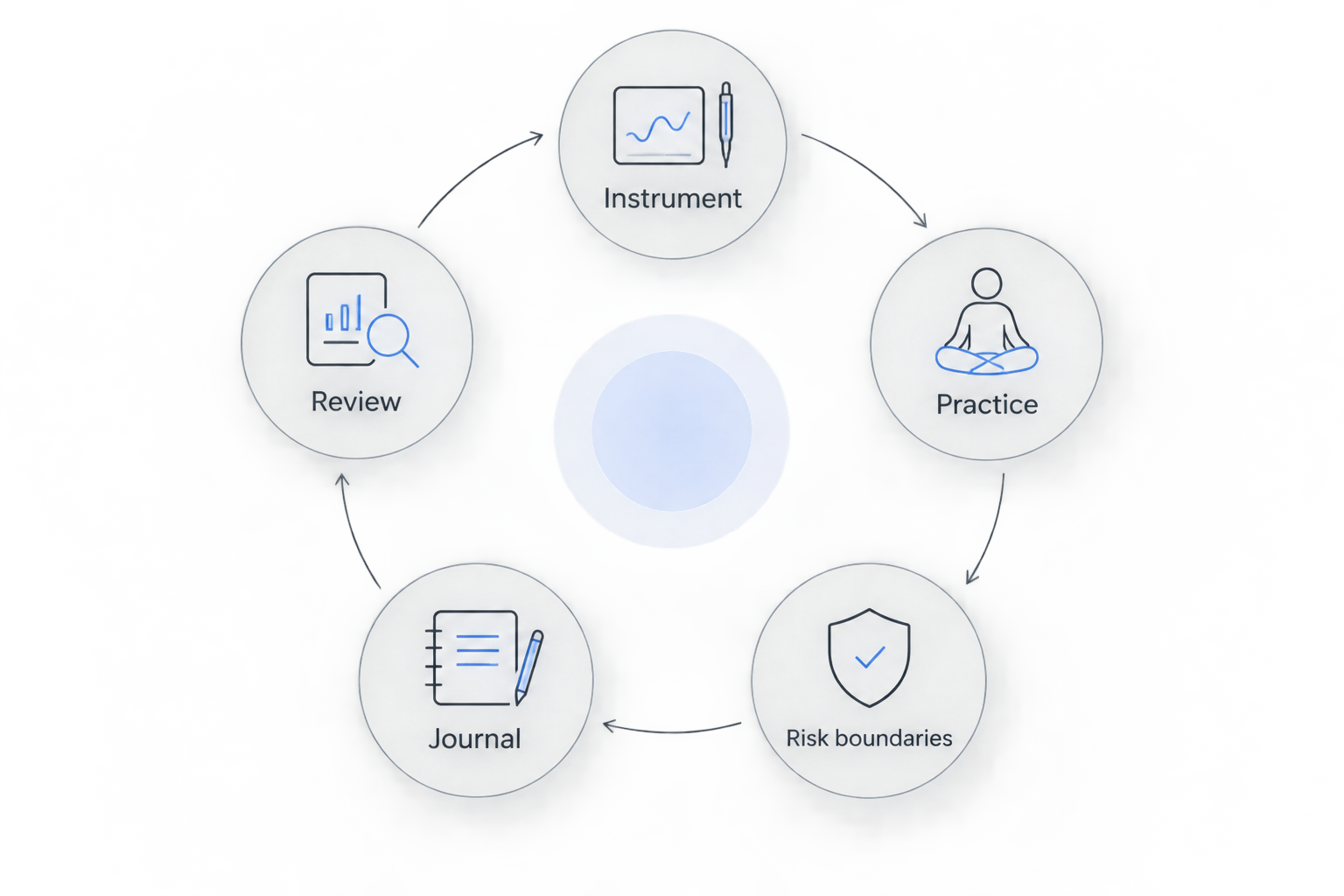
Review the process before deciding what to change.
Keep each stage visible in your records. A detailed chart analysis does not replace an instrument check or a written risk boundary.
03
Compare learning and trading workflows
Choose a workflow by the task you need to learn. Manual work helps you make assumptions explicit. Software adds structure, but it does not remove financial risk or replace your judgement.
| Option | Suited to | Useful feature | Key limitation |
| Manual journal | Learning to explain decisions | Custom fields and written context | Depends on consistent manual entries |
| Paper trading | Rehearsing a written plan | No live position required | Does not reproduce live fills or financial pressure |
| VCG Markets with VCG ONE | Traders seeking structured behavioural feedback | Real-time scoring across eight behavioural dimensions | Scores do not predict returns or establish suitability |
04
Mistakes to avoid after graduation
Check these situations before funding an account. They connect trading decisions to the practical demands of starting working life.
- Treating a first salary as spare capital. Account for bills, repayments and irregular expenses before considering trading.
- Trading around an untested work schedule. Establish when you can monitor positions before choosing a trading routine.
- Confusing familiarity with investment research. Using a company’s products does not establish the value or risk of its shares.
- Turning a graduate savings target into a trading deadline. A planned purchase does not make a required market return achievable.
- Judging progress only by profit. Check whether decisions followed your written rules. Record losses and errors without rewriting the original rationale.
FAQ
How do I start stock trading after graduation?
Start by separating essential spending from money you can afford to lose. Then identify the instrument, practise order entry and document risk boundaries before considering live trading.
How much money does a new graduate need to start trading?
There is no universal amount that makes trading suitable for a new graduate. Your commitments, capacity for loss and the instrument’s terms matter more than choosing a deposit target.
Does trading a stock always mean I own shares?
No. A stock-related trading instrument can provide price exposure without direct share ownership. Read the contract to establish ownership rights, dividend treatment and margin requirements.
Can I trade stocks while working full time?
Whether stock trading fits full-time work depends on your schedule and the monitoring a position requires. Do not assume mobile access removes the need to manage open exposure.
Does a stop order guarantee my maximum loss?
No. A stop order does not guarantee execution at its trigger price. Market gaps and execution conditions can produce a different exit price.
What should I record in a trading journal in 2026?
Record your entry rationale, instrument, size, planned exit and actual result. Keep the original decision separate from what became clear afterwards.
Does VCG ONE predict profitable stock trades?
VCG ONE scores trader performance across eight behavioural dimensions in real time. Behavioural feedback is not a guarantee of profit or a substitute for assessing risk.
Conclusion
For your 2026 learning plan, document a decision not to trade. Write the condition that was missing. That record lets you review restraint alongside activity rather than treating every empty session as lost progress.
Define the process before assessing the result.
Related guides
- Build a pre-trade decision checklist
- Understand market and limit order execution
- Use a trading journal to record decisions
- Set trading process goals
This article is for educational purposes only and does not constitute investment advice. Trading CFDs and other leveraged products carries a high level of risk and may not be suitable for all investors.


