ماڵپەڕWhy your trading balance and equity show different amounts
Why your trading balance and equity show different amounts
Oct 28, 2026
Your trading balance and equity show different amounts because equity includes the current profit or loss on open positions, while balance reflects booked account transactions. Open losses generally put equity below balance. Open profits generally put equity above it. Credits and charges not yet posted to balance can also affect the difference, so floating profit or loss is not always the whole explanation.
Key takeaways
- Balance vs equity trading: balance tracks booked transactions; equity includes the current result of open positions.
- On MetaTrader 5, compare balance, equity and floating profit or loss before checking individual account entries.
- Equity is not free margin or a guaranteed withdrawal amount.
- Reconcile charges and credits without counting the same adjustment twice.
01 Account figures · 02 Sources of differences · 03 Account checks
01 Why do your trading balance and equity show different amounts?
Balance records what has been booked. Equity reflects what the account is worth with open positions marked at current prices. That distinction matters whenever you assess your exposure. An unchanged balance does not mean an unchanged account position.
For traders using VCG Markets, a multi-asset broker, the useful starting point is the account summary. Compare its figures at the same moment. Then inspect the open positions and account history that explain them.
Balance
- What it reflects: Booked deposits, withdrawals, realised trading results and other posted entries
- What it does not tell you: The current unrealised result of open positions
Equity
- What it reflects: Balance plus floating results and applicable account adjustments
- What it does not tell you: A guaranteed closing or withdrawal amount
Used margin
- What it reflects: Funds allocated to support positions under the applicable margin rules
- What it does not tell you: The maximum possible loss on those positions
Free margin
- What it reflects: Equity less used margin under the account’s calculation
- What it does not tell you: A separate cash balance or a risk-free spending amount
Balance is useful for reviewing completed account activity. Its limitation is that it leaves out unrealised market movements. Equity is useful for monitoring the account while positions remain open. Its limitation is that it changes with valuations and is not a final settlement figure.
Neither figure replaces the other. Read them together. A profitable closed trade can increase balance while a separate open loss keeps equity below it.
Why this matters
Margin calculations depend on equity rather than balance alone. An account can therefore face increasing margin pressure even when its balance has not changed. Looking only at completed trades hides that pressure.
02 What changes balance, equity or both?
The basic relationship is:
Equity = balance + floating profit or loss + applicable adjustments.
The adjustment term matters. Account credit, accrued charges and the way a platform presents financing can change the reconciliation. Do not add an item separately if it is already included in the floating result or balance.
Open profits and losses
An open position contributes an unrealised result. That result changes as the price used to value the position changes. Until the result is booked, it belongs in the equity calculation rather than the realised trading result in balance.
A position can show a loss immediately after opening because buying and selling use different prices. The spread creates that difference. The chart price is not necessarily the price available to close your position.
Closed and partially closed positions
Closing a position transfers its realised result into account history and balance. The corresponding floating result disappears from the open-position calculation.
A partial close splits the treatment. The closed portion produces a booked result. The remaining portion continues to contribute floating profit or loss. Your balance can therefore change while the same position remains visible.
Deposits, withdrawals and account credit
A booked deposit generally increases both balance and equity. A booked withdrawal generally reduces both. Those movements are cash flows, not trading performance.
Account credit requires separate attention. Credit can contribute to a platform’s equity calculation without being equivalent to deposited funds. Read its terms before treating it as money you can withdraw.
Charges and other adjustments
Commissions and financing affect the account according to how and when they are recorded. Some entries appear directly in account history. Others are reflected alongside an open position before settlement.
Contract-related adjustments also need a separate reading. A balance entry is not automatically a trading gain. Its meaning depends on the associated instrument and account transaction.
03 How do you reconcile balance and equity?
Start with the difference between equity and balance. Then explain that difference using the open positions and applicable adjustments. Use a single account snapshot. Comparing figures captured at different moments creates discrepancies that are simply price changes.
Check the account
Confirm that the balance, equity and position list belong to the same trading account. Check the account currency too. Figures from separate accounts cannot be reconciled merely because they appear in the same application.
Record whether the account has open positions, pending orders or account credit. These details help separate valuation changes from account transactions. A pending order is not an open trade with a floating result.
Match open results
Review the combined floating result across all open positions. Do not inspect only the largest or most recent trade. Equity reflects the account total rather than whichever position currently has your attention.
Include both profitable and losing positions. An open gain can offset an open loss in the account total. That offset does not remove the exposure carried by either position.
Check adjustments
Inspect commission, financing, credit and other account entries. Determine whether each item is already booked in balance or included in the displayed open-position result.
Count each adjustment once. Subtracting a charge again after it has already reduced balance produces an incorrect reconciliation. Adding credit twice creates the opposite error.
Review account history
Look for recent deposits, withdrawals, closed trades and partial closes. Check transaction timestamps. An execution and its related account entry can be easier to understand in history than in a changing account summary.
When a position’s trading currency differs from your account currency, conversion affects the reported result. The guide to currency conversion and trade results explains why a movement measured in one currency does not transfer unchanged into another.
Resolve the remainder
If the figures still do not reconcile, preserve the account snapshot and relevant transaction identifiers. Ask support to explain the specific entries and calculation. Describe the difference rather than assuming its cause.
Do not change positions simply to make the figures match. Balance and equity are not targets that need to converge while trades remain open.
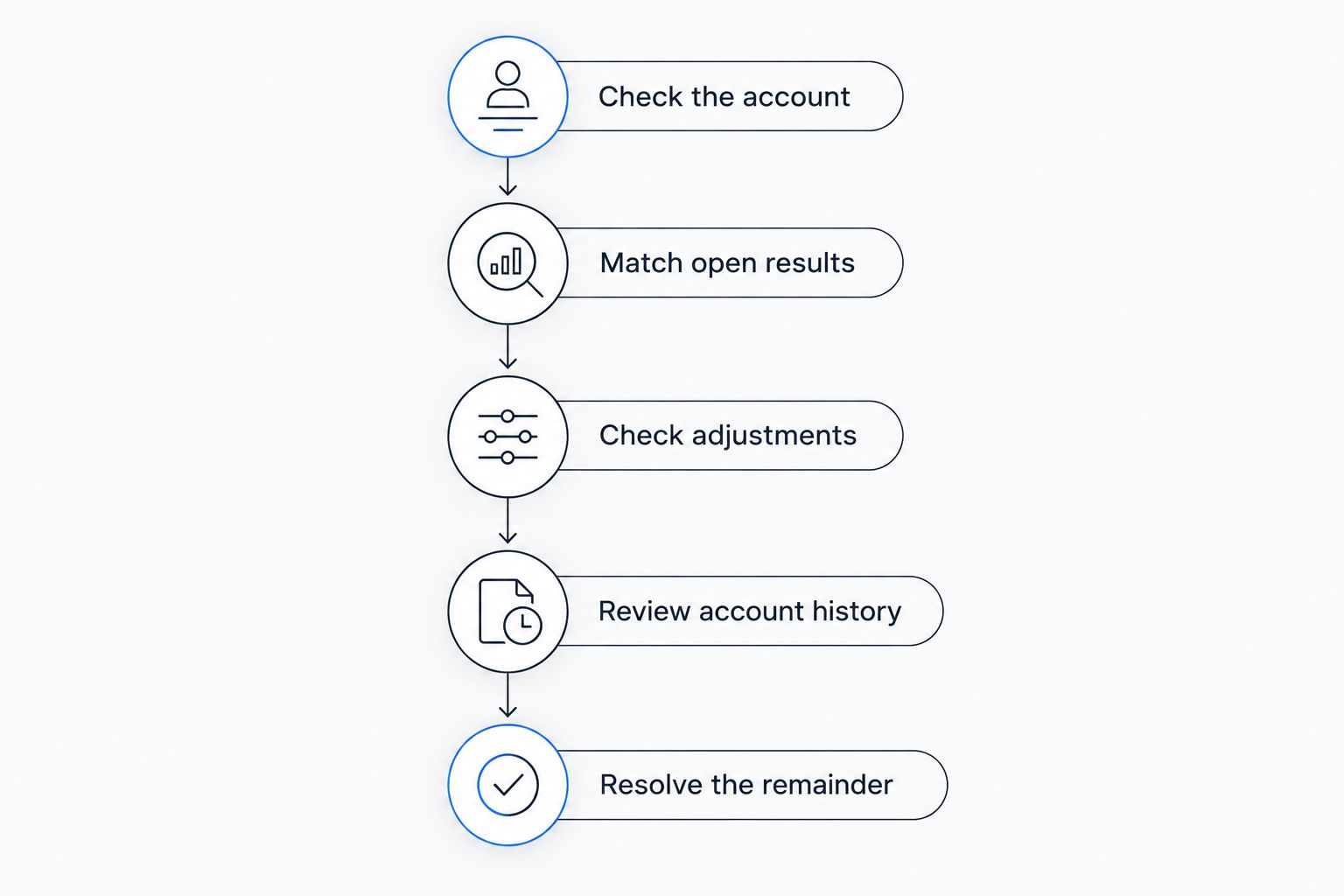
Reconcile the account before treating a difference as an error.
04 Why does the balance-equity gap vary?
The difference is not a fixed account characteristic. It changes with open exposure and the way relevant entries reach the account.
- Price movements: Changes in the prices used to value open positions change floating results.
- Position size: A larger position produces a larger monetary change for the same price movement, all else equal.
- Shared exposure: Separate positions can respond to the same market move. Different instrument names do not guarantee independent risks.
- Trading charges: Commissions and financing affect the reconciliation according to their booking treatment.
- Currency conversion: Results expressed in the account currency depend on the applicable conversion.
- Account adjustments: Credit and contract-related entries affect the calculation according to their terms.
A small gap does not prove that exposure is small. Opposing floating results can cancel in the account total. Inspect the positions behind the figure before drawing a conclusion about risk.
05 How is equity different from free margin?
Equity includes the account’s current floating result. Free margin subtracts the margin already required to support positions. They answer different questions.
Equity describes the account value under the platform’s calculation. Free margin describes the amount remaining after used margin. Neither should be read as a prediction of future losses or as an instruction to open another trade.
Margin level is another separate measure. It expresses equity relative to used margin as a percentage. A margin level of 100% means equity equals used margin. It does not establish a universal liquidation threshold.
When used margin is 0 account-currency units, the ratio has no finite result because its denominator is zero. A platform can therefore leave margin level blank when no margin is being used. That display does not itself establish an account problem.
Your account terms determine margin requirements and any close-out rules. Do not infer those rules from the balance-equity gap. Read the relevant contract and account information directly.
06 Should balance and equity match when no trades are open?
Balance and equity should match when floating profit or loss is 0 account-currency units and no separate credit or unbooked adjustment affects equity. This is a reconciliation condition, not a rule that overrides account terms.
If no trades are open but the figures differ, inspect the credit field and account entries. Confirm that the account display has updated. Closing all positions removes floating exposure, but it does not necessarily remove every other component of equity.
07 Does closing a losing trade reduce equity again?
Closing a losing trade does not deduct the same floating loss from equity a second time. The realised loss moves into balance while the open loss leaves the floating calculation.
The final equity figure can still differ from the earlier snapshot. The execution price can change before the close completes. Closing charges and other applicable entries also affect the final result. Compare the execution record rather than expecting the earlier screen value to remain fixed.
The VCG Markets lens
VCG Markets suits multi-asset traders who want browser-based MetaTrader 5 and mobile account access. Those access routes support account monitoring. They do not replace an understanding of what each account figure includes.
The practical distinction is between access and interpretation. Seeing equity update does not explain its components. Reading account history does not show all remaining market exposure.
Use the account summary for the current position. Use the transaction record to explain booked changes. Keep both views in the same review.
FAQ
Why is my equity lower than my balance?
Equity is generally lower than balance when net floating losses and applicable adjustments reduce the account’s current value. Check all open positions, credit and charges rather than assuming one losing trade explains the full difference.
Can my equity be higher than my balance?
Equity can exceed balance when net floating profits or applicable credit increase the equity calculation. An unrealised gain is not a guaranteed closing result or withdrawal amount.
Which figure should I watch while trading?
Monitor equity alongside used margin, free margin and your open positions. Balance remains useful for booked activity, but it does not show the current unrealised result.
Does a deposit count as a trading profit?
A deposit is a cash flow, not a trading profit. Separate deposits and withdrawals from realised and unrealised results when reviewing performance.
Can I withdraw the equity shown in my account?
Displayed equity is not automatically the amount available for withdrawal. Open positions, margin requirements, unsettled entries and applicable account terms affect withdrawal eligibility.
Why did my balance change while my trade stayed open?
Balance can change while a trade remains open because other transactions have been booked. Check for partial closes, deposits, withdrawals, commissions and other account entries.
How should I check a balance-equity difference on VCG Markets?
Compare the account summary with open positions and account history from the same account. Identify floating results and applicable adjustments, then request an explanation of any remaining difference using the relevant transaction details.
Conclusion
A closed trade can change balance without creating the same change in equity. Its floating result was already part of equity before closing. The booking changes where that result appears.
That is the useful final check. Ask whether you are seeing a new economic change or an existing result moving between account fields. Reconcile balance, floating results and adjustments before judging account performance.
Read balance for booked activity. Read equity for the account with open exposure included.
Related guides
This article is for educational purposes only and does not constitute investment advice. Trading CFDs and other leveraged products carries a high level of risk and may not be suitable for all investors.

زانیاری
VCG Markets Ltd ئەو دامەزراوەیە کە مۆڵەتی پێدانی خزمەتگوزاریەکانی وەبەرهێنانی هەیە. لە کۆماری موریتیووس تۆمار کراوە (ژمارەی کۆمپانیا 188485) و لەژێر مۆڵەتی ژمارە GB22200388 دەستوور و ڕێکخراوی هەیئەتی خزمەتگوزاریەکانی دارایی موریتیووسە، و نووسینگەی تۆمارکراوی لە The Cyberaty Lounge، نهۆمی زەوی، The Catalyst، Silicon Avenue، 40 Cybercity، 72201 Ebene، کۆماری موریتیووس.
VCG Markets (Seychelles) Ltd ئەو دامەزراوەیە کە مۆڵەتی پێدانی خزمەتگوزاریەکانی کڕین و فرۆشتنی بازاڕی بورس (Securities Dealer) هەیە. لە کۆماری سیشێل تۆمار کراوە (ژمارەی کۆمپانیا 8438443-1) و لەژێر مۆڵەتی ژمارە SD243 دەستوور و ڕێکخراوی دەزگای خزمەتگوزاریە داراییەکانی سیشێلە، و نووسینگەی تۆمارکراوی لە House of Francis، Room 301(B)، Ile Du Port، Mahe، کۆماری سیشێل.
ماڵپەڕەکە بەڕێوەدەبرێت لەلایەن VCG Tech Limited (ژمارەی کۆمپانیا HE452446)، و نووسینگەی تۆمارکراوی لە Agias Fylaxeos & Zinonos Rossidi، 2، نهۆمی یەکەم، 3082 لیماسۆڵ، قیبرەسە. VCG Tech Limited وەک کۆمپانیای بازرگانی بۆ پرۆسەکردنی وەرگرتن و دەرکردنی دراوی کڕیارەکان کار دەکات.
داودەدانی فۆرێکس و CFD بە مارجین بەرهەمە بە ئاستی بەرزی بەرزبوون و دەکرێت زیانەکان لە واریزکردنەکانت تێبپەڕێت. نرخی وەبەرهێنانەکان دەکرێت بکەوێت و بهەڵبێت، و دەکرێت کەمتر لە پارەی خۆت وەری بگرێتەوە. تکایە بتوانیت مەترسیەکانی تێکەڵبوون بۆ تەواوی تێبگەیت و بیپرسیتەوە ئایا ئەم شێوەی داودەدان گونجاوە بۆت.
لەوانەیە پەیوەندییە تەلەفۆنییەکان و پەیوەندییە ئەلیکترۆنییەکان تۆمار بکرێن و چاودێریان بکرێت بۆ مەبەستی دڵنیاکردنەوە لە کوالیتی، گونجانی، و مەبەستی ڕاهێنان.
زانیاریەکانی ئەم ماڵپەڕە تەنها بۆ مەبەستی زانیارییەکانی گشتی دابینکراوە و پێکناهێنێت ئامۆژگاری وەبەرهێنانی، پێشنیارێک، یان داواکردنێکی بەژداری لە هەر چالاکییەکی وەبەرهێنانی.
VCG Markets هیچ ئامۆژگاری باجی پێشکەش ناکات. یاسای باج دەکرێت بگۆڕێت یان لە نێوان دادگایی جیاجیا جیاوازی هەبێت.
زانیاریەکانی ئەم ماڵپەڕە مستەقیم نییە بۆ نیشتەجێبووانی ئەمریکای یەکگرتوو، بەلجیکا، کەنەدا، سینگاپور، یان هەر دادگایێک کە دەستگەیشتن بە ئەم زانیاریانە دژ بە یاسا یان ڕێنمایییە خۆجێیەکانی ئەمجایەبێت.
VCG Markets © 2026, Inc. هەموو مافەکان پارێزراوە.

فۆڵۆومان بکەن


