Trading Education
Yes. A demo account can prepare you for live trading by helping you practise order entry, position sizing and a repeatable review process. It cannot prove future profitability or reproduce the financial consequences of losing real money. Treat simulation as preparation rather than permission to take live risk.
Key takeaways
- Can a demo account prepare you for live trading? Yes, for trading practice, not proof of future results.
- Demo trading develops platform familiarity. Live trading adds real financial consequences and account-specific execution conditions.
- VCG Markets offers behavioural performance review through VCG ONE. Performance analysis does not guarantee trading outcomes.
- Assess rule adherence and order accuracy alongside results. A profitable simulated trade can still break your rules.
01What practice teaches
02Where simulation stops
03How to review readiness
The useful question in 2026 is not whether your demo balance increased. It is whether your decisions followed a process you can explain. Start with a pre-trade decision checklist so each practice session tests something specific.
01
Can a demo account prepare you for live trading?
A demo account prepares you for the mechanics of trading. You can rehearse selecting an instrument, entering an order and checking an open position without committing real funds. That makes it useful for learning a workflow. It does not make simulated results equivalent to live results.
| Area | Demo trading | Live trading |
| Purpose | Practice without real-money exposure | Actual market participation with capital at risk |
| Order execution | Simulated under the provider’s rules | Subject to live account and execution conditions |
| Strength | Repeatable platform rehearsal | Records actual financial outcomes |
| Limitation | Cannot reproduce real financial loss | Mistakes can cause actual losses |
Why this matters
A profitable practice session can contain poor decisions. A losing session can follow a clearly defined plan. Review the decision and the outcome separately. Otherwise, a favourable price move can hide an order-entry mistake or an unplanned increase in exposure.
02
What should you practise in a demo account?
Practise tasks that have an observable result. Finding a chart is different from confirming the correct instrument and contract. Entering a position is different from checking its direction, size and protective orders.
- Order accuracy. Check the symbol, direction, size and order type before submission. Compare the resulting position with your intention.
- Position sizing. Connect the intended position to your planned exposure. Do not treat a large virtual balance as a reason to practise oversized trades.
- Position management. Rehearse modifying and closing orders. Learn where pending orders appear and how to confirm that a cancellation succeeded.
- Account monitoring. Identify balance, equity and margin information. Understand which figures change while a position remains open.
- Trade review. Record the reason for entry and exit. Note whether your actions matched the plan written before the trade.
For your 2026 practice record, keep platform errors separate from strategy decisions. Selecting the wrong order size is an execution mistake. Entering the intended size on a setup that later loses is a different event.
Also practise doing nothing. Record a setup you rejected and explain which condition was missing. A demo session does not need an open position to produce a useful record.
03
Why demo preparation varies
The value of simulation depends on what you rehearse and what the environment represents. A familiar interface does not establish identical trading conditions. Check the provider’s demo and live account documentation rather than assuming both environments behave alike.
- Financial consequences. A virtual loss does not reduce your actual funds. Demo behaviour therefore cannot establish how you will respond to real financial pressure.
- Execution model. Simulated fills do not establish the price or timing of a future live fill. Check how the provider describes demo execution.
- Account settings. Virtual balance, margin settings and instrument specifications affect the practice environment. Compare them with the account conditions you are evaluating.
- Market coverage. Practice during one type of market does not demonstrate performance in another. Record whether conditions were quiet, fast-moving or interrupted by a gap.
- Record integrity. Resetting a virtual account removes continuity. Keep the earlier record if you want to understand the decisions that produced a loss.
In 2026, a realistic-looking chart still does not make a simulated fill a live execution record. Slippage means an execution price differs from the requested or expected price. A stop order also does not guarantee an exact exit price through a market gap.
Use demo results to describe the practice environment. Do not present them as a forecast. Keep any conclusion attached to the settings and conditions under which the trades occurred.
04
How do you make demo practice useful?
Give each session a defined purpose. Testing order handling requires a different review from evaluating a trading setup. Mixing both without labels makes it harder to identify what needs attention.
- Define the task. Write what you intend to practise before opening a position. Keep the objective specific enough to check afterwards.
- Check settings. Record the virtual balance and relevant contract conditions. Note any known differences from the live account you are considering.
- Write the plan. State the entry condition, intended exposure and exit logic. Record what would invalidate the trade before the outcome becomes visible.
- Record actions. Save the order details and your reasons for changes. Include mistakes instead of replacing them with a cleaner explanation later.
- Review decisions. Compare your actual actions with the original plan. Choose a specific process issue to practise again.
Keep your 2026 practice journal organised around these labels. The point is traceability. You should be able to follow a decision from its original intention to its recorded outcome.
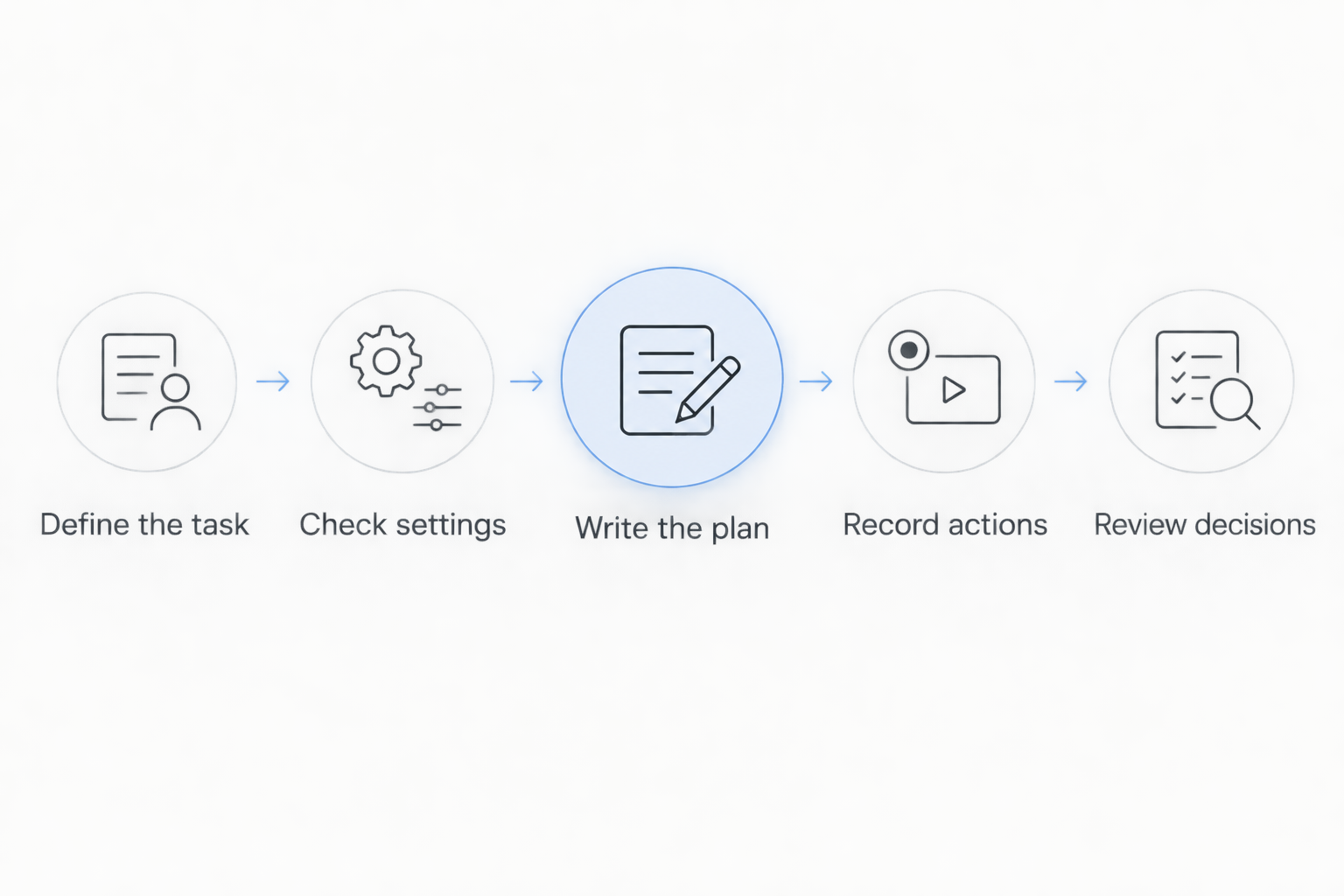
A useful practice record connects your original plan with your actual actions.
Change one practice objective at a time where possible. If you change your instrument, entry rules and management process together, the resulting record will not isolate which change affected your decisions.
05
How do you assess what your practice proves?
Does a profitable demo account mean I am ready?
A profitable demo account does not establish readiness for live risk. Check whether profits depended on oversized positions, ignored exits or repeated account resets. Those details change the meaning of the balance.
How long should I practise before live trading?
Elapsed time alone does not establish readiness. Review whether you can explain contract terms, enter intended orders and maintain a complete decision record. Remaining uncertain about a task is a reason to continue practising that task.
What should I review after a losing session?
Review the original plan before judging the loss. Separate an intended trade that lost from an unintended position or a rule breach. Record missing information rather than reconstructing certainty after the event.
Your 2026 review should end with a bounded conclusion. ‘I can locate and cancel a pending order’ describes a demonstrated task. ‘I will handle live losses calmly’ claims something simulation cannot establish.
Frequently asked questions
Can a demo account prepare you for live trading?
Yes. A demo account helps you practise platform mechanics and a repeatable decision process. It cannot establish future profitability or reproduce real financial loss.
Can I lose real money in a demo account?
A demo trading balance uses virtual funds rather than real trading capital. Confirm that you are in the demo environment before submitting an order.
Are demo execution prices the same as live prices?
Do not assume demo execution prices match live execution prices. Simulation rules and live execution conditions determine how orders are handled in each environment.
Does a winning demo strategy guarantee live profits?
No. Winning demo results do not guarantee live profits. Account conditions, execution and your decisions remain relevant when real capital is at risk.
Should I reset my demo account after losses?
Preserve the original record before resetting a demo account. A fresh balance does not explain the decisions that caused the earlier losses.
What should I write in a demo trading journal?
Record your intended trade, actual order details and reasons for changing or closing the position. Separate rule adherence from the financial result.
Is demo trading only useful for beginners?
No. Demo trading also provides a place to rehearse unfamiliar platform tasks. Successful rehearsal still does not establish identical live execution or future results.
Conclusion
A demo account is useful when you define what the session is testing. Keep a record that distinguishes platform familiarity, rule adherence and trading outcomes. None substitutes for the others.
One final exercise: review a winning trade without looking at its profit first. Check the original plan against the order history. If the trade broke your rules, record the breach even though the outcome was favourable.
Use demo trading to test your process. Do not use it to promise your results.
Related guides
This article is for educational purposes only and does not constitute investment advice. Trading CFDs and other leveraged products carries a high level of risk and may not be suitable for all investors.