Multi-asset trading · Account essentials
Yes. You can trade forex and shares from the same account when your broker enables both markets within that account. A shared login does not prove this. Check the account permissions and contract terms before treating the markets as one trading account.
Key points
- Can you trade forex and shares from the same account? Yes, when that account supports both markets.
- VCG Markets offers forex and shares. Confirm the permissions attached to your specific trading account.
- One platform does not necessarily mean one account balance or shared margin.
- Check share ownership, trading hours and currency conversion separately for each instrument.
01Account access
02Contract differences
03Shared exposure
Why this matters: one interface can make different instruments look alike. Their ownership rights and trading rules remain distinct. Start with the contract specifications rather than the appearance of the order screen.
01
Can you trade forex and shares from the same account?
Yes, provided the trading account supports both instrument groups. Confirm that forex pairs and share instruments belong to the same account identifier. Then establish whether they use the same balance and margin pool.
For a 2026 account review, separate platform access from account access. An instrument appearing in a search result does not establish permission to trade it. A broker can display several markets while assigning them to different accounts.
| Check | Forex | Shares |
| Instrument | A currency pair | A company share or a contract referencing it |
| Trading access | Check pair permissions | Check share permissions and ownership terms |
| Schedule | Pair-specific trading sessions | Share-specific trading sessions |
| Account impact | Check margin and settlement currency | Check margin, currency and corporate actions |
Shared access is an account feature. Identical trading conditions are not. Use the comparison to identify what needs separate verification.
02
What does the same account actually mean?
The phrase can describe a shared login, a shared trading account or shared collateral. These are different arrangements. Identify which one applies before moving funds or placing an order.
- Shared login: you access several accounts through one profile.
- Shared account: forex and share orders belong to the same trading account.
- Shared collateral: eligible funds support positions across the account under its margin rules.
A shared account simplifies viewing your positions together. The limitation is that account-level figures can conceal differences between instruments. Keep the contract details visible alongside the combined totals.
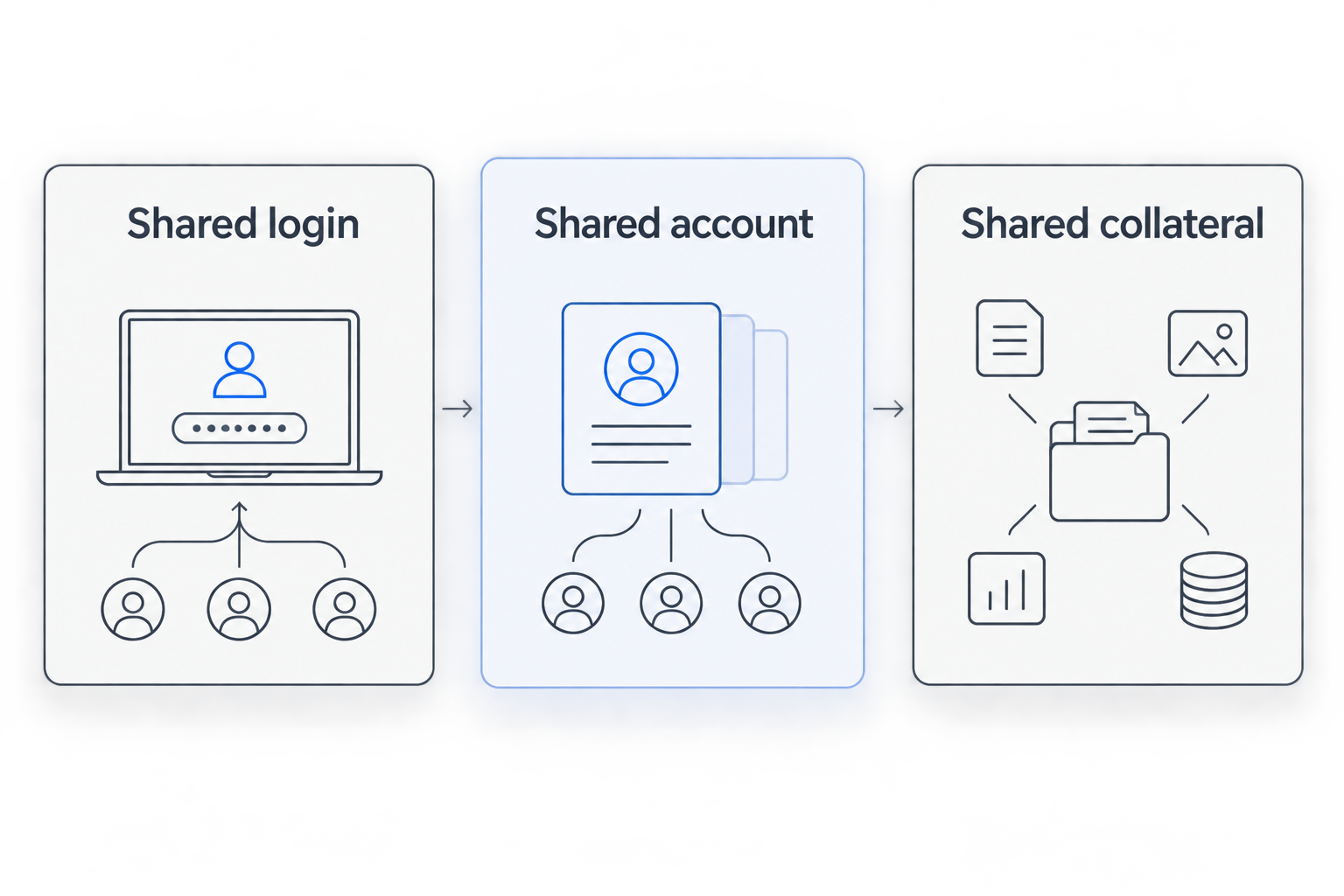
One login does not establish that balances or collateral are shared.
For your 2026 checklist, record the account identifier beside each enabled market. Keep any subaccounts separate in your notes. A common dashboard is not evidence that funds move automatically between them.
03
Does trading shares mean owning shares?
Not necessarily. A share-related instrument can provide price exposure without transferring ownership of the underlying company shares. The instrument name alone does not settle the question.
Check the legal description and custody terms. Establish whether you hold shares or a contract referencing their price. Voting rights and dividend treatment depend on that distinction.
Ownership also changes what a corporate action means for your account. A dividend payment and a contractual dividend adjustment are different entries. Read the applicable terms rather than assuming that the familiar company name brings shareholder rights.
For a 2026 statement review, label the instrument type explicitly. Use the same label in your trading journal. That keeps a review of share-price exposure separate from a review of investments held in custody.
04
How does shared margin affect your positions?
When positions share a margin pool, their gains and losses affect the same account equity. A losing forex position can reduce the free margin supporting other positions. Separate market names do not create separate financial buffers.
The useful distinction is between balance and equity. Balance excludes unrealised trading results. Equity reflects them. Read the account rules to establish how equity and required margin determine free margin.
A single account gives you a combined view. Its limitation is the connection between positions that share collateral. Check the margin level and the applicable liquidation rules before treating each trade as financially independent.
Different asset classes also do not guarantee diversification. Currency movements can affect both a forex position and a company exposed to that currency. Review the underlying drivers rather than counting the number of market categories.
05
Why do trading conditions vary within one account?
The account is a container. Each instrument retains its own contract specifications. Compare these factors separately:
- Trading sessions: forex and individual shares follow different schedules. An open platform does not mean every instrument is open for execution.
- Contract size: a volume field does not carry the same economic meaning across all instruments. Check what each unit represents.
- Margin requirements: required collateral depends on the instrument and account terms. Do not copy an assumption from one market to another.
- Currency treatment: an instrument’s quotation currency can differ from the account currency. Conversion affects the result shown in your statement.
- Corporate actions: share-related positions require checks for dividends and other company events. Apply the rules for the specific contract.
- Holding conditions: overnight treatment depends on the instrument and account agreement. Check the current terms before carrying a position across sessions.
Keep a dated copy of your checks. A 2026 review should use the terms applying to that account and instrument at the time. An old screenshot is not a substitute for current documentation.
06
How do you confirm access before placing a trade?
Verify the account first. Then inspect each instrument. This sequence separates an access question from a trading decision.
- Identify the account. Record its name, identifier and base currency. Distinguish the live account from any practice account.
- Check permissions. Establish whether forex and share instruments are enabled on that specific account.
- Inspect the contract. Read the instrument type, volume units, session schedule and margin requirements.
- Confirm the funding structure. Establish whether positions share a balance and collateral pool or require separate funding.
- Review account protection rules. Locate the margin warning and liquidation provisions. Ask for clarification where the terms are unclear.
Save the answers with your 2026 account records. Repeat the check when changing account types or adding a new market. Access through the same application does not remove the need to understand a new contract.
Frequently asked questions
Can I use the same money to trade forex and shares?
Yes, if both markets use the same account balance and eligible collateral pool. A shared login alone does not establish this. Check the account funding and margin rules.
Does buying a share instrument make me a shareholder?
Not necessarily. Direct share ownership and a contract referencing a share price provide different rights. Read the ownership and custody terms before assuming voting or dividend rights.
Can forex losses affect my share positions?
Yes, when the positions share account equity and collateral. Forex losses can reduce free margin and affect the account supporting your share-related positions. The account rules determine the consequences.
Can I trade shares whenever forex is open?
No. Each instrument follows its own trading schedule. Check the share instrument’s sessions rather than using forex access as a guide.
Do I need to convert currency before every trade?
That depends on the account structure and instrument terms. Check whether conversion occurs when funding the account, booking trading results or settling transactions.
Does one account make forex and share trading less risky?
No. One account changes how you access and monitor positions. It does not remove market risk, currency exposure or the consequences of shared margin.
Does a broker offering both markets guarantee access from my account?
No. A broker’s market range does not establish the permissions on your specific account. Confirm the account type and enabled instruments before placing an order.
Conclusion
Forex and shares can sit within one trading account. Verify the permissions, ownership terms and margin structure first. A combined interface is useful only when you understand the positions behind it.
One final check: compare the currency of the instrument with the currency of your account. A position’s quoted result and its converted account result are not necessarily identical. Keep both visible when reviewing performance.
One account can connect markets. Each contract still needs its own checks.
Related guides
This article is for educational purposes only and does not constitute investment advice. Trading CFDs and other leveraged products carries a high level of risk and may not be suitable for all investors.