Order Execution · Risk Management
No. A trailing stop cannot protect against every price move. It can move a stop level as the market moves in your favour, but gaps and slippage can produce an exit beyond that level. Whether the trailing level continues updating also depends on how your platform runs the instruction.
Key points
- Trailing stop limitations include price gaps, slippage and platform-dependent updates.
- A stop level sets a trigger. It does not guarantee the execution price.
- A stop-limit instruction controls the acceptable price but can leave your position open.
- VCG Markets traders should check trailing-stop behaviour on the platform used for each position.
01Trigger versus fill
02Execution limits
03Platform checks
01
Can a trailing stop protect against every price move?
A trailing stop manages an exit instruction. It does not control the prices available when that instruction reaches the market. The distinction matters because liquidity affects order execution after a stop triggers.
For a long position, a conventional trailing stop moves upward as the reference price rises. It does not move downward simply because the market reverses. For a short position, the direction is reversed.
That movement is the useful part. You can adjust an exit threshold without manually moving it after each favourable move. The limitation is separate: an updated threshold still does not guarantee a matching fill.
A trailing stop moves the trigger, not the market. Check whether reaching that trigger submits a market order or a limit order. Those instructions handle execution differently.
02
Trailing stops and stop-limit instructions
The word trailing describes how a trigger moves. It does not fully describe the order submitted afterward. Read the order description rather than assuming every trailing instruction works the same way.
The comparison below describes common order mechanics. It is not a statement that every platform offers each instruction. Suitability depends on whether your priority is seeking an exit or restricting its acceptable price.
| Instruction | Useful for | Advantage | Limitation |
| Trailing stop-market | Moving a trigger while seeking an exit | Updates after qualifying favourable moves | Execution price is not guaranteed |
| Trailing stop-limit | Moving a trigger with a price restriction | Restricts the acceptable execution price | Can remain unfilled after triggering |
| Fixed stop-market | Keeping a defined trigger unchanged | Does not require trailing updates | Does not follow favourable moves or guarantee price |
A stop-limit instruction does not remove risk. It exchanges an unrestricted execution price for the possibility of no execution. Your position remains exposed while the exit order is unfilled.
03
What happens between the trigger and the fill?
Separate the process into stages. A successful trailing update establishes a new stop level. A later price move activates the exit instruction. Execution then depends on the order type and available prices.
- Trailing update: The reference price makes a qualifying favourable move. The trailing mechanism adjusts the stop.
- Stop trigger: The relevant market quote reaches or passes the active stop level under the platform’s rules.
- Order execution: The exit instruction seeks a fill. A market instruction does not reserve the earlier stop price.
A chart can make these stages look like a single event. They are not the same event. The quote that activates an order and the price that fills it serve different functions.
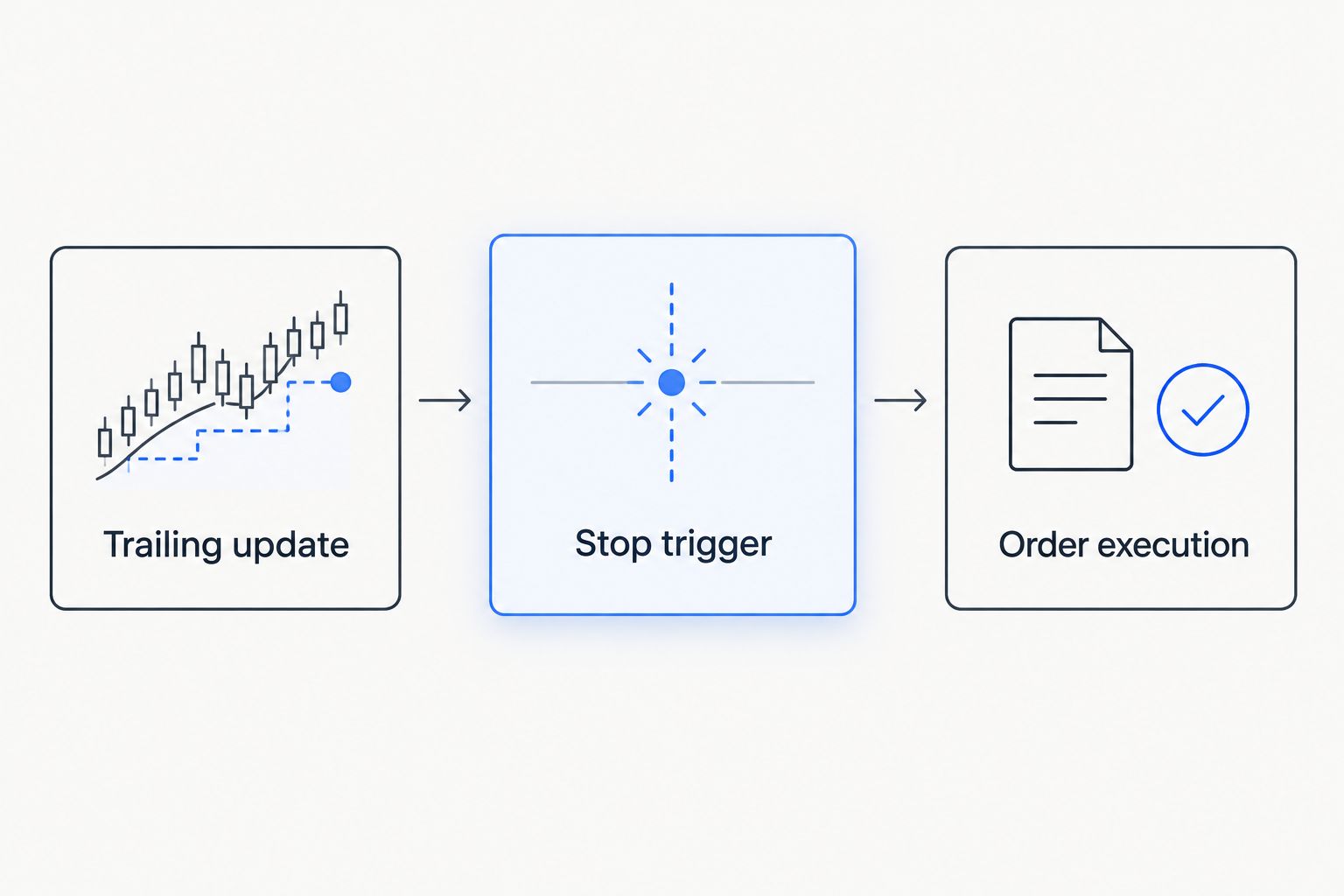
An updated stop level is not a reserved execution price.
Check the execution record when reviewing a stopped position. Look at the last accepted stop level and the actual fill. An unfavourable difference does not by itself establish that the trailing update failed.
04
Why trailing-stop results vary
Trailing stop limitations come from both market conditions and order settings. A distance that feels comfortable on a quiet chart does not establish the maximum possible loss. Execution still depends on what happens when the order activates.
- Price gaps: The next available quote can sit beyond the stop level. There is no executable price at every point between quotes.
- Available liquidity: The volume available at a price affects how an exit fills. Larger orders can require execution across different prices.
- Spread changes: The bid and ask can move differently. A stop can activate even when the chart price you watch appears short of the level.
- Trailing distance: A tighter distance gives the position less room for ordinary fluctuations. A wider distance allows a larger reversal before activation.
- Update location: A terminal-dependent trailing process needs that terminal to operate. Server-side handling has different connection requirements.
- Instrument rules: Trading sessions and minimum stop distances affect when instructions can update or execute.
These factors can overlap. A spread change can activate the order during thin liquidity. The resulting fill can then differ from the trigger price. Changing the trailing distance does not remove that execution risk.
05
Can a trailing stop lock in a profit?
A trailing stop can move beyond your entry level. That does not guarantee a realised profit. An adverse gap can carry execution back beyond entry before the position closes.
Your net result also depends on applicable trading costs. A stop above the entry price on a long position describes a price relationship. It does not establish the final account result after charges.
Use precise language when reviewing the position. An active stop beyond entry is a recorded instruction. A realised gain is an outcome confirmed after execution and costs.
Do not treat an unrealised gain as protected cash. The distinction matters while a trade is open because the active stop cannot reserve liquidity or prevent a market gap.
06
Will a trailing stop keep working after disconnection?
Continued trailing depends on where the update process runs. A server-side process does not rely on your device remaining connected in the same way as a client-side process. Check the implementation rather than assuming the setting follows you across devices.
An existing server-held stop and the process that moves it are separate. An accepted stop can remain active even when a local trailing process stops updating. The last accepted level then matters more than the distance displayed in a disconnected terminal.
Confirm what happens when you close the application or lose connectivity. Also check whether opening the position on another device transfers the trailing instruction. Seeing the position does not establish that the new device has taken over its management.
This is an operational check rather than a forecast. It tells you which instructions exist and which process must remain active to change them.
07
What should you check before enabling a trailing stop?
Start with the instruction rather than a preferred distance. The platform’s order rules determine what your setting means. A familiar label does not establish identical behaviour across instruments or interfaces.
- Confirm the unit. Establish whether the distance uses points, price units or a percentage. A point is not automatically the same as a pip.
- Check activation. Identify when trailing begins. Do not assume selecting a distance immediately creates an active protective stop.
- Identify the reference quote. Confirm which bid, ask or other reference updates the trail and triggers the exit.
- Check update requirements. Read the connection requirements and the instrument’s permitted stop distances.
- Verify acceptance. Inspect the active stop level after setting or changing the instruction. A submitted change is not proof of an accepted change.
Keep the order record when investigating an unexpected exit. The requested change and the accepted stop level answer different questions. So do the trigger quote and the execution price.
The distinction between chart price and execution price helps explain why a visual chart check alone cannot reconstruct the full order sequence.
Frequently asked questions
Can a trailing stop protect me from a market gap?
A trailing stop cannot guarantee protection at its stop level during a market gap. A stop-market exit can fill beyond that level when the next executable price is less favourable.
Why did my trailing stop close at a different price?
A trailing stop can close at a different price because the trigger price is not a guaranteed fill. Available liquidity and price movement during execution affect the result.
Can a trailing stop close my position before the chart touches it?
A trailing stop can trigger before the displayed chart price touches it when the triggering quote differs from the quote shown. Check the bid and ask rules for your position.
Is a trailing stop-limit safer than a trailing stop-market?
A trailing stop-limit restricts the acceptable execution price but introduces non-execution risk. The position can remain open if no acceptable fill is available.
Does a trailing stop continue when I close the application?
Continued trailing depends on whether the update process runs on your device or on a server. An accepted server-held stop can remain active even if local trailing updates cease.
What trailing distance prevents unnecessary exits?
No trailing distance prevents every unwanted exit. A tighter distance allows less fluctuation before triggering, while a wider distance permits a larger reversal.
Does moving a stop beyond entry guarantee a profit?
Moving a stop beyond entry does not guarantee a profit. Execution beyond the stop level and applicable trading costs can change the final result.
Conclusion
A trailing stop can automate changes to an exit level. It cannot remove gaps, ensure liquidity or guarantee a realised gain. Treat its distance as a setting for the trigger rather than a ceiling on the eventual loss.
Before leaving a position unattended, check the last accepted stop level. That recorded instruction matters more than an assumed update. If trailing has stopped running, the active level need not match the distance you expect.
Check the trigger. Verify the update process. Separate both from the fill.
Related guides
- Stop-loss execution during a market gap
- Positive and negative slippage
- Why spreads widen in quiet markets
This article is for educational purposes only and does not constitute investment advice. Trading CFDs and other leveraged products carries a high level of risk and may not be suitable for all investors.


