Trading Psychology
Recent trades distort your view of performance when you give them more weight than the wider record supports. A winning streak can make your process look stronger than it is. A losing streak can make the same process look weaker. The distinction is whether your assessment reflects comparable evidence or simply the outcomes you remember most clearly.
Key takeaways
- Recency bias trading reviews overweight recent outcomes and underweight the wider performance record.
- Separate trading psychology, decision quality and realised results before judging a winning or losing streak.
- Recent evidence matters when market conditions change. It still needs context.
- VCG Markets provides behavioural analysis for traders reviewing their decisions, not a promise of future returns.
01Recent outcomes
02Comparable evidence
03Consistent reviews
01
Why can recent trades distort your view of performance?
Recent outcomes are easier to recall than a complete trading history. That makes them convenient evidence. It does not make them representative evidence. Your latest result can become the reference point for judging decisions made under different conditions.
This matters because your assessment affects what you change next. You might increase exposure after profitable trades without checking whether the decisions followed your rules. You might abandon a process after losses without checking whether those losses reveal a repeatable problem.
A performance review needs separate questions. Did you follow the intended process? What happened after execution? What evidence supports changing the process? Trading process goals help keep the first question distinct from the final result.
Recent trades are evidence. They are not the whole verdict. A profitable decision can break your rules. A losing decision can follow them. Neither observation proves that the rules themselves are effective. That requires a wider assessment of comparable decisions and their results.
02
Recent evidence versus recency bias
Giving recent trades attention is not automatically biased. Market conditions change. So do your execution and behaviour. The problem starts when recency replaces an explanation rather than contributing to one.
| Review approach | Useful for | Limitation |
| Recent trades | Spotting current changes in behaviour or execution. | A short sequence need not represent the wider process. |
| Wider history | Putting recent outcomes in context. | Older trades can reflect a different process or market. |
| Matched trades | Comparing similar setups and conditions. | Narrow filters leave less evidence to assess. |
Use recent results to identify a question. Use the wider record to investigate it. Then check whether comparable trades support the same interpretation. This avoids treating either the latest streak or the lifetime total as a complete explanation.
Write the suspected change in observable terms. A change in position sizing is testable against your records. A feeling that you have lost your ability is not a useful measurement. Keep the review attached to decisions you can inspect.
03
Why the weight of recent trades varies
Recency bias does not explain every change in performance. Before attributing a streak to psychology or skill, inspect what changed around the trades. The relevant differences belong in your review rather than outside it.
- Market conditions. A setup used during a sustained trend is not directly comparable with the same setup in a range.
- Position sizing. Larger exposure changes the monetary impact of an outcome. A larger profit does not by itself demonstrate a better decision.
- Trading process. A revised entry or exit rule changes what you are evaluating. Keep versions identifiable rather than blending them together.
- Shared exposure. Trades driven by the same underlying move are not independent confirmations of your judgement.
- Record quality. Missing reasons for entry or exit leave less evidence for separating planned decisions from reactions.
These factors can occur together. A profitable period might combine favourable conditions with larger positions and weaker rule adherence. The result alone cannot tell you which explanation carries the most weight.
Record the differences before reaching a verdict. Otherwise you risk explaining gains as skill and losses as circumstances without applying the same standard to both.
04
How to review performance without letting the latest trade lead
Set the review method before looking for a reassuring answer. The aim is not to dismiss recent results. It is to make the same evidence answer the same questions after gains and losses.
- Set the scope. Define the period and trading process under review. Keep that boundary fixed while inspecting the results. Extending or shortening it until the conclusion looks comfortable defeats the comparison.
- Check the record. Inspect entries, exits, exposure and available decision notes. Identify missing information. Do not replace an absent record with a confident recollection of what you intended.
- Separate decisions. Assess whether each action followed the rules that existed at the time. Keep that assessment distinct from whether the position ended profitably.
- Compare conditions. Look for differences in setup, market behaviour and position sizing. Label those differences before deciding that the process improved or deteriorated.
- State the finding. Describe what the record demonstrates and what remains unresolved. A specific observation is more useful than a broad judgement about your trading ability.
Keep observations separate from explanations. Entering before your documented condition appeared is an observation. Saying you entered because of overconfidence is an interpretation. Your notes might support that interpretation, but the distinction should remain visible.
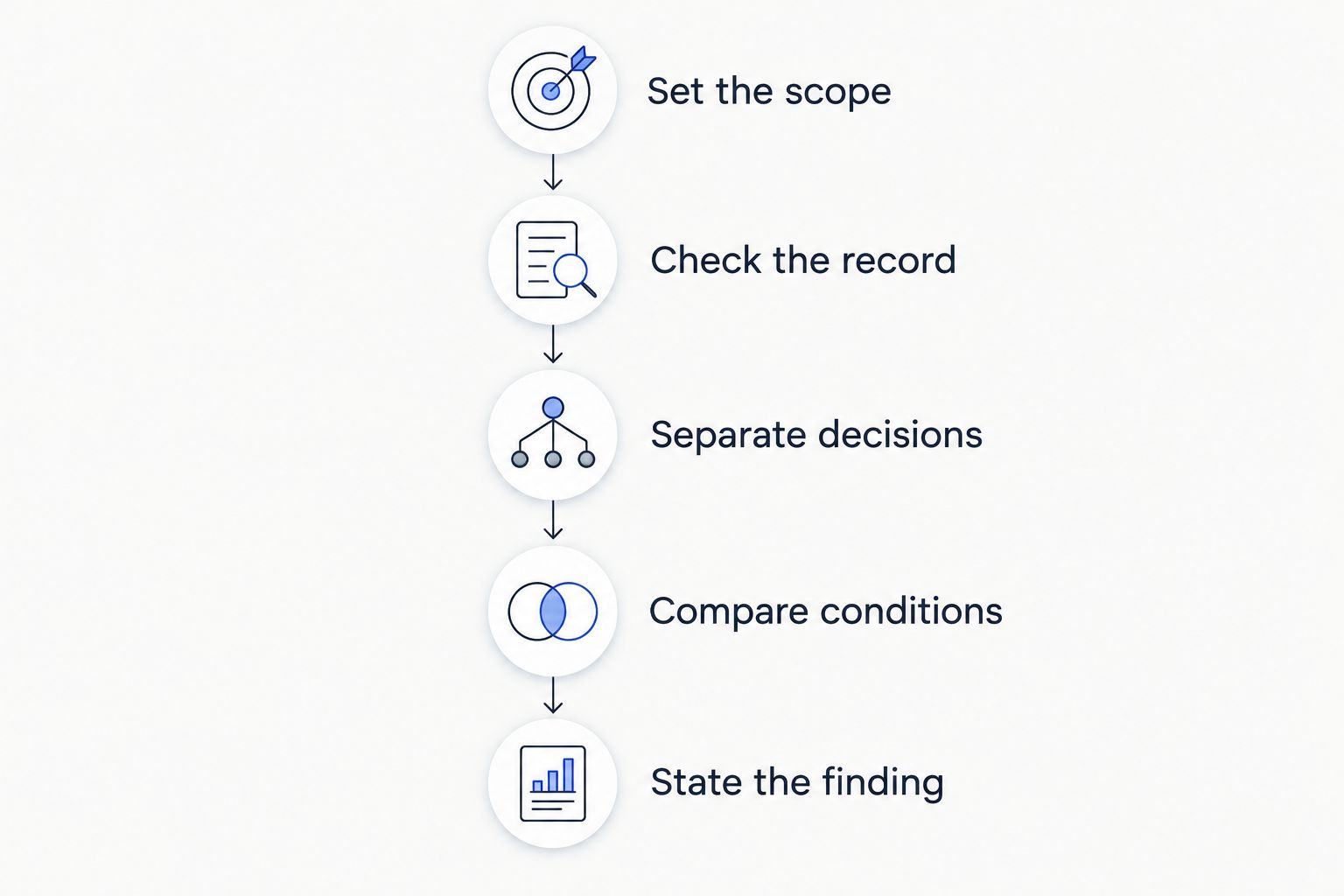
Define the review before letting its result influence the method.
Finish with a question your next review can revisit. For example, check whether the same rule deviation appears again under comparable conditions. Do not turn an unresolved explanation into a confirmed pattern simply because it sounds plausible.
05
Can winning trades make your process look better than it is?
Winning trades can make a weak decision appear justified. The profit is real. The conclusion that the decision was sound still needs evidence. This distinction matters when a favourable outcome follows an unplanned increase in exposure or an entry outside your rules.
Review what happened before the result was known. Did the entry meet your conditions? Did the position size match the plan? Was the exit planned or improvised? Apply those questions even when you are satisfied with the outcome.
Also inspect what the winning trades share. Several positions benefiting from the same market move do not provide the same evidence as unrelated decisions across different conditions. Counting each profitable position as a separate endorsement can overstate what the record demonstrates.
A profitable outcome does not erase a process deviation. Record both. That preserves information you would lose by classifying every winner as a good trade and every loser as a bad one.
06
Does a losing streak mean your strategy has stopped working?
A losing streak alone does not establish that a strategy has stopped working. It also does not establish that nothing needs attention. Both conclusions require more than the sequence of outcomes.
Separate losses that followed your process from losses involving deviations. Then inspect whether the conditions match those the process was designed to address. Rule adherence and strategy effectiveness are different questions. Following a rule does not prove that the rule has value.
Avoid changing several rules at once simply to respond to disappointment. Multiple simultaneous changes make it harder to identify what explains later results. Record the reason for any revision and keep the revised process distinguishable from its predecessor.
The review should produce an observation rather than a personal label. A repeated exit deviation is something you can investigate. A verdict that you are a poor trader adds no comparable evidence to the record.
07
Will a larger trading history remove recency bias?
A larger history provides more context. It does not remove bias from how you select or interpret trades. You can still focus on the latest results while overlooking the rest of a detailed record.
More data also creates comparison problems when it combines different strategies or conditions. A lifetime total can conceal a recent change. A recent total can exaggerate one. Keep the broader history available while making the comparison relevant to the question.
There is no universal trade count that proves a process works. The usefulness of the record depends on comparability, variation and the claim being assessed. Treat a precise-looking total as a description of the sample, not a certificate of reliability.
FAQ
What is recency bias in trading?
Recency bias in trading means giving recent trades more weight than the wider evidence supports. It can distort how you judge your process after either gains or losses.
Is recency bias the same as judging a trade by its outcome?
Recency bias concerns which results receive extra weight. Outcome bias concerns judging a decision by its result rather than the information available when you made it. Both can affect the same review.
Should I ignore my latest trades when reviewing performance?
Do not ignore your latest trades. Compare them with relevant history and inspect whether behaviour, exposure or market conditions changed.
Does a winning streak prove my trading has improved?
A winning streak does not prove that your trading process has improved. Check decision quality, position sizing and shared exposure before attributing the result to better judgement.
How many trades do I need for a reliable performance review?
There is no universal trade count that makes every performance review reliable. Comparable conditions, consistent records and the specific claim under review determine what the evidence can support.
Can a behavioural score replace my trading journal?
A behavioural score does not replace the underlying trading record. Review the score alongside decision notes, exposure and market conditions before drawing conclusions.
Conclusion
Before your next review, write down what evidence would challenge your current explanation. Do this whether the latest trades were profitable or losing. It gives you a way to test the story rather than collect results that support it.
For your VCG Markets trading review, keep the outcome and the decision assessment visible together. Neither should erase the other. The useful conclusion is the one your record supports.
Let recent trades raise the question. Let comparable evidence shape the answer.
Related guides
This article is for educational purposes only and does not constitute investment advice. Trading CFDs and other leveraged products carries a high level of risk and may not be suitable for all investors.


