InicioHow does market liquidity affect order execution?
How does market liquidity affect order execution?
Oct 22, 2026
Market liquidity affects order execution through the quantity available to trade at each price. Deeper liquidity supports execution closer to the quoted price. Thin liquidity increases the risk of wider spreads, partial fills and slippage. The result also depends on your order size, order instructions and the execution rules for the instrument.
TL;DR
- Market liquidity order execution depends on available quantity, order size and how quickly quotes change.
- Market orders prioritise execution. Limit orders control the acceptable price but do not guarantee a fill.
- Slippage can improve or worsen your execution price. A stop trigger does not guarantee its execution price.
- VCG Markets offers multi-asset access. Check each instrument’s execution terms before placing an order.
01. How does market liquidity affect order execution?
Liquidity determines how much of an order can trade at an available price. A quote shows a price. It does not establish that your entire order can execute there.
If sufficient quantity remains available when your order reaches execution, it can fill at that level. If the quantity is insufficient, execution can involve other price levels. Some orders remain partly unfilled. Others expire or are cancelled under their execution instructions.
Your order type changes which outcome is acceptable. A market order accepts the available execution price. A limit order sets a price boundary. Neither instruction creates liquidity where none exists.
Why this matters
For your 2026 trading plan, separate the price you want from the execution conditions you accept. That distinction matters before entry and again when you close a position.
VCG Markets is an international multi-asset broker offering access to forex, shares and commodities. Access to an instrument does not guarantee execution at the price visible before submission. Read the applicable order terms alongside the market quote.
More quantity near the quoted price
- What happens during execution: More of an order can execute without reaching further price levels
- What to check: Whether that quantity covers your order size
Less quantity near the quoted price
- What happens during execution: An order can use several price levels or remain partly unfilled
- What to check: Fill price, filled quantity and remaining quantity
Quotes changing rapidly
- What happens during execution: The price available at submission can differ from the price available at execution
- What to check: Execution timestamp and order instructions
Few executable quotes
- What happens during execution: Execution can be delayed, rejected or left pending under the applicable rules
- What to check: Instrument terms and order status
These are execution mechanics. They do not establish that a particular broker caused a particular fill. Review the order record before drawing that conclusion.
02. Market orders: execution without a fixed price boundary
A market order instructs the execution system to transact at the available market price. It prioritises execution over a specified price. It does not guarantee a particular fill price or immediate completion under every market condition.
Suitable for: an instruction that prioritises execution over a fixed price boundary. Trade-off: you do not set the maximum purchase price or minimum sale price through the market-order instruction itself.
When available liquidity is insufficient at the initial price level, execution can extend to other levels. The resulting average fill price reflects the quantities executed at those levels. A larger order therefore needs more available quantity to complete without moving beyond the initial quote.
Do not assess a market order using the chart alone. A chart does not necessarily show the executable bid and ask that applied to your order. Check which price the chart displays and which price triggered or executed the instruction.
For a 2026 execution review, retain the order details rather than relying on a screenshot of the last visible price. The relevant evidence includes the submitted instruction, execution time and actual fill.
03. Limit orders: price control without a guaranteed fill
A buy limit order sets the highest acceptable purchase price. A sell limit order sets the lowest acceptable sale price. Execution must respect that boundary under the applicable order rules.
Suitable for: an instruction with a defined acceptable price. Trade-off: the order can remain unfilled or fill only in part.
A price reaching your limit does not guarantee that sufficient quantity was available for your order. On order books with priority rules, other orders can have priority at the same level. Price movement alone does not reveal how much executable quantity reached your instruction.
The distinction is practical. A market order can complete at a price you did not expect. A limit order can preserve your price boundary while leaving your intended position incomplete.
Check the order’s duration too. An instruction that remains active can execute later under different conditions. An expired instruction cannot execute merely because the market subsequently returns to its limit.
04. Stop orders: the trigger is not the fill
A stop order becomes eligible for execution when its specified trigger conditions are met. A conventional stop-market order then seeks execution at the available market price. The stop level is not a promise that the trade will complete at that price.
Suitable for: an instruction activated by a specified trigger. Trade-off: a stop-market instruction remains exposed to slippage after activation.
A stop-limit order adds a limit-price condition after the stop triggers. That provides a price boundary. It also introduces the risk that the order will not execute if the market moves beyond that boundary.
Gaps make this distinction especially important. The market can move from one quoted level to another without an executable opportunity at every price between them. A stop-market order can then fill beyond its trigger.
Check whether the trigger uses the bid, ask or another specified reference. Different instruments and execution arrangements use different rules. The label on the order ticket is not a substitute for those terms.
Market order
- Priority: Available execution
- Suitable for: Acting without a fixed execution-price boundary
- Main limitation: Fill price is not fixed
Limit order
- Priority: Acceptable price
- Suitable for: Buying or selling only within a stated boundary
- Main limitation: Execution is not guaranteed
Stop-market order
- Priority: Execution after activation
- Suitable for: Trigger-based instructions that prioritise execution
- Main limitation: Trigger price can differ from fill price
Stop-limit order
- Priority: Price boundary after activation
- Suitable for: Trigger-based instructions with a limit condition
- Main limitation: The order can remain unfilled
05. Why execution quality varies
Liquidity is not a fixed property of an instrument. Available quantity changes as participants submit, amend, cancel and execute orders. Your execution depends on the market conditions when your instruction reaches the relevant system.
The main factors are:
- Order size. An order needs enough executable quantity to fill. Size matters relative to available depth, not in isolation.
- Market depth. Quantity near the quoted price determines how much can execute before reaching other levels.
- Quote changes. A quote can change between your decision, submission and execution.
- Trading sessions. Participation changes across sessions and around market openings or closings. Check the instrument’s actual schedule.
- Scheduled announcements. Participants can change or withdraw quotes as new information arrives. Spreads and available depth can change during that adjustment.
- Execution rules. Order type, duration, trigger conditions and handling instructions determine whether an order fills, remains pending or is cancelled.
High trading volume is not proof of sufficient liquidity for your next order. Volume records completed activity. Depth concerns the quantity available to execute now.
The same distinction applies to volatility. Volatility describes price movement. Liquidity describes the ability to transact. A fast-moving market and a thin market can produce related execution problems without being the same condition.
06. How should you review an order’s execution?
Use a repeatable record for your 2026 execution reviews. Compare the instruction you submitted with the execution that occurred. Keep market conditions separate from assumptions about the cause.
- Check instructions. Record the order type, direction, size and duration. For triggered orders, identify the trigger reference and any limit condition.
- Check quotes. Identify the relevant bid or ask. Confirm whether the reference came from an executable quote or a chart display.
- Review fills. Compare requested quantity with filled quantity. Check whether the record shows several fills or a remaining balance.
- Read terms. Review execution rules and instrument conditions. Use those terms to interpret delays, cancellations or rejections.
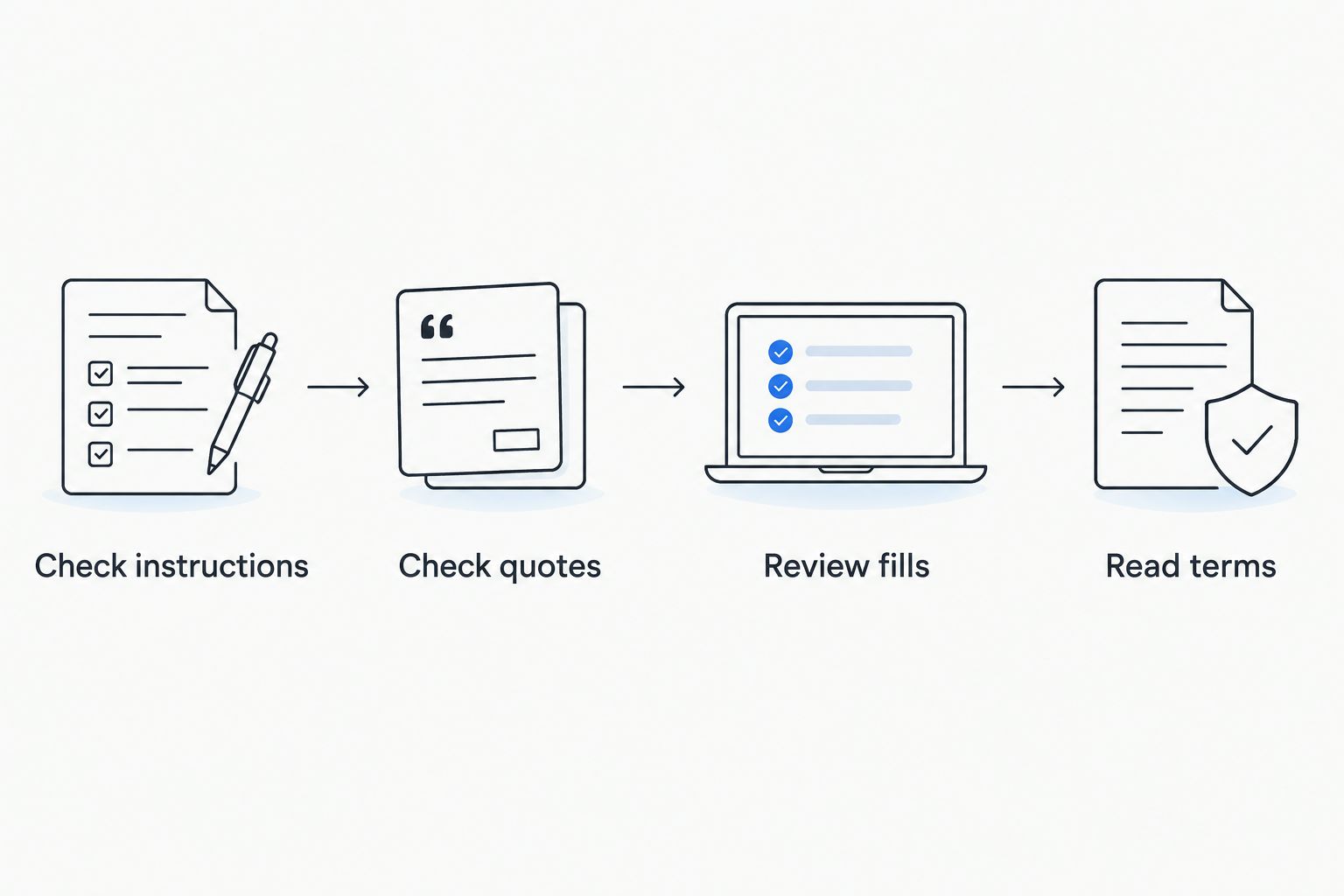
Review the instruction and execution record before assigning a cause to a price difference.
Slippage measures the difference between a relevant reference price and the actual execution price. The reference must be clear. Comparing a buy execution against a displayed bid can produce a misleading conclusion before market movement enters the calculation.
Slippage is not always adverse. An execution can also improve on the reference price. The guide to positive and negative slippage explains that distinction.
A partial fill also needs a separate review. Confirm how much executed and what happened to the remainder. Do not treat a partly completed order as either fully executed or completely rejected.
07. Does a narrow spread mean an order will execute well?
A narrow spread shows a small difference between the quoted bid and ask. It does not reveal how much quantity is available at either price. Spread and depth answer different questions.
Your 2026 pre-trade checklist should therefore look beyond the visible spread. A tight quote with little available quantity can still produce slippage when an order exceeds that quantity. A wider quote can have more depth, although the wider spread remains relevant to execution.
Do not confuse a price adjustment with slippage either. Instrument events and contract changes can affect displayed prices under the instrument’s terms. Slippage concerns execution relative to the appropriate reference price.
Keep the categories separate when reviewing a trade. Otherwise, you risk attributing every difference on a chart to liquidity.
08. Can a limit order prevent slippage?
A limit order prevents execution outside its stated price boundary under the applicable rules. It does not guarantee execution. The protection concerns the acceptable price rather than completion of the intended trade.
That creates a choice between execution certainty and price control. Neither is absolute. A market order does not guarantee completion under every condition, and a limit order does not guarantee that an opportunity remains available.
Assess the instruction against its purpose. A limit order that does not fill has not failed its price condition. It has left the intended transaction incomplete.
09. Does a trading platform remove liquidity risk?
A trading platform does not remove market liquidity risk. Its interface lets you submit and manage instructions. Available quantity and the applicable execution arrangements still determine what can fill.
The VCG Markets lens
VCG Markets is a multi-asset broker for traders seeking access to forex, shares and commodities. Its offering includes MT5, TradingView integration and a dedicated mobile app.
Those tools do not make an execution price certain. Keep platform capability separate from market conditions. A clear interface and a correctly submitted order do not create available quantity at your preferred price.
FAQ
What does market liquidity mean for order execution?
Market liquidity determines how much quantity can trade at available prices. Your order size and instructions determine whether execution stays near the quote, reaches other price levels or remains incomplete.
Why did my market order fill at a different price?
A market order can fill at a different price because quotes or available quantities changed before execution. Review the relevant bid or ask, execution timestamp and fill record before assigning a cause.
Can high trading volume guarantee a good fill?
High trading volume does not guarantee a particular fill. Volume measures completed trading, while execution depends on the quantity available when your order reaches the market.
Does a stop-loss guarantee my exit price?
A conventional stop-market instruction does not guarantee its exit price. After activation, it seeks execution at the available market price and remains exposed to slippage.
Can I receive only a partial fill?
An order can receive a partial fill when only some of its quantity executes. The order’s instructions and execution rules determine what happens to the remaining quantity.
What should I check before placing an order in 2026?
Before placing an order in 2026, check the order type, size, relevant quote and instrument terms. For triggered orders, also confirm the trigger reference and any limit-price condition.
One last thing
Judge an order against its instruction, not just the price you hoped to receive. A limit order can respect its boundary without filling. A market order can execute correctly at a price different from the earlier quote.
Before submitting your next instruction, identify which outcome you are accepting: a changing execution price or the possibility of no execution. That distinction makes the order record easier to interpret afterward.
Related guides
- Correlated pairs and hidden exposure
- Oil supply and demand reactions
- Futures rollover price adjustments
This article is for educational purposes only and does not constitute investment advice. Trading CFDs and other leveraged products carries a high level of risk and may not be suitable for all investors.

Información
VCG Markets Ltd es la entidad autorizada para prestar servicios de inversión. Está constituida en la República de Mauricio (N.° de empresa 188485) y está autorizada y regulada por la Comisión de Servicios Financieros de Mauricio bajo la Licencia N.° GB22200388, con domicilio social en The Cyberaty Lounge, planta baja, The Catalyst, Silicon Avenue, 40 Cybercity, 72201 Ebene, República de Mauricio.
VCG Markets (Seychelles) Ltd es la entidad autorizada para prestar servicios de intermediación de valores (Securities Dealer). Está constituida en la República de Seychelles (N.° de empresa 8438443-1) y está autorizada y regulada por la Autoridad de Servicios Financieros de Seychelles bajo la Licencia N.° SD243, con domicilio social en House of Francis, Room 301(B), Ile Du Port, Mahe, República de Seychelles.
El sitio web es operado por VCG Tech Limited (N.° de empresa HE452446), con domicilio social en Agias Fylaxeos & Zinonos Rossidi, 2, 1.er piso, 3082 Limassol, Chipre. VCG Tech Limited actúa como empresa comercial para el procesamiento de depósitos y retiros de clientes.
El trading de Forex con margen y los CFD son productos apalancados y pueden dar lugar a pérdidas que superen sus depósitos. El valor de las inversiones puede disminuir o aumentar, y es posible que reciba menos de lo que invirtió originalmente. Asegúrese de comprender plenamente los riesgos involucrados y considere si dicho trading es adecuado para usted.
Las llamadas telefónicas y las comunicaciones electrónicas pueden ser grabadas y monitoreadas con fines de control de calidad, cumplimiento normativo y capacitación.
La información de este sitio web se proporciona únicamente con fines informativos generales y no constituye asesoramiento de inversión, una recomendación ni una solicitud para participar en ninguna actividad de inversión.
VCG Markets no brinda asesoramiento fiscal. La legislación fiscal puede cambiar o diferir entre jurisdicciones.
La información en este sitio web no está dirigida a residentes de los Estados Unidos de América, Bélgica, Canadá, Singapur, ni a ninguna jurisdicción donde el acceso a dicha información sea contrario a las leyes o regulaciones locales.
VCG Markets © 2026, Inc. Todos los derechos reservados.

Síganos


