InicioHow sunk cost bias affects decisions about open trades
How sunk cost bias affects decisions about open trades
Nov 3, 2026
Sunk cost bias affects open trades when past losses, time or effort become reasons to keep a position open. The decision shifts away from current evidence and remaining risk. A losing position is not proof of bias; the warning sign is defending it because of what you have already committed.
Key takeaways
- Sunk cost bias trading means letting past commitments drive decisions about future exposure.
- An unrealised loss still affects account equity. Keeping a trade open does not erase it.
- For VCG Markets traders, the useful distinction is current evidence versus past commitment.
- A trading journal should record why an open position remains justified, not just its result.
Trading Psychology · Decision Review
01 Current evidence · 02 Remaining risk · 03 Decision records
01 How does sunk cost bias affect decisions about open trades?
Sunk cost bias changes the reason behind a decision. Instead of asking whether the position still fits your strategy, you ask how to avoid wasting the money or effort already committed. The past becomes a justification for future exposure.
Your pre-trade decision checklist provides a reference point. Compare the original conditions with what is true now. A changed decision needs a current reason, not a stronger attachment to the original forecast.
The distinction is about reasoning rather than direction. Holding, reducing or closing a position does not establish whether bias is present. Each action needs to be assessed against the information available when you chose it.
Hold an open trade
- Evidence-based reasoning: The original conditions remain valid within planned risk
- Sunk-cost reasoning: Too much time has gone into this position to leave
- Limitation to recognise: Holding preserves exposure to further adverse movement
Reduce exposure
- Evidence-based reasoning: The remaining risk no longer fits the plan
- Sunk-cost reasoning: Reducing feels acceptable only if the original loss can still be recovered
- Limitation to recognise: The remaining position still carries risk
Close a trade
- Evidence-based reasoning: The reason for holding no longer applies
- Sunk-cost reasoning: Close only after reaching the original entry price
- Limitation to recognise: An exit does not prove the original analysis was wrong
Add exposure
- Evidence-based reasoning: A separately justified decision fits the strategy and total risk
- Sunk-cost reasoning: A larger position feels like a way to rescue the original decision
- Limitation to recognise: Adding increases exposure and requires a fresh assessment
Judge the reason for the decision, not whether the trade later recovers. A favourable result does not turn past commitment into useful market evidence.
02 Why this matters for your 2026 trading review
An open trade connects an earlier decision with a new one: whether to keep taking the remaining risk. Those decisions occur under different information. Treating them as identical hides changes in the market and in your account.
Past research remains useful when its evidence still applies. The time spent producing that research is different. Hours of analysis do not make a forecast more likely to be correct.
The same distinction applies to an unrealised loss. Its size matters to your account and risk assessment. It does not, by itself, explain the next price move or justify waiting for recovery.
A useful 2026 review separates the original thesis from the current holding decision. Record what supported entry. Then record what supports continued exposure. If the second explanation consists only of the first explanation repeated more firmly, inspect the evidence again.
03 Is an unrealised loss a sunk cost?
An unrealised loss is not identical to a completed, irreversible expense. An open position still changes value. Its current loss affects equity, while future price movements affect the result from here.
The sunk-cost error appears when the earlier loss becomes a reason to accept additional risk. You treat recovering the original commitment as more important than assessing the position on current terms.
This distinction prevents a misleading conclusion: recognising sunk cost bias does not mean ignoring the account. Equity, exposure and margin requirements remain relevant. What does not follow is that a previous loss makes recovery more likely.
The past loss matters to your account. It is not evidence about the next price move. Keeping the position open preserves exposure; it does not remove the economic effect of the loss already reflected in equity.
Does closing a trade create the loss?
Closing crystallises the position's result. It does not create the adverse price movement that preceded it. An unrealised loss already affects account equity while the position remains open.
This is why the distinction between realised and unrealised results should not replace a risk assessment. An open position is still an active financial exposure.
04 Why sunk cost bias takes different forms
Past commitment is not always financial. A trader can become attached to the work behind a position, the public explanation given for it or the wish to finish without a loss. These are different pressures with the same decision problem.
Watch for these factors in your explanation:
- Past losses: The amount already lost becomes the main reason to continue holding.
- Research effort: Time spent analysing the trade becomes a substitute for checking whether the analysis still applies.
- Entry-price attachment: The original entry becomes the required exit point without a current market reason.
- Repeated commitment: Earlier decisions to hold become reasons not to reconsider the position now.
- Recovery framing: The objective changes from following the strategy to making this particular trade recover.
These factors are prompts for review, not a diagnosis from a single sentence. A position near its entry price can still have a valid rationale. The question is whether that rationale exists independently of the desire to undo the past.
05 A structured open-trade review for 2026
A decision review makes the reasoning visible. It does not predict the outcome. Use the same questions whether the open position shows a gain or a loss.
Separate history
Record the original entry reason and the conditions that would invalidate it. Keep this historical note intact. Rewriting the entry rationale after the market moves makes later review less useful.
Then identify what has changed. Separate changes in market evidence from changes in how comfortable you feel about the result.
Check evidence
Write down the evidence supporting continued exposure today. Name the observation rather than the conclusion. A statement that the trade should recover is a forecast, not an explanation of its basis.
Ask what evidence would challenge that view. If no possible observation would change your reasoning, the position needs closer scrutiny.
Assess exposure
Review the position's remaining risk alongside account equity and other open exposure. Do not assess it solely against the amount already lost. A familiar position still needs to fit the current risk framework.
Keep execution conditions in view too. An intended exit and the eventual execution price are not necessarily identical, particularly during gaps or reduced liquidity.
Record reasoning
Before the outcome is known, write why you chose to hold, reduce or close. Include the information you relied on and the condition that would prompt another review.
That record separates decision quality from hindsight. A later gain or loss belongs in the review, but it should not overwrite what was knowable at the time.
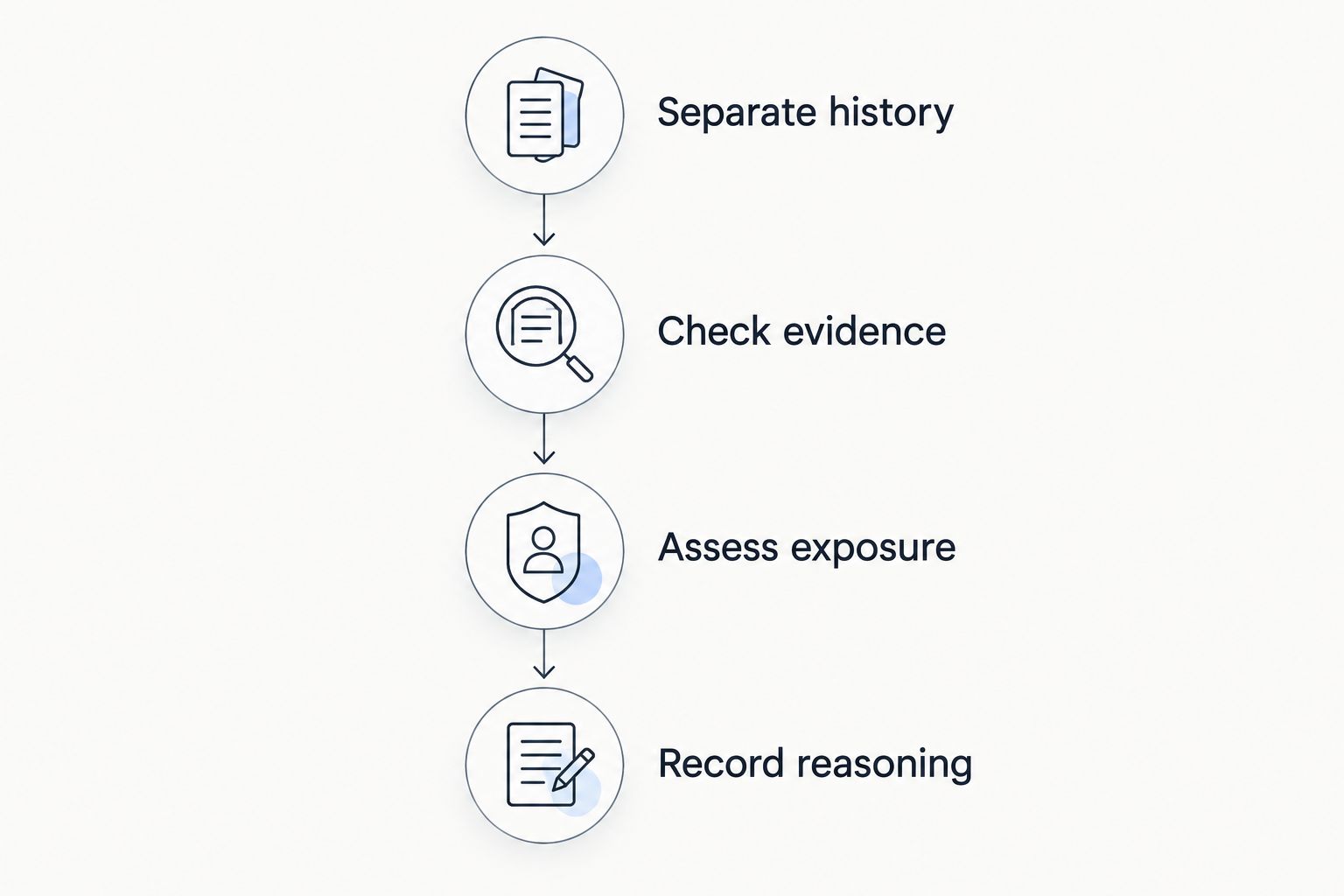
Review current evidence before judging the decision by its eventual result.
The sequence is a recordkeeping method. It is not a signal to enter or exit a particular market. Your strategy and applicable account conditions remain separate parts of the assessment.
06 What sunk cost bias is not
Not every difficult holding decision reflects sunk cost bias. A trade can remain open through an adverse move because that movement falls within the strategy's original assumptions. The supporting conditions still need to be identifiable.
Loss aversion is related but distinct. It concerns sensitivity to losses relative to gains. Sunk cost bias concerns the influence of past commitments on a decision about what happens next.
Anchoring is another separate concept. An entry price can become a reference point that receives too much weight. That attachment becomes part of sunk-cost reasoning when getting back to the reference point justifies continued exposure regardless of current evidence.
Adding to a position also requires careful interpretation. A planned entry process is not automatically a rescue attempt. The relevant question is whether the additional exposure has its own justification and remains within the intended risk framework.
A trade's direction does not identify the bias. The explanation does. This applies to profitable positions as well as losing ones. Time and effort can influence either.
07 The VCG Markets lens: review the decision, not just the result
VCG Markets is an international multi-asset broker. For traders reviewing open positions, the useful distinction is between information about performance and evidence supporting continued exposure.
VCG ONE scores trader performance across eight behavioural dimensions in real time. That supports behavioural review, but a performance score is not a reason to hold a specific trade. Your account conditions and the position's current rationale still require attention.
For VCG Markets traders reviewing sunk cost bias trading, current evidence matters more than past commitment. Use that distinction when reading a journal entry or examining a holding decision. Neither a score nor an eventual recovery proves the reasoning was sound.
08 What should your 2026 trading journal record?
A journal should preserve the explanation available before the result. Recording only entry, exit and profit or loss leaves the central bias question unanswered: why did you continue taking risk?
Use separate fields for the original rationale, current evidence, invalidation condition and reason for any change. Keep observations distinct from expectations. That makes it easier to see when a market-based explanation became a recovery-based explanation.
Record emotional context without turning it into a judgement about ability. Frustration, relief and attachment are relevant observations. They are not market signals.
When reviewing the record, look for changes in language. A shift from a specific condition to a need to get the money back deserves attention. The purpose is to identify the decision pattern, not to criticise the trader.
Frequently asked questions
What does sunk cost bias mean in trading?
Sunk cost bias trading means allowing past losses, time or effort to influence whether you keep taking future risk. The position's current evidence and remaining exposure become secondary to recovering what you committed.
Does a losing open trade mean I have sunk cost bias?
A losing open trade does not establish sunk cost bias. The relevant distinction is whether your holding decision follows current evidence and planned risk or mainly reflects a wish to recover the past loss.
Should I ignore my entry price when reviewing a trade?
Your entry price remains relevant to calculating the position's result. It does not automatically become a justified target or prove that price will return to it.
Is adding to a losing position always sunk cost bias?
Adding to a losing position is not automatically sunk cost bias. The additional exposure needs an independent rationale and an assessment against the strategy's total risk, rather than a desire to rescue the original trade.
Can a trading journal help identify sunk cost bias?
A trading journal helps make sunk-cost reasoning visible when it records decisions before their outcomes. Separate the original entry reason from the current reason for holding and preserve both.
Can VCG ONE tell me whether to keep a trade open?
VCG ONE scores trader performance across eight behavioural dimensions in real time. A behavioural score does not establish whether a particular open position remains justified or predict its next price move.
What should I change in my 2026 trading review?
In your 2026 trading review, separate the original commitment from the current holding decision. Record what supports continued exposure now and what evidence would challenge that explanation.
Conclusion
Before reviewing the result, read the reason you recorded for keeping the trade open. That short explanation is where the distinction becomes visible. Current evidence describes the position; past commitment describes your history with it.
One final check: remove the entry price from your explanation and see whether a current reason for holding remains. This is a reasoning exercise, not an instruction to trade.
Related guides
This article is for educational purposes only and does not constitute investment advice. Trading CFDs and other leveraged products carries a high level of risk and may not be suitable for all investors.

Información
VCG Markets Ltd es la entidad autorizada para prestar servicios de inversión. Está constituida en la República de Mauricio (N.° de empresa 188485) y está autorizada y regulada por la Comisión de Servicios Financieros de Mauricio bajo la Licencia N.° GB22200388, con domicilio social en The Cyberaty Lounge, planta baja, The Catalyst, Silicon Avenue, 40 Cybercity, 72201 Ebene, República de Mauricio.
VCG Markets (Seychelles) Ltd es la entidad autorizada para prestar servicios de intermediación de valores (Securities Dealer). Está constituida en la República de Seychelles (N.° de empresa 8438443-1) y está autorizada y regulada por la Autoridad de Servicios Financieros de Seychelles bajo la Licencia N.° SD243, con domicilio social en House of Francis, Room 301(B), Ile Du Port, Mahe, República de Seychelles.
El sitio web es operado por VCG Tech Limited (N.° de empresa HE452446), con domicilio social en Agias Fylaxeos & Zinonos Rossidi, 2, 1.er piso, 3082 Limassol, Chipre. VCG Tech Limited actúa como empresa comercial para el procesamiento de depósitos y retiros de clientes.
El trading de Forex con margen y los CFD son productos apalancados y pueden dar lugar a pérdidas que superen sus depósitos. El valor de las inversiones puede disminuir o aumentar, y es posible que reciba menos de lo que invirtió originalmente. Asegúrese de comprender plenamente los riesgos involucrados y considere si dicho trading es adecuado para usted.
Las llamadas telefónicas y las comunicaciones electrónicas pueden ser grabadas y monitoreadas con fines de control de calidad, cumplimiento normativo y capacitación.
La información de este sitio web se proporciona únicamente con fines informativos generales y no constituye asesoramiento de inversión, una recomendación ni una solicitud para participar en ninguna actividad de inversión.
VCG Markets no brinda asesoramiento fiscal. La legislación fiscal puede cambiar o diferir entre jurisdicciones.
La información en este sitio web no está dirigida a residentes de los Estados Unidos de América, Bélgica, Canadá, Singapur, ni a ninguna jurisdicción donde el acceso a dicha información sea contrario a las leyes o regulaciones locales.
VCG Markets © 2026, Inc. Todos los derechos reservados.

Síganos


