Trading behaviour · 2026
AI trading performance scores need context because a summary cannot explain every trade, exposure or market condition behind it. Read the score alongside its inputs and calculation period. A higher score is not a forecast of profit or an instruction to trade.
Key takeaways
- AI trading performance scores summarise measured behaviour. They do not establish future profitability.
- VCG Markets supports behavioural performance review. Read scores alongside trading records and market conditions.
- Compare like-for-like periods before interpreting a score change as progress.
- An explained score supports review. An unexplained score leaves its meaning unresolved.
01Understand the measure
02Check the context
03Review the explanation
01
Why do AI performance scores need context and explanation?
A score compresses information. Its explanation must restore enough detail for you to understand what was measured. At a multi-asset broker such as VCG Markets, that distinction matters across different instruments and trading decisions.
In 2026, the useful question is not simply whether a score increased. Ask what changed underneath it. A different calculation period, a different group of trades or a revised scoring method changes the basis of comparison.
Consider profitable trades that departed from a written trading plan. The profit records the financial outcome. It does not establish that the decisions followed the plan. The reverse also holds: a losing trade does not by itself prove that the process was inconsistent.
Read a performance score as a prompt for investigation, not a verdict on your ability. Its value depends on whether you can connect the summary to identifiable evidence.
02
Why this matters: measurement is not prediction
A behavioural measure describes the behaviour it captures. A profit measure describes financial results over its stated period. Neither establishes what the next market move will be. Calling a score intelligent does not remove that boundary.
Separate these questions during a review: Did the trade make money? Did the decision follow the plan? What risk did the account carry? The answers describe different aspects of performance. Combining them without explanation makes the result harder to interpret.
An overall score is useful for orientation. Its limitation is compression. A detailed explanation supports inspection, but it still needs readable definitions and access to the underlying records. More text alone does not make a score more informative.
| Review approach | Useful for | Limitation |
| Score alone | A quick summary | Does not explain the underlying decisions |
| Score with explanation | Reviewing a specific pattern | Still depends on data coverage and clear definitions |
03
What should you check before interpreting a score?
Use the same review sequence for a new score and a familiar one. For your 2026 trading journal, record the explanation alongside the result. That preserves the basis of your interpretation rather than leaving only a dashboard snapshot.
- Define the measure. Establish whether it describes behaviour, financial results, exposure or a combination. Do not infer its purpose from its name.
- Check the records. Identify the calculation period and included trades. Ask how the measure treats open positions and incomplete records.
- Trace the explanation. Look for the specific decisions associated with the assessment. A general description is not a trade-level explanation.
- Compare like-for-like. Check that the method and scope match before treating a change as progress or deterioration.
- Record the limit. State what the score does not establish. Keep trading decisions separate from the desire to improve a displayed measure.
If an explanation cannot identify the relevant records, leave the interpretation unresolved. You do not need to fill that gap with confidence. A clearly stated limit is more useful than a detailed story unsupported by the data.
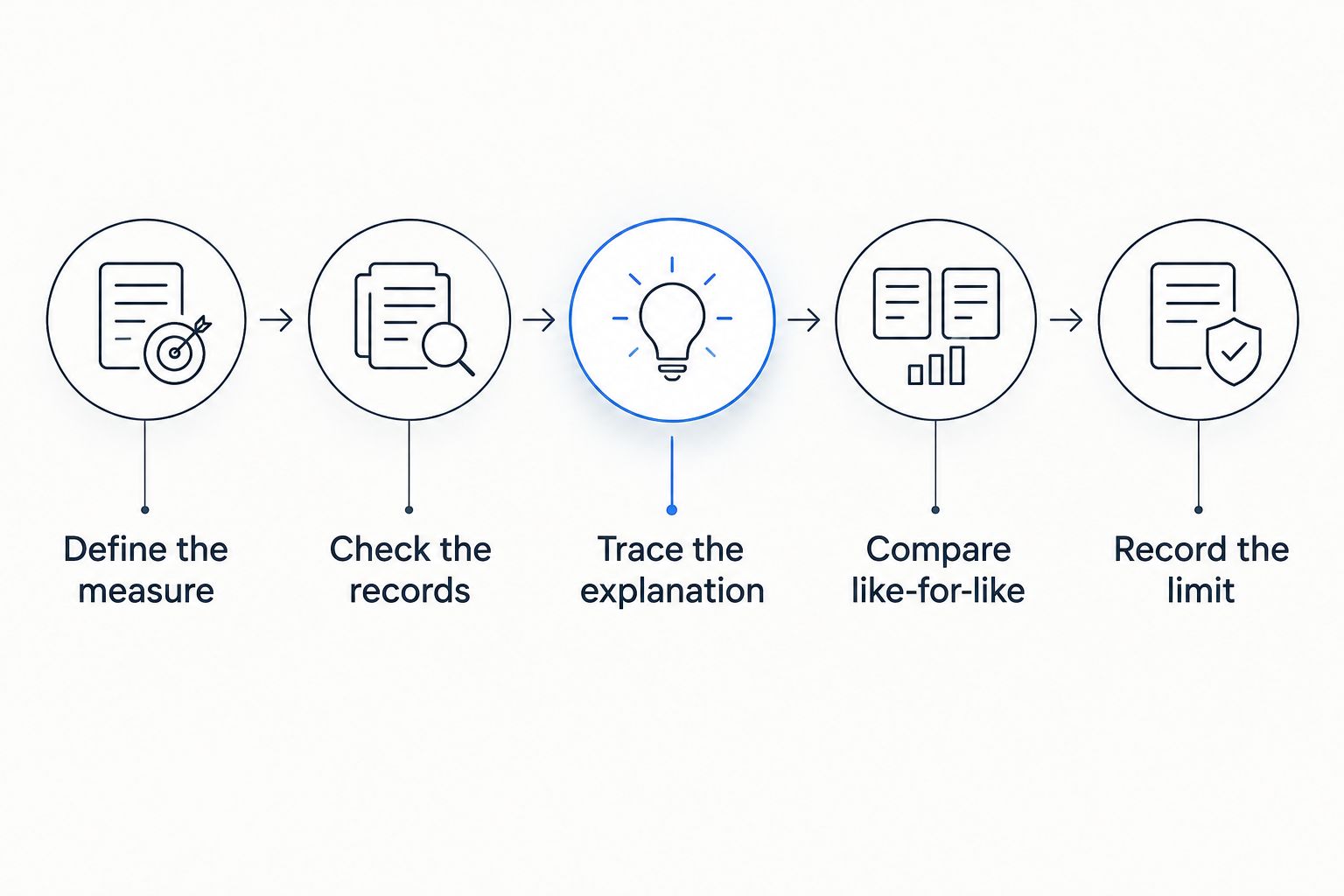
Establish what the score measures before interpreting a change.
04
Why the interpretation varies
Context changes what you can conclude from a score. These factors belong in the review even when they are not inputs to the scoring model. Check the documentation before assuming any particular factor affects its calculation.
- Observation period. A short recent window and a longer account history answer different questions. Neither should silently stand in for the other.
- Trade coverage. A measure based on closed trades does not by itself describe unrealised gains or losses on open positions.
- Instrument exposure. Different trade names do not guarantee independent risk. Review what the positions depend on.
- Market conditions. Volatility and liquidity affect the setting in which decisions and execution occur. Record that setting without assuming it explains every outcome.
- Scoring method. Definitions and weighting determine what a combined measure represents. A method change requires an explanation before comparison.
Shared currency exposure illustrates why trade-level context matters. Buying EUR/USD and GBP/USD creates positions that both benefit from a weaker dollar. Looking at each trade separately does not remove the common dependency.
Read about correlated pairs and hidden exposure.
This does not establish how a particular score handles correlation. It establishes a question to ask. Does the explanation address account-level exposure, or does it describe each trade in isolation?
05
Does a higher score mean you should trade more?
A higher performance score does not establish a reason to increase trading activity. The score concerns its defined observations. A new position introduces a new decision and new exposure.
Keep the review question separate from the execution question. You can investigate a behavioural pattern without placing another trade. You can also acknowledge an improved measure without changing position size or risk limits.
Can a profitable period still reveal a process problem?
A profitable period can include decisions that departed from your stated process. Compare the record with the plan you had before entry. Do not rewrite the plan after seeing the result.
Can a falling score still provide useful information?
A falling score provides useful information when its explanation identifies a change you can verify. First check whether the records, method or observation period changed. Do not treat an unexplained movement as a diagnosis.
FAQ
What do AI trading performance scores actually tell me?
AI trading performance scores summarise the measures defined by their scoring method. Check whether the assessment concerns behaviour, financial results, exposure or a combination before interpreting it.
Can an AI performance score predict my next profitable trade?
A performance score does not establish that your next trade will be profitable. A measure of observed behaviour is not the same as a validated forecast of future returns.
Why did my score rise when my account lost money?
A rising score and a financial loss are not necessarily contradictory if the score measures behaviour rather than profit. Check the definition and included records before explaining the change.
Can I compare scores from different trading platforms?
Scores are comparable only when their definitions, scales and observation periods support that comparison. Matching displayed values alone does not establish matching performance.
What should I ask when a score has no explanation?
Ask what it measures, which records it uses and how the result was calculated. Without those answers, do not infer a specific behavioural problem or improvement.
How should I interpret behavioural scores at VCG Markets?
Interpret behavioural scores alongside their definitions and your underlying trading records. Use the assessment for review rather than as a promise of returns or an instruction to open a position.
Conclusion
For your next 2026 review, write a plain-language explanation before recording whether a score improved. Name the measure. Identify the records. State the limitation. If you cannot explain the movement without repeating the displayed value, the review is not yet complete.
One final check: ask what evidence would change your interpretation. That question prevents a favourable score from becoming something you defend rather than examine. The purpose is understanding the record, not protecting a number.
Understand the explanation before acting on the score.
Related guides
This article is for educational purposes only and does not constitute investment advice. Trading CFDs and other leveraged products carries a high level of risk and may not be suitable for all investors.


