Trading Psychology · Data Review
Automation bias matters when reviewing trading data because an automated conclusion can replace your own verification. A polished score does not establish that its inputs are complete or that its interpretation fits your positions. In 2026, the distinction remains simple: use automated analysis as evidence to examine, not a decision to inherit.
Key takeaways
- Automation bias trading reviews confuse an automated conclusion with verified evidence.
- Check source data, calculation methods and missing context before accepting a performance score.
- VCG Markets gives traders ownership of their data; that ownership supports independent review.
- A profitable outcome does not establish that the original decision followed your trading plan.
01Recognise the bias
02Check the evidence
03Record your reasoning
01
Why automation bias matters when reviewing trading data
An automated review answers the question its calculation was designed to answer. Your trading review has a wider job. It must connect the result to your exposure, execution and original reasoning.
For example, separate winning positions do not necessarily represent separate sources of risk. The guide to correlated pairs and hidden exposure explains why different currency pairs can depend on the same underlying move.
Why this matters: accepting a summary without checking its scope can leave that shared exposure unexplained. Automation bias concerns the authority you give the output. It is not proof that the software made a calculation error.
The distinction applies throughout a 2026 trading review. A calculation can be accurate while the conclusion you draw from it remains incomplete.
| Review method | Useful for | Limitation |
| Automated calculation | Applying defined rules to recorded data | Does not establish that the data captures every relevant circumstance |
| Manual review | Checking records against your written reasoning | Still depends on your attention and interpretation |
Use each method for a different task. Let calculations organise the records. Use independent review to question what those records establish.
02
Why automated conclusions vary
Different summaries can describe the same account differently without either containing an arithmetic error. Before comparing conclusions, check whether they use the same definitions.
- Review period. A session summary and a full trading history answer different questions. Keep the dates consistent when comparing results.
- Included positions. Closed trades exclude positions that remain open. Check whether the summary describes realised results or includes unrealised changes.
- Recorded costs. A result before applicable charges is not the same measurement as a result after those charges. Read the calculation basis.
- Currency basis. Instrument values and account reporting can use different currencies. Check the conversion method before interpreting a difference.
- Grouping method. A trade-by-trade view separates records. A portfolio view asks how positions interact.
These are checks on interpretation. They do not establish that a particular platform omits information. The task is to identify what the displayed measure includes before asking it to support a broader conclusion.
03
How do you check an automated trading review?
Use 4 checks before accepting a conclusion. This is a review framework for 2026, not a trading signal or a requirement to change a position.
- Source data. Open the underlying trade records. Confirm the instrument, direction, execution details and period match the summary you are examining. Do not compare records drawn from different filters.
- Calculation method. Establish what the measure means. Check whether it includes open positions, applicable costs and currency conversion. If its definition is unclear, leave that part of your conclusion unresolved.
- Missing context. Compare the output with your original plan. Look for shared exposure, changed position sizes or an execution condition that a single headline figure does not explain.
- Decision record. Write what you accept, what you question and which record supports each judgment. Keep the automated output separate from your interpretation.
The order matters. Checking the source before reading a recommendation gives you an independent reference point. Starting with the conclusion and searching only for supporting records reverses that process.
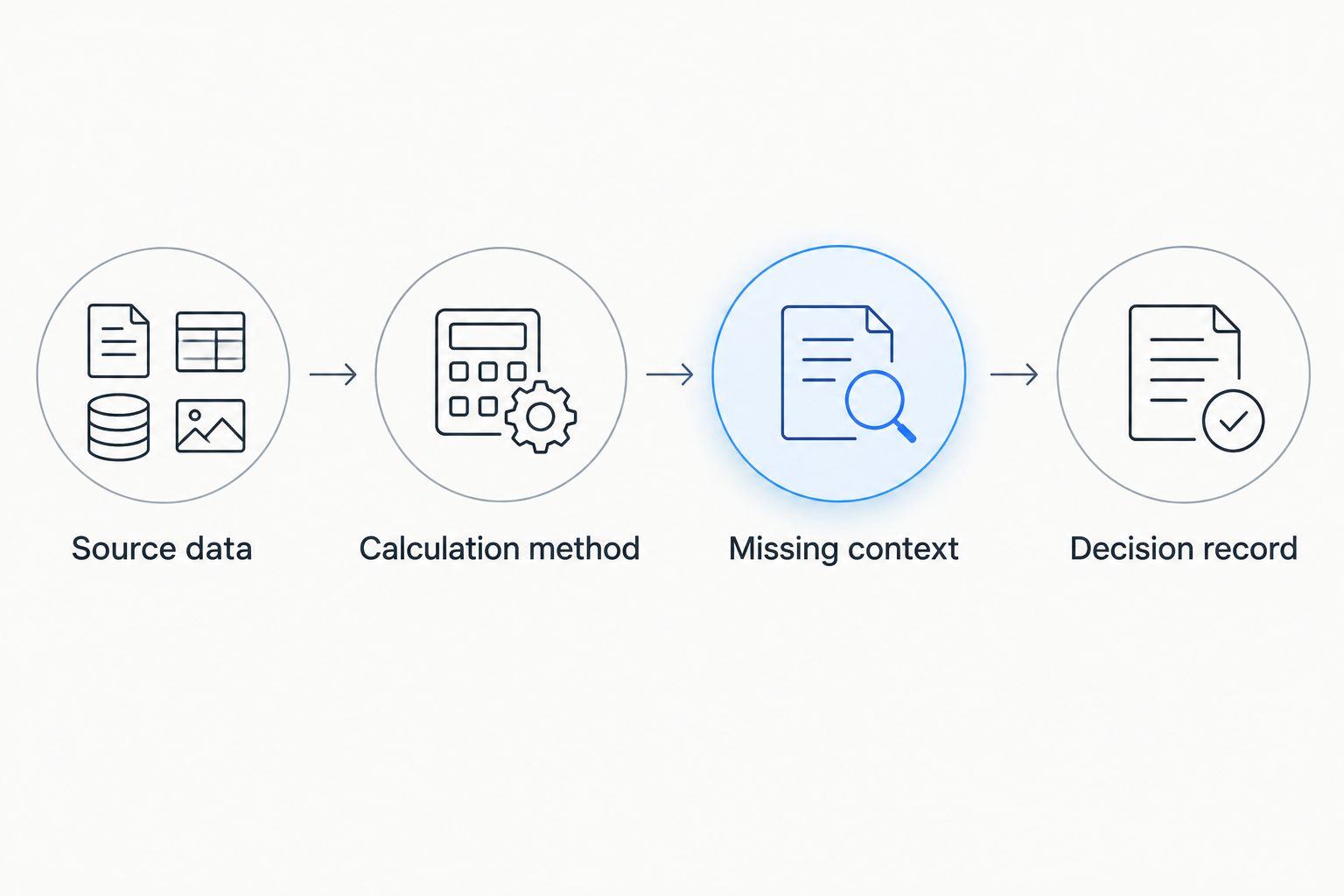
Verify the records before accepting the conclusion.
Make the review repeatable. Use the same questions when a result is favourable and when it is disappointing. Otherwise, the standard of evidence changes with the outcome.
For instrument-level details, use the guide to reading contract specifications. Contract information helps you check what a position represents before interpreting its performance.
04
What does automation bias look like in a trading review?
Watch for 2 error types: accepting an incorrect automated conclusion and overlooking something because the system did not flag it. These are commonly described as commission and omission errors.
Consider a hypothetical review that labels a profitable session as disciplined. You accept the label without checking whether your position sizes followed your plan. The profit is recorded evidence. The claim about discipline still needs a separate check.
Now consider a review with no warning about shared currency exposure. You interpret the absence of a warning as confirmation that the positions are independent. That conclusion requires an exposure check. Silence does not establish that the relevant condition was assessed.
A missing warning is not a completed check. Record whether a condition was examined, rather than treating an empty alert area as evidence that it was.
05
Does a profitable trade validate an automated recommendation?
A profitable trade does not validate an automated recommendation. It establishes the recorded financial outcome of that trade. It does not establish that the reasoning was sound or that the same reasoning will work again.
Separate outcome review from process review. Ask whether the position matched your written plan using information available at the time. Then examine the financial result without using it to rewrite your original reasoning.
This separation also matters after a loss. A losing result does not automatically prove that a calculation was wrong. Check the calculation and the decision independently.
06
Should you reject automated analysis to avoid the bias?
Rejecting automated analysis is not the same as checking it. Automated calculations can apply defined rules consistently. Manual interpretation adds context but remains open to selective attention and hindsight.
Assign each a clear role. Use the calculation to identify what changed in the records. Use your review to establish whether the proposed explanation follows from those records.
When the evidence conflicts, preserve the disagreement in your journal. Do not choose whichever answer feels more reassuring. Identify the disputed input or definition before treating either conclusion as established.
Frequently asked questions
What is automation bias in trading data reviews?
Automation bias is excessive reliance on an automated output instead of independently checking the relevant evidence. In trading reviews, it includes accepting a performance label without examining the underlying records.
How can I check an automated trading score?
Check the score against its source data and calculation definition. Then compare its interpretation with your original plan and any relevant exposure or execution context.
Does an accurate calculation mean the recommendation is right?
An accurate calculation does not establish that a recommendation is right. The calculation can describe recorded data correctly while leaving out context needed for the decision.
Is manual review free from bias?
Manual review is not free from bias. Use consistent questions and written records rather than assuming your interpretation is independent simply because you produced it yourself.
Does no warning mean my trading risk was checked?
No warning does not establish that your trading risk was checked. Confirm whether the system assessed the specific condition you are concerned about.
What should a trading journal include in 2026?
A trading journal in 2026 should separate the original plan, recorded outcome and later interpretation. Include the evidence supporting your assessment and identify questions that remain unresolved.
Conclusion
Automation bias begins when the output becomes the authority instead of part of the evidence. Keep the source records, calculation and interpretation distinct. That gives each conclusion a visible basis.
One last thing: add 1 journal entry stating what evidence would change your assessment. Write it before rereading the automated conclusion. This creates a specific question to investigate rather than another summary to accept.
Your 2026 review rule: verify the evidence before adopting the conclusion.
Related guides
- How trading balance differs from equity
- How currency conversion affects trade results
- Why chart prices differ from execution prices
This article is for educational purposes only and does not constitute investment advice. Trading CFDs and other leveraged products carries a high level of risk and may not be suitable for all investors.


