Trading Psychology · 2026
Fear of missing out affects trading decisions when the urgency to join a move replaces your entry criteria and risk checks. It can lead you to chase price, increase exposure or abandon an exit plan. The distinction is whether the trade meets your rules, not whether the market keeps moving afterwards.
Key points
- In fomo trading psychology, urgency replaces the entry criteria that should guide your decision.
- A missed move is not a trading loss. Your account changes only when you take exposure.
- Use a pre-trade checklist to distinguish a planned momentum entry from price chasing.
- VCG Markets supports behavioural review through VCG ONE. Performance scores do not establish whether a trade is suitable.
01Recognise urgency
02Check the decision
03Review the process
Start with a [pre-trade decision checklist](https://vcgmarkets.com/en/blog/pre-trade-decision-checklist). Written criteria give you something specific to compare against the urge to act.
01
How does fear of missing out affect trading decisions?
Fear of missing out changes the question from whether a trade meets your criteria to whether you can tolerate watching it happen without you. The pressure becomes the reason for entry. Price movement alone does not establish that your intended entry, exit and exposure still make sense.
| Decision point | Planned momentum entry | Fear-driven entry |
| Entry reason | A condition specified before the decision | Urgency to avoid missing further movement |
| Exposure | Checked against the existing plan | Chosen or increased to catch the move |
| Limitation | A valid setup can still lose | A profitable result can conceal a broken rule |
A momentum strategy deliberately responds to price movement. That does not make every momentum entry fear-driven. The distinction is whether you apply a defined method or invent a justification after deciding you must participate.
Why this matters
A trade creates financial exposure. Watching a move does not. Treating an untraded opportunity as money already lost can push you towards a position that your original plan would reject.
02
Why the pressure to participate varies
For your 2026 trading journal, record the trigger rather than labelling the whole session emotional. Different triggers require different checks. These are situations to examine, not a diagnosis of how you trade.
- Rapid movement. A fast change in price creates time pressure. Check whether your entry condition still exists at the current level.
- Visible gains. A shared winning trade shows an outcome. It does not establish the trader’s total exposure or the trades omitted from view.
- A missed entry. Watching price move beyond your planned level can turn waiting into chasing. A missed setup does not automatically create a replacement setup.
- A recent loss. Wanting to recover money changes the purpose of the next decision. Recovery pressure does not validate the next trade.
- A recent win. Confidence from a profitable trade can influence the next position. The previous result does not remove the need to check current risk.
Notice which part of your process changes under pressure. You might keep your entry rule but increase size. You might preserve size but move the exit. Both deserve review even when the entry itself looks familiar.
03
Use 3 checks before placing an order
Make these 3 checks part of your 2026 decision record. Their purpose is to expose the reasoning behind an order. They do not identify profitable trades or eliminate trading risk.
- Entry reason. Write the condition that permits the trade. Describe something observable rather than the feeling that price is getting away. If your original condition no longer holds, record that explicitly.
- Risk check. Review position size, existing exposure and the point at which your trade idea no longer holds. Ask whether the proposed order changes the account risk you intended to accept. Available margin alone does not answer that question.
- Exit condition. State how the position will be managed if the idea fails. Check the order type and its execution limitations before relying on it. A stop instruction is not a promise that execution will occur at the displayed stop level.
Keep the sequence visible beside your decision record. An entry reason without a risk check is incomplete. A risk check without an exit condition leaves a different gap.
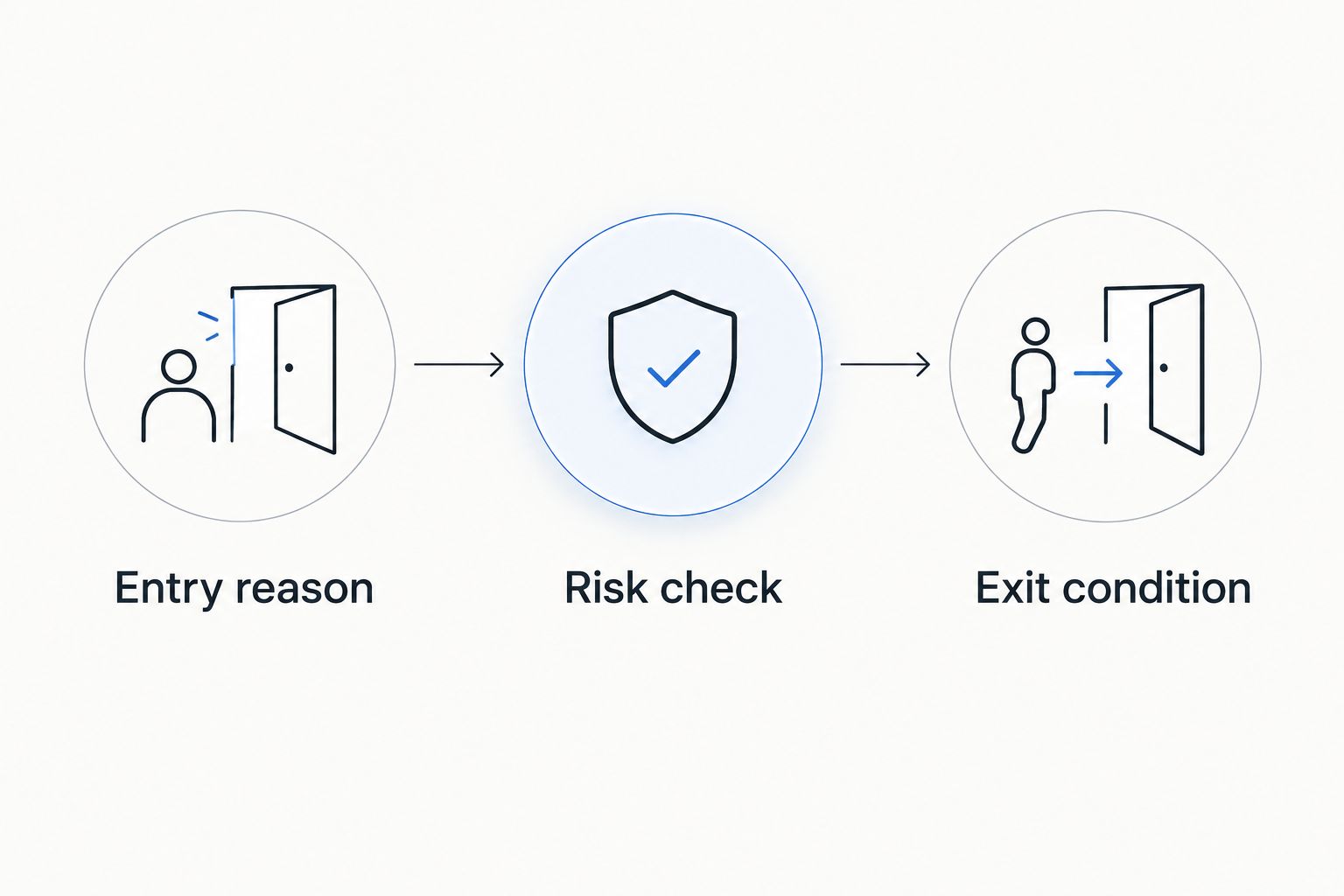
Check the reason, exposure and exit before placing the order.
A checklist helps you identify omissions. It cannot establish that your strategy has an advantage. Completing every field still leaves uncertainty about the market and the eventual execution.
Review [stop-loss execution during a market gap](https://vcgmarkets.com/en/blog/stop-loss-market-gap) separately from trading psychology. Emotional discipline does not remove the execution limits of the order you choose.
04
Keep 4 fields in your trading review
Your 2026 review needs evidence from the decision itself. Memory after the outcome is not the same record. Keep 4 fields that separate the trigger from the action:
- Trigger: What happened immediately before you wanted to trade?
- Original plan: What entry, exposure and exit conditions had you already defined?
- Actual action: What did you place, change or cancel?
- Rule difference: Where did the action depart from the plan?
Then ask 2 review questions. Would you describe the decision differently if the trade had produced the opposite result? Did you change a rule because market information changed or because waiting became uncomfortable?
A winning trade does not settle those questions. Neither does a losing trade. Record the financial result separately so that it does not become your only measure of decision quality.
Keep trades that followed the plan distinct from trades that broke it. Mixing them makes it harder to tell whether you are reviewing the method or departures from the method. A journal supports that distinction but does not prove why a result occurred.
Frequently asked questions
What does fomo trading psychology mean?
Fomo trading psychology concerns decisions driven by fear of missing a market opportunity. The practical warning sign is urgency replacing your written entry or risk criteria.
Is buying after a price rise always fear-driven trading?
Buying after a price rise is not automatically fear-driven trading. A planned momentum entry follows defined conditions. A fear-driven entry substitutes urgency for those conditions.
How do I check whether I am chasing a trade?
Use 3 checks: entry reason, risk check and exit condition. Compare each with your original plan rather than treating continued price movement as permission to enter.
Can a profitable trade still come from fear of missing out?
A profitable trade can still break your trading rules. Record whether you followed the plan separately from whether the position made money.
Does a stop-loss order remove the risk of an impulsive entry?
A stop-loss order does not remove the risk of an impulsive entry. Position size, combined exposure and execution conditions still matter. A stop price is not a guaranteed execution price.
Should I enter immediately after missing my planned entry?
A missed entry does not automatically justify a new order. Reassess whether a valid setup exists under your written rules rather than treating the missed move as a loss to recover.
Can VCG Markets performance scores tell me when to trade?
VCG Markets behavioural performance scores are a review input, not an instruction to trade. They do not establish the suitability or expected outcome of a specific position.
Conclusion
A profitable rule-breaking trade deserves attention precisely because the outcome feels reassuring. For your next 2026 review, examine the decision before looking at its result. That keeps the market’s response separate from the process you controlled.
A missed move is not a trading loss. An order creates exposure.
Related guides
This article is for educational purposes only and does not constitute investment advice. Trading CFDs and other leveraged products carries a high level of risk and may not be suitable for all investors.


