VCG Markets · Order execution
A market order requests execution at the available market price. A limit order permits execution only at your specified price or better. The distinction is execution priority versus price control: neither order guarantees that your entire requested quantity will trade.
Key takeaways
- Market order vs limit order: market orders prioritise execution; limit orders set a price boundary.
- A market order does not lock the quote you see when submitting it.
- A limit order controls the acceptable price but can remain unfilled.
- Liquidity, order size and execution rules affect whether an order fills completely.
01Execution differences
02Price and liquidity
03Order checks
01
Market order vs limit order: how does execution differ?
A market order accepts available execution prices. A limit order rejects prices outside its boundary. Liquidity and order execution explain why either order can depend on the quantity available to trade.
| Execution feature | Market order | Limit order |
| Priority | Execution at available prices | Execution within a price boundary |
| Price protection | No trader-set limit price | Limit price or better |
| Main benefit | Does not wait for your chosen price | Restricts acceptable execution prices |
| Main limitation | Final price can differ from the quote | Execution is not assured |
| Completion | Depends on liquidity and execution rules | Depends on eligible liquidity and execution rules |
Why this matters
Your order instruction determines which trade-off you accept. A market order leaves the final price open. A limit order leaves execution uncertain. Neither instruction removes market risk after the position opens.
02
Market orders: execution without a fixed price boundary
A market buy seeks available selling liquidity. A market sell seeks available buying liquidity. The order does not instruct the execution system to wait for a more favourable price.
The quote visible before submission is not a reserved fill. Quotes can change while your instruction travels to the execution system. Available quantity can also change before the order arrives.
If the requested quantity exceeds liquidity at the first available price, execution can involve multiple prices. The result depends on the instrument and execution rules. The displayed average fill then describes the combined execution rather than a single transaction price.
A market order prioritises execution. It does not guarantee a particular price. Trading restrictions, insufficient margin or unavailable liquidity can still prevent execution. Treat a submitted instruction and a confirmed fill as separate events.
03
Limit orders: price control without assured execution
A buy limit sets the highest acceptable execution price. A sell limit sets the lowest acceptable execution price. A fill must respect that boundary or provide a better price.
Buy limitExecution at the limit price or lower. A lower fill price is a better purchase price.
Sell limitExecution at the limit price or higher. A higher fill price is a better sale price.
Reaching the limit does not guarantee a complete fill. There must be eligible liquidity for your order. Queue priority can matter on order-book venues. Broker execution rules determine how pending instructions are processed elsewhere.
A limit instruction also has a validity period. Check whether it remains active until cancelled or expires under a specified rule. A pending order can remain relevant to the execution system after your original reason for placing it has changed.
A limit order protects its execution boundary. It does not reserve liquidity or guarantee a profitable position. Price control applies to the fill. It does not prevent losses after execution.
04
Why order execution varies
The order type is one part of execution. Market conditions and the instrument's rules determine what happens when the instruction reaches the execution system.
- Available liquidity. The quantity available at eligible prices determines how much can trade.
- Order size. A larger requested quantity requires more matching liquidity. A visible quote does not establish the quantity available for your entire order.
- Price movement. Quotes can change between submission and execution. A market order can fill away from the quote you saw.
- Bid and ask. Buying generally executes against the ask. Selling generally executes against the bid. A chart need not display the relevant executable side.
- Execution rules. Fill policy, order validity and trading-session restrictions affect whether an instruction fills, remains pending or is cancelled.
These factors interact. A small order in a fast-moving market can receive a different outcome from a larger order in deeper liquidity. Order size alone does not establish execution quality.
Why did my chart touch the limit without a fill?
A chart touch is not proof of an executable fill. The chart might show the bid, ask or last traded price. The relevant side and available quantity still matter. The distinction between chart price and execution price helps explain this mismatch.
05
What should I check before submitting an order?
Check the instruction before checking the outcome. A correctly selected order type can still produce an unexpected result if the quantity, direction or validity setting is wrong.
- Order direction. Confirm whether the instruction buys or sells. Check whether it opens, reduces or closes exposure under your account's position rules.
- Order quantity. Check the requested amount and the instrument's contract specification. Similar-looking order tickets need not represent the same exposure.
- Price boundary. For a limit order, verify the limit and its direction. For a market order, recognise that the displayed quote is not a fixed execution price.
- Validity and fill policy. Read how long the order remains active. Check how the system handles a quantity that cannot fill completely.
- Execution confirmation. Review filled quantity, average fill price and remaining quantity. Do not rely only on the order-submission message.
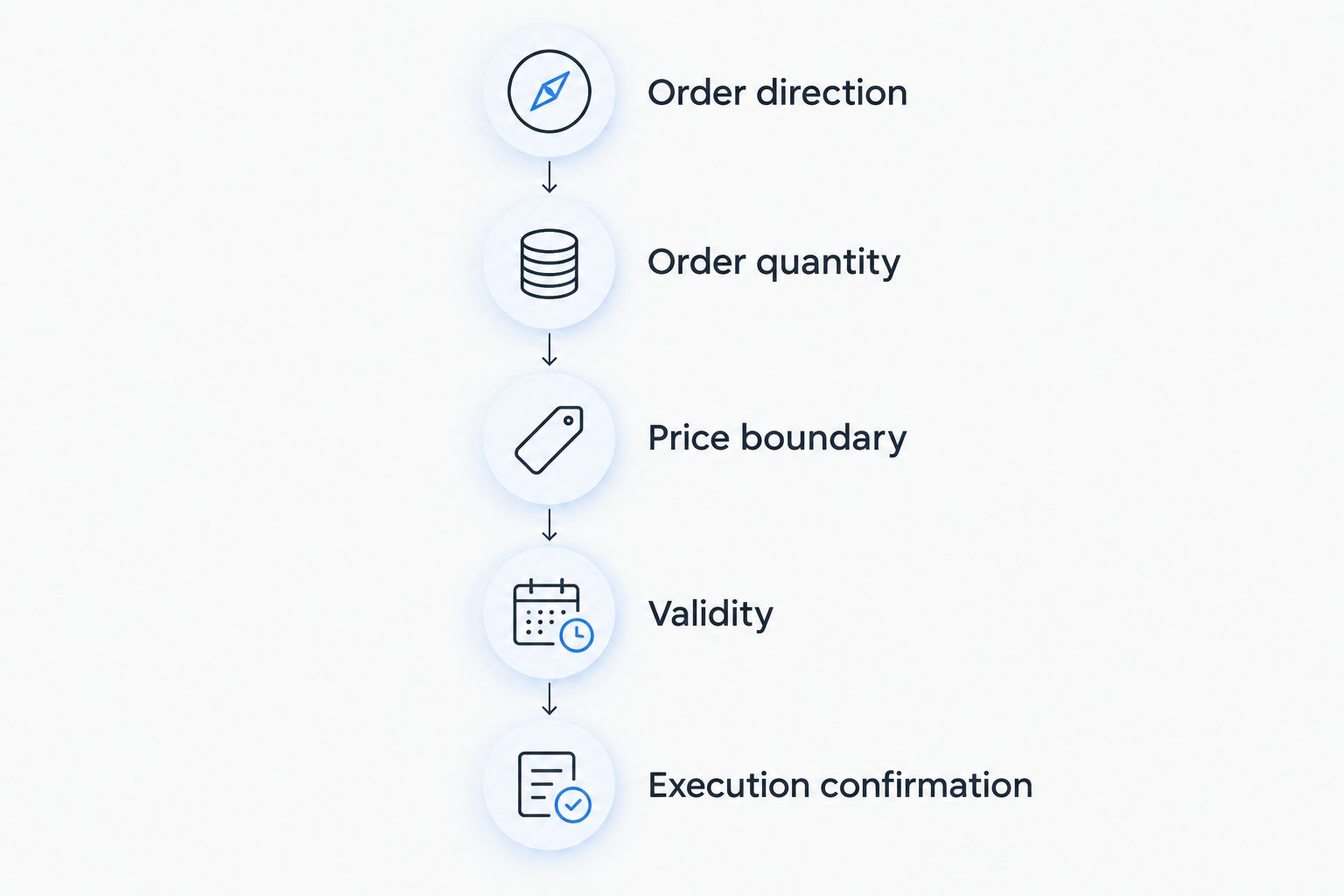
Check the instruction before submission and the confirmed result afterwards.
A cancellation request is not a cancellation confirmation. An order can execute while cancellation is being processed. Verify the final status before replacing an instruction to avoid creating unintended additional exposure.
Can either order fill only partly?
Both market and limit orders can receive partial fills where the execution rules permit them. Some of the requested quantity trades while the rest remains unfilled. The treatment of that remainder depends on the fill policy. Read about partially filled orders before treating an accepted order as a completed trade.
Frequently asked questions
What is the main difference between a market order and a limit order?
A market order requests execution at available market prices. A limit order permits execution only at its specified price or better. The trade-off is execution priority versus price control.
Does a market order guarantee immediate execution?
A market order does not guarantee immediate execution. Trading-session rules, available liquidity, account checks and execution restrictions can affect whether it fills.
Can a limit order execute at a better price?
A limit order can execute at a better price. A buy limit permits a lower execution price. A sell limit permits a higher execution price.
Why did my limit order remain unfilled when the chart touched it?
A chart touch does not guarantee eligible liquidity for your order. Check which price the chart displays and which side is relevant to execution. Queue priority and execution rules can also affect the result.
Can a market order fill at several prices?
A market order can fill at several prices where the execution rules permit it. This happens when completing the requested quantity requires liquidity at different price levels.
Is a limit order the same as a stop-loss order?
A limit order is not the same as a stop-loss order. A limit order sets an acceptable execution boundary. A stop-loss instruction activates under a specified trigger rule, with subsequent execution determined by the order terms.
Does cancelling an order guarantee that it has not traded?
A cancellation request does not guarantee that an order has not traded. Execution can occur before cancellation takes effect. Check the final order status and filled quantity before placing a replacement.
Conclusion
The order ticket records an instruction. The execution record shows what happened. Compare requested quantity with filled quantity before assuming the position matches your intention.
One final check matters: an unfilled remainder can still be active. Confirm its status after a partial fill. Otherwise a later execution can change your exposure without a new order submission.
Choose the instruction deliberately. Verify the execution separately.
Related guides
This article is for educational purposes only and does not constitute investment advice. Trading CFDs and other leveraged products carries a high level of risk and may not be suitable for all investors.


