Trading performance · Data quality
Missing trade data distorts a performance review by changing which results count and which costs remain visible. Missing losing trades can inflate a win rate. Missing charges or open positions can also make a profitable-looking review incomplete.
Key takeaways
- Missing trading data analysis should start with account reconciliation, not conclusions about trading skill.
- Match executions, charges and cash movements before calculating net trading results.
- A complete closed-trade record still excludes unrealised results unless open positions are reviewed separately.
- VCG Markets supports ownership of trading data. Performance conclusions still require complete records.
01Check completeness
02Reconcile results
03Limit conclusions
01
How can missing trade data distort a performance review?
Missing records change the calculation before you interpret it. A review that excludes losing trades overstates the proportion of winners. A review that excludes charges overstates net results. Missing [currency conversion details](https://vcgmarkets.com/en/blog/currency-conversion-trade-results) also prevents you from checking how instrument-level results became account-currency amounts.
Check the records before judging the strategy. Use this sequence to separate a data problem from a performance problem:
- Define the account and review period. Record the reporting timezone and the treatment of positions spanning the boundary.
- Match executions to positions. Include partial entries and exits without counting them as unrelated completed trades.
- Reconcile charges and account adjustments. Keep deposits and withdrawals separate from trading results.
- Identify open exposure. Do not treat a closed-trade summary as a complete account valuation.
- Calculate only the measures supported by the reconciled records. Mark unresolved gaps clearly.
Why this matters
A precise calculation can still describe an incomplete sample. If missing records cluster around volatile sessions or losing positions, the remaining trades no longer represent the full period. The resulting conclusion concerns the surviving records rather than the complete account.
02
Which missing fields change the conclusion?
Different gaps affect different measures. Missing timestamps prevent a reliable session analysis. Missing position sizes prevent meaningful exposure comparisons. A blank field is not a zero and should not silently become one during spreadsheet calculations.
| Missing record | Review affected | Required check |
| Completed trades | Win rate and average result | Match the full history |
| Charges and adjustments | Net trading result | Reconcile booked amounts |
| Execution times | Holding periods and sequence | Confirm timestamps and timezone |
| Open positions | Equity and remaining exposure | Use the same valuation time |
Trade counts need a definition too. An order is an instruction. An execution records a fill. A position represents exposure. Treating every execution as a separate completed trade changes your denominator and can make comparisons inconsistent.
Check [partially filled orders](https://vcgmarkets.com/en/blog/partially-filled-orders) when an order appears across several records. Preserve the individual fills for reconciliation. Then apply a consistent grouping rule for the performance review. Grouping should explain the records rather than erase their detail.
03
Why the effect of missing data varies
The significance of a gap depends on what it removes. A missing journal note limits behavioural interpretation. A missing closing execution prevents you from establishing the completed result. Assess the gap against the specific question you want to answer.
- Selection pattern. Missing losing trades creates a different distortion from missing trades without a relationship to their outcome.
- Position size. A missing large position affects account-level results differently from a missing small position. Trade counts alone do not capture that difference.
- Reporting boundary. Positions opened before the period or closed after it need an explicit inclusion rule.
- Cost treatment. Charges recorded outside individual trade rows still belong in the appropriate net-result calculation.
- Timing detail. Closing results cannot reconstruct every movement in equity while a position remained open.
Do not rank gaps only by how many rows are missing. Identify which conclusion each gap blocks. A complete set of closing results supports a different analysis from a continuous equity history.
That distinction matters for drawdown. A sequence of closed-trade results can show drawdown in that closed-result series. It does not establish the account's deepest equity decline between those observations. Name the series you actually measured.
04
How to rebuild a review without guessing
Keep the original records unchanged. Work on a separate copy and document every correction. This preserves the difference between information supplied by the account record and decisions made during analysis.
- Set the scope. Record the account, period, currency and timezone before combining files.
- Match identifiers. Connect orders, executions and positions using their recorded references. Investigate repeated references before deleting apparent duplicates.
- Reconcile cash. Explain the movement from opening balance to closing balance using booked trading results, cash movements and other entries.
- Separate open exposure. Record unrealised results at a consistent valuation time. Do not add them to realised results without labelling the combined measure.
- Record exceptions. List unmatched executions, unexplained charges and missing fields. State which calculations remain unsupported.
A reconciled total is a checkpoint, not proof that every field is correct. Offsetting mistakes can leave the closing balance unchanged. Check trade-level links as well as account-level totals.
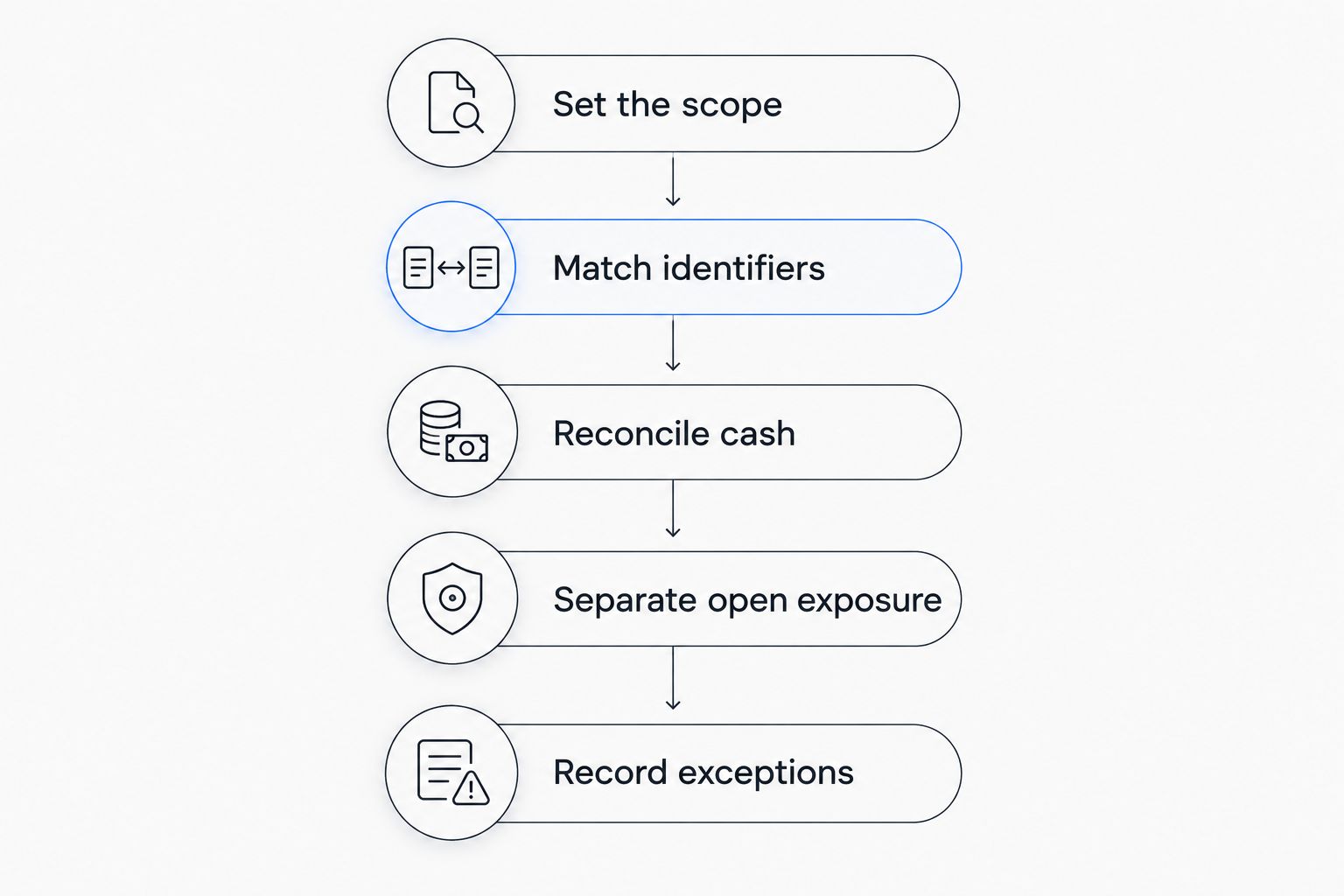
Reconcile the records before drawing performance conclusions.
If records remain unavailable, narrow the review. Describe it as an analysis of the available closed trades rather than a complete account review. Do not fill missing execution prices with chart prices or infer undocumented exits from a later balance.
Preserve the inclusion rule when comparing periods. A change from execution-level counting to position-level counting can create an apparent change in performance without any change in the underlying trades. Recalculate both periods on the same basis before comparing them.
05
What can you still learn from incomplete records?
Incomplete records do not make every observation unusable. They restrict its scope. You can describe documented outcomes within the available sample. You cannot assume the missing trades behaved the same way.
Can I calculate a win rate if some trades are missing?
You can calculate a win rate for the recorded sample. Label it that way and define how you treat breakeven trades. Do not present it as the account's full-period win rate while completed trades remain unmatched.
Does a complete trade history explain why I traded?
A complete trade history records transactions rather than intent. Without contemporaneous notes or a documented plan, it does not establish whether an entry followed your rules. Keep observed execution patterns separate from explanations of motivation.
Should I remove trades with missing fields?
Do not delete incomplete trades from the source record. Exclude them only from calculations that require the missing field. Explain that exclusion so the reader knows whether different measures describe different samples.
Frequently asked questions
What does missing trading data analysis involve?
Missing trading data analysis identifies absent records and determines which performance measures they affect. Start by matching executions, positions, charges and cash movements to the review period.
Can missing trades make my results look better?
Missing losing trades can make recorded results look better than the complete results. Missing winning trades can distort the review in the opposite direction.
Why does my spreadsheet disagree with my account statement?
Different scope, omitted entries or inconsistent calculations can produce a disagreement. Check the reporting period, timezone, currency conversion, charges, cash movements and open positions before changing formulas.
Is an empty charge field the same as no charge?
An empty charge field does not establish that no charge applied. Confirm the booked amount or mark it as unresolved rather than converting the blank to zero.
Can I reconstruct equity drawdown from closed trades?
Closed trades alone do not establish the deepest equity drawdown between trade closures. You need records that capture unrealised results through the period being measured.
What should I do if I cannot recover missing records?
Limit the review to conclusions supported by the available records. Label the sample, document the gaps and avoid presenting partial results as a complete account assessment.
One last thing
A matching closing balance can hide offsetting errors. A duplicated gain and an omitted gain of the same amount leave the total unchanged. That is why account reconciliation and trade-level matching belong together.
Before changing a trading rule because of a review, identify the exact records supporting the conclusion. If those records are incomplete, correct the review first. A decision based on a data gap does not become stronger because the spreadsheet is precise.
Reconcile what happened before interpreting what it means.
Related guides
- Trading balance and equity
- How to read contract specifications
- How correlated pairs create hidden exposure
This article is for educational purposes only and does not constitute investment advice. Trading CFDs and other leveraged products carries a high level of risk and may not be suitable for all investors.


