Trading process · 2026
Document a pre trade checklist by recording your trade rationale, entry condition, invalidation, exposure checks and decision before submitting an order. Save the original with a timestamp. Add execution details and your review separately so later price moves do not rewrite your reasoning.
Key takeaways
- A pre trade checklist records your reasoning before an order, not after the result.
- EUR/USD and GBP/USD positions can share dollar exposure. Record existing positions alongside the proposed trade.
- Use six required fields and three decision states to make your trading journal easier to review.
- Keep the original checklist unchanged. Add execution details and later observations as separate records.
01Record the decision
02Check the exposure
03Preserve the original
Why this matters
A completed trade shows what happened. A pre-trade record shows what you knew when you acted. Those are different records. Keeping them separate lets you compare your stated process with your actual decision.
For traders using [VCG Markets](https://vcgmarkets.com/), the same distinction applies: account activity records execution, while your checklist records intent. A profitable result does not establish that you followed your rules. A loss does not establish that you ignored them.
01
How to document a pre-trade decision checklist
Use 6 required fields for your 2026 checklist. Complete them before placing the order. Each field should contain a specific observation or decision rather than a tick confirming that you looked.
- Identify the instrument. Record the exact symbol, proposed direction and intended holding period. Include the contract or instrument type where relevant. Similar names do not establish identical trading terms.
- State the rationale. Describe the observation behind the proposed trade. Separate an observed price move from your interpretation of it. Name the source and its timestamp when your reasoning depends on external information.
- Define the trigger. Write the condition that must be present before you act. Record whether it is met, not met or unverified. An expectation that a condition will appear is not confirmation that it exists.
- Define invalidation. State what would make the original reasoning no longer applicable. Record the planned exit instruction separately. An invalidation condition explains your reasoning; an order instruction describes an action.
- Document exposure. Record the proposed size, planned risk calculation and existing positions. Include available margin and relevant contract terms. Note assumptions that depend on execution at a particular price.
- Save the decision. Record proceed, wait or skip with a reason. Timestamp the completed record before submitting an order. If a material condition changes, create an updated entry rather than silently replacing the original.
Check the instrument details before calculating exposure. The guide to [reading contract specifications](https://vcgmarkets.com/en/blog/read-contract-specifications) explains the information that belongs behind those calculations. A symbol alone does not document the assumptions you used.
The sequence separates the market observation from the decision. It also gives an unverified condition somewhere to go. You do not need to turn uncertainty into a completed check.
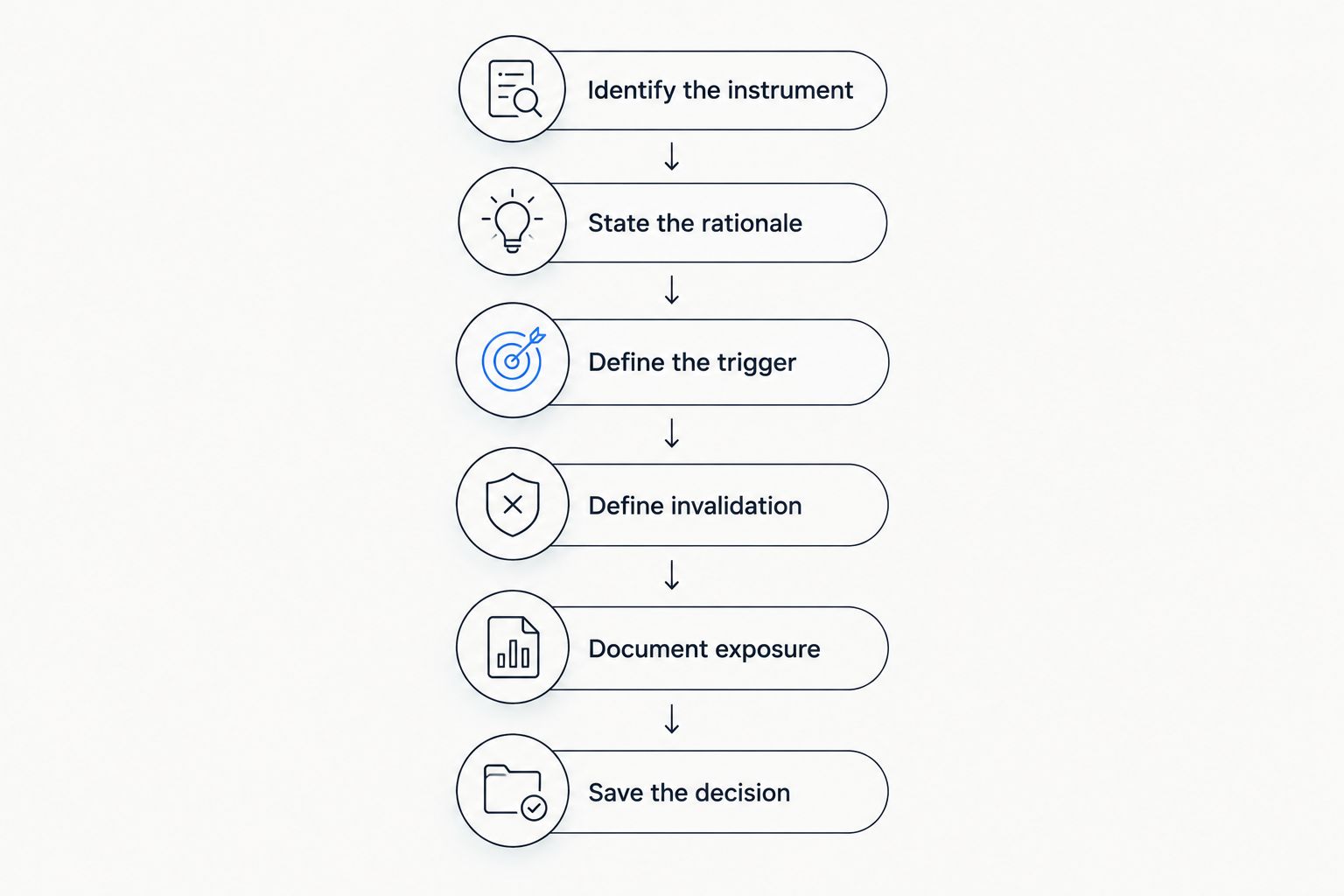
Save the reasoning and exposure checks before submitting the order.
02
A reusable 2026 pre trade checklist template
Copy these prompts into your trading journal. Answer them in your own words. Keep the prompts consistent so you can compare decisions without having to interpret a different format each time.
- Record details: checklist version, record identifier, creation date, time and time zone.
- Instrument: exact symbol, direction, contract details and intended holding period.
- Rationale: observed condition, interpretation, supporting source and source timestamp.
- Trigger: required condition, current evidence and verification status.
- Invalidation: condition that contradicts the reasoning and the planned response.
- Exposure: proposed size, calculation inputs, existing positions and shared market drivers.
- Decision: proceed, wait or skip; reason; completion timestamp.
- Attachments: relevant chart capture, calculation record or source reference.
The record details and attachments support the 6 required fields. They are not extra trade signals. A chart capture should show the instrument and timeframe used in your reasoning. It should not replace the written explanation.
For a proposed EUR/USD position, the exposure field should also identify other positions with dollar exposure. A GBP/USD position has a different symbol but can still depend on the same dollar move. Document that connection without assuming the relationship will remain fixed.
Avoid vague entries such as a general statement that risk looks acceptable. Record the calculation inputs and the rule you checked. If an input is unknown, mark it as unverified. Do not enter a guessed value simply to finish the form.
A useful attachment has a clear purpose. Save the chart that supports your stated trigger rather than a collection of unrelated screenshots. Keep the source timestamp visible when the decision depends on information that changes.
03
Use three decision states
Use 3 decision states: proceed, wait and skip. These labels describe the checklist decision. They do not predict whether a trade will make money.
ProceedYour documented conditions are met. Record the evidence supporting that assessment. This status is not a guarantee of execution or outcome.
WaitA required condition is absent or unverified. Record what needs checking. Identify what would justify reassessing the decision.
SkipThe proposal does not meet your documented rules. Save the reason without turning the record into a prediction about the next price move.
Keep wait and skip decisions in the journal. Otherwise, your review contains only the proposals that became trades. The resulting record cannot show which conditions led you to hold back.
Do not score a skipped trade solely by its later price movement. Review whether the decision matched the information and rules recorded at the time. Preserve that distinction in your 2026 journal.
04
Choose a record format you can maintain
Choose the format around the record you need to preserve. A spreadsheet supports consistent fields. A written entry gives more room for context. Neither format verifies your reasoning for you.
| Format | Suitable for | Strength and limitation |
| Spreadsheet | Consistent fields and filtering | Supports structured comparisons. Needs space for reasoning and safeguards against overwriting. |
| Written journal | Explanations and chart context | Allows detailed reasoning. Needs fixed prompts to keep entries comparable. |
For either format, retain 2 timestamps: checklist completion and order submission. Link the execution record through a shared identifier. Add the actual fill and any deviation from the plan without changing the pre-trade entry.
If your system cannot preserve edit history, save a separate snapshot before ordering. A saved file documents what you recorded. It does not independently prove that the underlying information was correct.
05
Why checklist detail varies
Keep the core fields stable. Change the supporting prompts when the instrument or decision requires different evidence. More fields are useful only when they document something relevant.
- Instrument terms. Contract size, trading hours and settlement arrangements determine which details need checking.
- Existing exposure. Open positions add context that an isolated order record does not show. Record shared currencies or market drivers.
- Holding period. Your intended duration determines which events and ongoing charges belong in the review.
- Order instructions. Different order conditions change the balance between price control and execution. Record the instruction you intend to use.
- Information quality. A current primary source and an undated summary are not equivalent evidence. Record what you checked and what remains unknown.
Version changes should be visible. When you revise your 2026 template, record what changed and when it took effect. Review older decisions against the checklist that existed then rather than a rule introduced later.
Remove a prompt if you cannot explain how its answer affects the decision or its review. Keep the reason for removing it in the template history. This preserves accountability without filling the checklist with unused detail.
06
Should I complete a checklist for every order?
Complete a decision record before each new exposure decision. Link amendments to the original entry. Explain a changed size or exit instruction rather than letting the execution history stand in for the reason.
Can I edit the checklist after placing the trade?
Add a timestamped correction or update without replacing the original. Label factual corrections separately from changes in your assessment. That distinction keeps the record readable without presenting later knowledge as pre-trade evidence.
Does a completed checklist make a trade safe?
No. A completed checklist documents a decision; it does not remove market or execution risk. Record assumptions about exit prices explicitly. A planned stop level does not guarantee execution at that level.
Frequently asked questions
What should I write in a pre trade checklist?
Write the instrument, rationale, entry trigger, invalidation, exposure checks and decision before submitting an order. Add a timestamp and preserve the original record.
How long should my pre-trade checklist be?
Keep the checklist long enough to document the decision and short enough to complete before acting. Use consistent prompts and remove fields that serve no decision or review purpose.
Should I use a spreadsheet or a trading journal?
Use a spreadsheet for consistent fields and filtering. Use a written journal when explanations and chart context need more space. Both need a way to preserve the original entry.
What should I do when a checklist answer is unknown?
Mark the answer as unverified rather than guessing. Record the missing information and whether the decision is to wait or skip.
Should I record trades I decide not to take?
Yes. Save wait and skip decisions with their reasons so your journal includes proposals that did not become positions.
Can VCG Markets performance analysis replace my checklist?
No. VCG Markets performance analysis and a pre-trade checklist serve different purposes. Behavioural analysis reviews trading data; your checklist records the reasoning available before the order.
Does completing a checklist prevent trading losses?
No. A checklist documents your process but does not guarantee execution prices or trading outcomes. Market and execution risks remain.
Conclusion
Before using your checklist again, test whether you can reconstruct the decision from the saved entry alone. Can you identify the evidence, the unresolved questions and the reason for acting? If not, clarify the prompts rather than adding more boxes.
One final recommendation: keep missing information visible. An honest unverified field gives your later review something specific to examine. An invented answer hides the gap and makes the original decision harder to assess.
Record what you knew before the order. Preserve what you learned afterwards separately.
Related guides
- How correlated pairs create hidden exposure
- Stop-loss orders and market gaps
- Missing data in a trading review
This article is for educational purposes only and does not constitute investment advice. Trading CFDs and other leveraged products carries a high level of risk and may not be suitable for all investors.


