Margin education · 2026
Read margin level as equity divided by used margin, multiplied by 100%. Then review the open positions behind both figures. The percentage shows the relationship between your account equity and its margin requirement. It does not show how quickly losses can grow or which positions share the same exposure.
Key points
- How to read margin level: compare equity with used margin, then inspect the open positions behind the percentage.
- A 100% margin level means equity equals used margin. It is not a universal liquidation threshold.
- Shared exposure can make separate positions lose together without appearing in the margin percentage.
- VCG Markets provides multi-asset access. Your account terms determine margin requirements and position-closing rules.
01Read the ratio
02Inspect shared exposure
03Check account rules
Start with the calculation. Then connect it to position size and contract terms. This guide to reading contract specifications explains the instrument details to check alongside the account display.
01
How do you read margin level alongside your open positions?
Margin level = equity ÷ used margin × 100%. Read the numerator and denominator separately before interpreting the result. Equity reflects the account value after floating trading results and applicable account adjustments. Used margin is the amount allocated to margin requirements.
- Read equity rather than balance alone. Open losses can reduce equity while the displayed balance remains unchanged.
- Read used margin. Identify the margin requirement supporting the current positions.
- Read the resulting percentage. Compare it with the account’s documented warning and close-out rules.
- Inspect each open position. Check its direction, size and contribution to floating profit or loss.
The following percentages are mathematical relationships. They are not recommended targets or VCG Markets account thresholds.
| Margin level | What it means | What it does not establish |
| 200% | Equity equals twice used margin. | How far the market can move before account intervention. |
| 100% | Equity equals used margin. | A universal warning or liquidation threshold. |
| 50% | Equity equals half of used margin. | The closing sequence or execution price. |
Why this matters
Margin level measures a relationship. It does not measure every source of trading risk. For your 2026 account review, keep the percentage beside the positions list rather than reading it as a separate safety score.
02
Why does margin level change?
Margin level changes when equity changes, used margin changes or both change together. A falling percentage does not identify the cause. Read the underlying figures to separate trading losses from a change in margin requirements.
- Floating results. Adverse price movements reduce equity. Favourable movements increase it before other account adjustments.
- Position changes. Opening, increasing, reducing or closing exposure can change used margin. The exact effect depends on the account’s margin calculation.
- Margin requirements. Instrument rules and account terms determine the requirement. A changed requirement changes the denominator even without a new trade.
- Charges and adjustments. Booked financing charges, commissions and other applicable adjustments affect account value.
- Currency conversion. Results and requirements involving another currency can change when translated into the account currency.
A percentage can also rise for different reasons. Floating profits increase the numerator. Releasing margin reduces the denominator. Those changes do not tell the same story about the remaining positions.
Check what changed before deciding what the change means. Compare equity and used margin with their earlier readings. Then match the movement to transactions, position changes and account entries.
03
What do your open positions add to the picture?
The positions list shows where changes in equity can come from. Margin level compresses the account into a percentage. It does not identify the market move that would hurt several positions together.
Buying EUR/USD and GBP/USD creates shared exposure to a weaker dollar. Both positions can lose when the dollar strengthens. Different instrument names do not remove that common driver.
- Direction. Identify which price movement benefits or hurts each position.
- Size. Read volume alongside contract size and price sensitivity. Equal displayed volumes do not establish equal exposure across instruments.
- Shared exposure. Group positions that depend on the same currency or market driver.
- Exit conditions. Check stop orders and their execution rules. An order level is not proof of a guaranteed fill.
A position showing a small current loss can still contribute substantial exposure. Current profit or loss measures the result so far. It does not measure the sensitivity of the position to the next price movement.
Read exposure in groups as well as individual rows. An account can hold several instruments while remaining concentrated in a common market direction. Margin level alone cannot distinguish that concentration from more varied exposure.
04
How do you review the account figures together?
Use this 2026 review sequence to connect the account display with its underlying exposure. Compare figures from the same account and the same moment. Mixing an earlier equity reading with a current margin requirement produces a misleading interpretation.
- Read equity. Separate the account’s current value from its balance. Identify the floating result contributing to the difference.
- Read used margin. Check the requirement attached to the current positions. Do not substitute their total market exposure.
- Read position exposure. Review direction, contract size and common drivers. Identify which positions can move against the account together.
- Read account rules. Find the warning threshold, close-out threshold and closing method in the applicable terms.
- Review changes. After a trade or account adjustment, compare the new equity and used margin with the earlier figures.
This sequence separates calculation from interpretation. The calculation tells you the current ratio. The positions and account terms explain the exposure and the rules surrounding it.
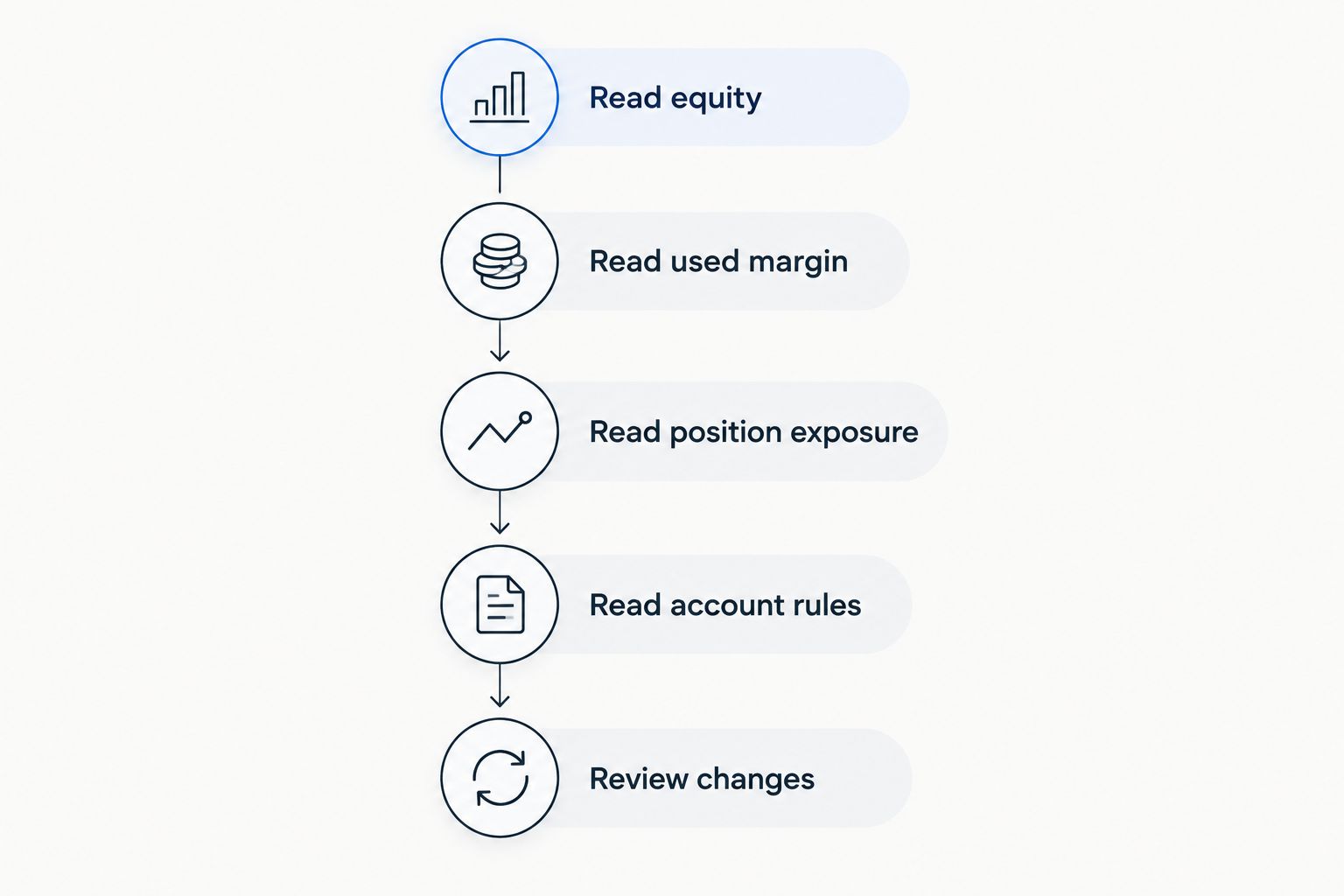
Read the account ratio together with the positions and rules behind it.
Keep an account review separate from a trade recommendation. A margin calculation cannot determine whether a position fits your circumstances. It also cannot establish an appropriate position size or guarantee an exit price.
05
Does a 100% margin level mean my positions will close?
A 100% margin level means equity equals used margin. Whether it triggers a warning, an order restriction or position closure depends on the account terms. The formula does not establish the intervention threshold.
Read the documented closing method as well as the threshold. An account rule can specify which positions are closed and how the process continues. Do not assume that every position closes together or that a warning guarantees time to respond.
Execution remains a separate issue. During a price gap, a market can move past a quoted level without trading at every intermediate price. A displayed threshold therefore does not guarantee a particular closing price or final account result.
06
Is a 200% margin level enough to judge account risk?
A 200% margin level means equity equals twice used margin. It does not establish that an account is safe. Risk also depends on position sensitivity, shared exposure and execution conditions.
Accounts with the same percentage can hold different market exposures. Their margin requirements can also differ. The ratio contains neither the direction of the positions nor the size of a possible adverse price move.
Use the percentage to understand margin coverage. Use the position details to understand what can change that coverage. Neither reading replaces the other.
Conclusion
For your 2026 account review, read margin level beside equity, used margin and open positions. Check the account rules separately. A percentage becomes useful when you understand both the calculation and the exposure behind it.
One final distinction matters: closing a losing position does not automatically restore the loss. The floating loss becomes realised. Any resulting improvement in margin level can come from releasing used margin rather than recovering equity.
A higher margin percentage does not necessarily mean recovered account value.
FAQ
How do I calculate margin level?
Calculate margin level by dividing equity by used margin and multiplying by 100%. Use figures from the same account at the same moment.
What does a 100% margin level mean?
A 100% margin level means equity equals used margin. Your account terms determine whether that level triggers a warning, restriction or position closure.
Is margin level the same as free margin?
Margin level is a percentage. Free margin is generally equity minus used margin and is expressed in the account currency.
Why is my margin level falling when I have not opened another trade?
Margin level can fall because equity decreases or used margin increases. Floating losses, account charges, conversion effects and changed requirements can affect those figures.
Does a stop-loss order guarantee my margin level?
A stop-loss order does not guarantee a margin level. Execution conditions and price gaps can cause the final fill to differ from the stop level.
Does closing a losing trade always improve margin level?
Closing a losing trade does not always improve margin level. The result depends on the equity remaining and the used margin released under the account calculation.
Can I compare margin levels across different accounts?
You can compare the ratios, but matching percentages do not establish matching risk. Requirements, position exposure and close-out rules can differ.
Related guides
- How correlated pairs create hidden exposure
- Stop-loss orders and market gaps
- How currency conversion affects trade results
This article is for educational purposes only and does not constitute investment advice. Trading CFDs and other leveraged products carries a high level of risk and may not be suitable for all investors.


