Trading process · Decision records
Keep a trading journal by recording your reason for a trade before entry. Add a timestamped note whenever you change the plan. After closing the position, record the outcome separately so later knowledge does not replace your original reasoning.
Key takeaways
- VCG Markets trading journal guidance: preserve your original decision before reviewing the outcome.
- Separate your trading plan, live changes and post-trade review. Each answers a different question.
- Record skipped trades and missing information. A complete decision record includes actions you did not take.
- Judge rule adherence separately from profit or loss. A winning trade does not prove a sound process.
01Record the decision
02Preserve the changes
03Review the process
Your account history records transactions. It does not explain why you acted. Use a pre-trade decision checklist to define the questions your journal will answer before an order exists.
01
How do you keep a trading journal that records your decisions?
Build each entry around 3 stages: Before entry, During the trade and After exit. Keep them separate. Your original explanation should remain visible even when your opinion changes.
- Before entry: Write the condition you observed. Record the action you planned and the condition that would invalidate it.
- During the trade: Append changes with their timestamps. Explain what changed in the market or in your interpretation.
- After exit: Reconcile the execution record. Then assess whether your actions followed the written plan.
For your 2026 journal, use the same field names throughout. Consistent labels make entries comparable. A changing vocabulary makes it harder to tell whether the setup changed or only its name.
| Stage | What it captures | Limitation alone |
| Before entry | Original reasoning and intended action | Does not show what you executed |
| During the trade | Changes and their stated reasons | Does not establish the final result |
| After exit | Execution, outcome and rule adherence | Cannot recreate an unwritten intention |
Preserve the sequence, not just the result. A later explanation belongs beside the original note. It should not replace it.
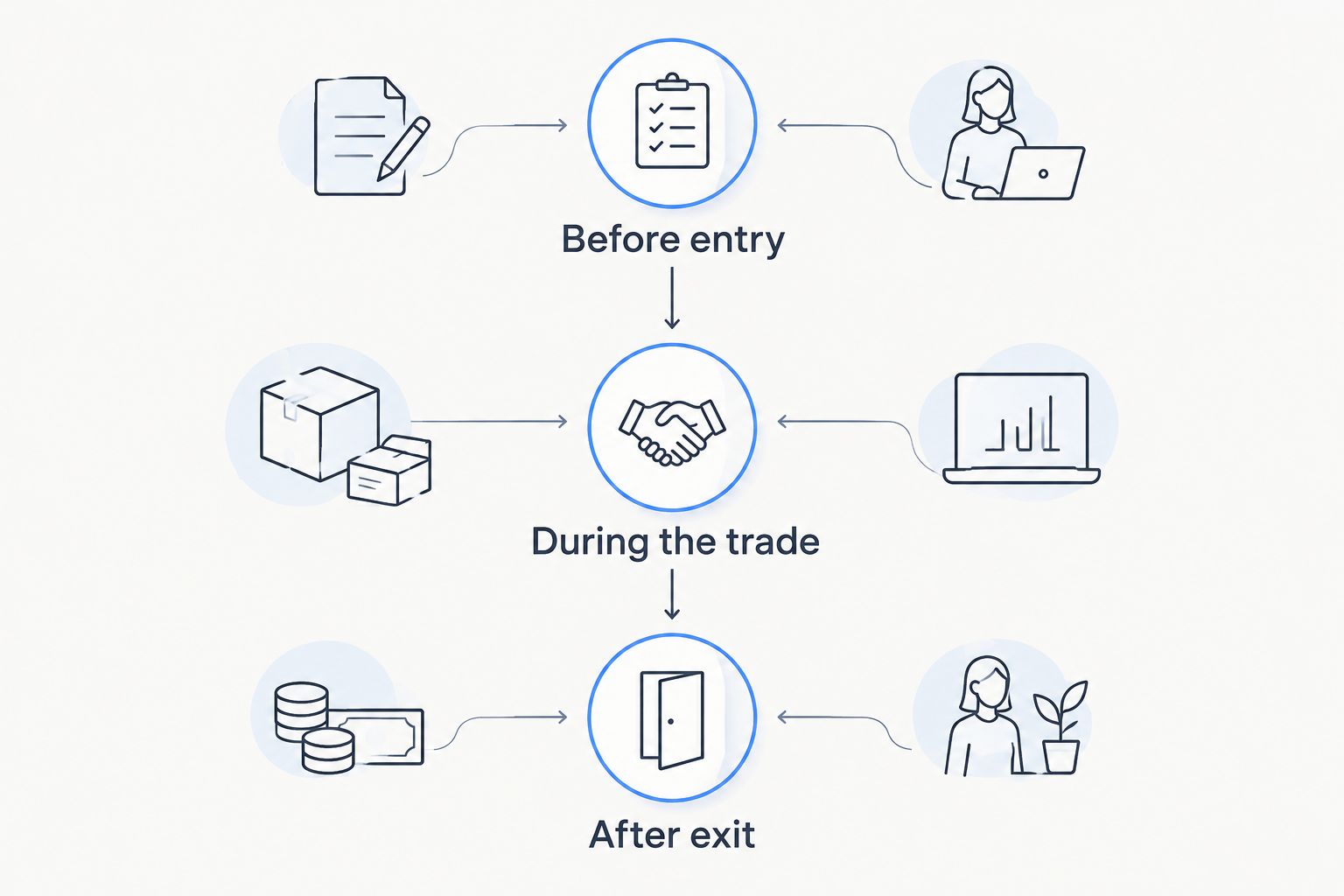
Keep the original decision separate from later changes and the outcome.
02
What should your trading journal template contain?
Use fields that distinguish observation from interpretation. An observed price movement is not the same as your explanation for it. Record both without treating the explanation as an established fact.
Start your 2026 template with these fields. Leave an explicit missing-data note when information is unavailable. An empty cell does not explain whether you forgot the detail or chose not to record it.
- Identity: Instrument, direction, date, time zone and order or position reference.
- Observation: What you could see when you made the decision. Attach a timestamped chart where relevant.
- Reason: Why that observation met your written criteria. Include evidence that challenged your interpretation.
- Plan: Intended entry conditions, position size, planned risk, invalidation and exit conditions.
- Changes: What you altered, when you altered it and the reason recorded at that moment.
- Execution: Actual fills, position changes, closing details and recorded trading charges.
- Review: Which rules you followed, which you changed and what remains uncertain.
Keep 2 separate time fields: decision time and execution time. They describe different events. Use the same time zone throughout or label every exception.
A screenshot supports the record but does not replace your reasoning. Capture what mattered in writing. A chart alone cannot tell a later reader which feature influenced your action.
Avoid filling gaps from memory without marking them. Label a reconstructed note as reconstructed. Preserve its creation time rather than presenting it as a contemporaneous entry.
03
Why does the detail in a trading journal vary?
The right detail follows the decision you need to reconstruct. More text is not automatically more useful. Add a field when it answers a review question that your existing record cannot answer.
- Decision frequency: Frequent decisions call for short structured entries. Longer explanations belong in the later review.
- Position changes: Partial entries and exits need separate event records. A final position summary hides the sequence.
- Holding period: A position held across sessions needs notes on decisions made between entry and exit.
- Shared exposure: Record other open positions when their risks overlap with the trade under review.
- Information source: Identify the chart, announcement or research you used. Preserve the publication time when timing matters.
Keep a template version date when you add fields during 2026. Earlier entries will lack information that later entries contain. Treat that difference as a recording change rather than a change in trading behaviour.
Record your emotional state in descriptive terms. Note urgency, hesitation or distraction without turning the label into a diagnosis. Explain the observable action associated with it.
04
How do you review decisions without rewriting them?
Read the original plan before assessing the result. Compare the written intention with the execution record. Then separate a rule breach from an outcome you disliked.
For a weekly review, use 4 questions: What was planned? What happened? What changed? What evidence supports the explanation? This is a suggested review structure, not a performance benchmark.
- Check completeness: Reconcile journal entries against the account record. Include losing trades and abandoned plans.
- Check adherence: Compare actions with the rules that existed at decision time. Do not apply a later rule retroactively.
- Check interpretation: Separate direct observations from explanations written after the outcome became known.
- Define the next observation: State what you will record more clearly. Do not treat an isolated result as proof of a repeatable pattern.
Give your 2026 review notes their own date. Keep them separate from the trade date. This preserves the difference between what you knew then and what you concluded later.
Should you record trades you did not take?
Record a skipped trade when you considered it against your written criteria. State why you declined. Do not assign a hypothetical profit based on a later chart.
Does a winning trade prove the decision was sound?
A winning trade does not prove the decision was sound. Compare the action with the information and rules available at the time. Keep outcome and adherence as separate review fields.
Frequently asked questions
What should I write in my trading journal before entering a trade?
Write your observation, decision criteria, planned action and invalidation condition before entering. Add the instrument, timestamp and intended risk so the entry can be matched to the execution record.
How often should I update my trading journal?
Update your trading journal before entry, when you change the plan and after exit. Keep later analysis separate from the original notes.
Do I need a spreadsheet to keep a trading journal?
You do not need a spreadsheet. Use a format that preserves timestamps, separates original notes from later changes and lets you retrieve the relevant execution record.
Should I include my emotions in a trading journal?
Include your emotional state when it influenced a decision. Describe the action it accompanied rather than using an emotion label as the entire explanation.
Can a trading journal guarantee better results?
A trading journal cannot guarantee better results. It records decisions for review, but the record itself does not remove market risk or establish that a strategy is effective.
What should I do if I forgot to record a trade?
Add the missing trade and mark any reconstructed explanation clearly. Use the execution record for transaction details without presenting later memories as notes written before entry.
Should I delete an incorrect explanation from my journal?
Preserve the original explanation and append a dated correction. This keeps the decision history visible while making the correction explicit.
Conclusion
Before your next entry in 2026, add a field for evidence that would challenge your interpretation. Leave it visible during the review. A journal should preserve uncertainty as carefully as conviction.
One final check: identify which notes existed before you knew the outcome. If you cannot tell, improve the timestamps before adding more analysis. That distinction is what makes the record useful.
Record what you knew. Preserve what changed. Review the decision separately from the result.
Related guides
This article is for educational purposes only and does not constitute investment advice. Trading CFDs and other leveraged products carries a high level of risk and may not be suitable for all investors.


