Commodities · Oil trading
Yes. You can trade oil without holding a futures contract yourself through broker-issued oil instruments or oil-linked funds. Energy company shares provide indirect exposure. Not holding futures directly does not remove futures-linked pricing, financing charges or market risk.
Key points
- Can you trade oil without a futures contract? Yes. Broker-issued oil instruments and oil-linked funds provide alternatives.
- Oil-linked funds can hold futures even when you do not hold those contracts directly.
- Energy company shares provide indirect oil exposure. Business performance also affects their value.
- VCG Markets offers oil trading through a multi-asset broker. Read the instrument terms before placing an order.
01Choose exposure
02Read contract terms
03Review risk
01
Can you trade oil without a futures contract?
Yes. The distinction is between the instrument you hold and the market it references. Before choosing oil exposure in 2026, read the contract specifications. A familiar oil symbol does not explain ownership or settlement.
A broker-issued oil instrument gives you a contractual position with the broker. A fund gives you ownership of fund shares. An energy company share gives you equity exposure to that business. These are different positions even when oil influences all their returns.
| Route | What you hold | Useful for | Main limitation |
| Broker-issued oil instruments | A contractual oil-price position | Expressing an oil-price view | Financing, margin and broker contract terms |
| Oil-linked funds | Shares in a pooled vehicle | Fund-based commodity exposure | Fund structure, expenses and futures rolling |
| Energy company shares | Equity in an operating business | Business exposure linked to energy | Company and equity-market risk |
Why this matters
Your oil forecast and your instrument choice are separate decisions. You can correctly anticipate an oil move yet receive a different return because of financing, fund construction or company-specific events. Choose the exposure before choosing the trade size.
02
Broker-issued oil instruments: check the reference market
A broker-issued oil instrument lets you take a position without holding an exchange-traded futures contract yourself. You do not receive barrels of oil. Your profit or loss follows the instrument's specified pricing and settlement rules.
That removes direct futures ownership. It does not necessarily remove futures exposure. The broker's instrument can reference a particular futures month or use a pricing method derived from several contracts.
For a 2026 instrument review, establish whether the position expires. Then check overnight financing and any rollover adjustment. An undated label describes the position's expiry structure. It does not mean the underlying reference remains unchanged.
The benefit is access to an oil-price position without managing an exchange futures contract directly. The limitation is contractual complexity. Margin requirements and financing still affect the position. A lower initial margin requirement does not mean lower market exposure.
03
Oil-linked funds: inspect what the fund holds
An oil-linked fund can provide commodity exposure through exchange-traded shares. You hold the fund shares rather than its underlying futures positions. The fund manager handles those positions according to the published investment mandate.
Read that mandate carefully. A fund labelled around oil can hold futures, energy company shares or another specified mix of assets. An energy equity fund is not the same exposure as a crude-oil futures fund.
Futures-based funds must manage expiring contracts. Replacing an expiring contract with a later one affects returns when their prices differ. Fund expenses also reduce performance. A rise in headline oil prices does not guarantee an equal rise in an oil fund.
For fund research in 2026, review the current holdings and prospectus together. The benefit is delegated management of the underlying positions. The trade-off is that your return follows the fund's actual strategy rather than a generic oil chart.
04
Energy company shares: business exposure, not barrels
Buying shares in an oil producer gives you exposure to a business. Oil prices influence revenue. Production costs, debt, hedging and management decisions also influence the share price.
Different energy businesses respond differently. Producers sell oil. Refiners buy crude and sell refined products. Their operating economics are not interchangeable. An oil-price forecast alone does not explain either company's expected earnings.
The benefit of direct share ownership is a claim on the company rather than a commodity contract. The limitation is company-specific risk. Rising oil does not prevent an energy share from falling after disappointing results or an operational disruption.
Also establish whether you are buying the actual share. A broker-issued instrument referencing a share is a separate contract. Its ownership rights and financing arrangements differ from holding equity directly.
05
Why oil exposure varies between instruments
There is no single return that every oil-related position delivers. These factors explain why instruments can diverge even during the same market session.
- Reference market. Different crude benchmarks reflect different delivery markets and supply conditions. Confirm which benchmark your position tracks.
- Contract month. Nearer and later futures contracts have separate prices. A chart using one month is not a direct substitute for another.
- Holding period. Financing and fund expenses accumulate over time. Rollover events also depend on when you hold the position.
- Position structure. Margin changes how much exposure you control relative to deposited funds. It does not limit the underlying price movement.
- Currency exposure. Your account currency and the instrument's quotation currency affect the converted result.
- Business performance. Energy shares reflect company earnings and equity-market conditions as well as oil.
In a 2026 trade review, compare your result with the correct reference market. Comparing a fund or an energy share with an unrelated oil chart can turn a structural difference into an apparent execution problem.
For futures-linked positions, understand contango and backwardation. Those terms describe the relationship between contract months. They do not provide a standalone forecast of the next oil move.
06
What should you check before placing an oil trade?
Use the instrument documents before using the order ticket. A chart explains market movement. It does not explain the legal position you are opening or the rules that govern it.
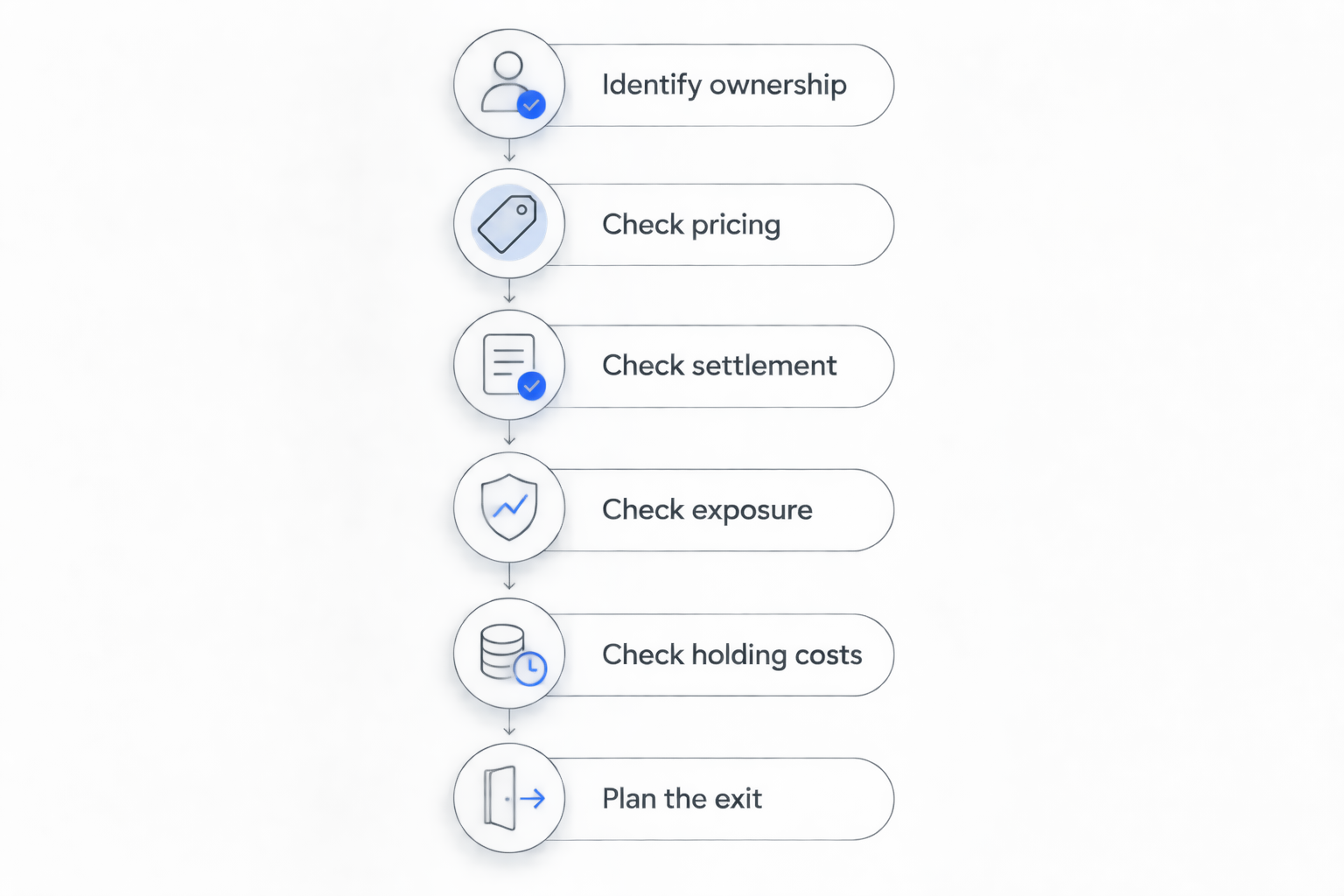
- Identify ownership. Establish whether you hold a broker contract, fund shares or company shares. Record the legal issuer or counterparty.
- Check pricing. Find the benchmark and any reference contract month. Confirm the quotation currency and trading schedule.
- Check settlement. Read the expiry, cash-settlement and rollover rules. Do not infer them from the symbol's name.
- Check exposure. Read the contract size and minimum trade increment. Calculate the underlying exposure separately from the required margin.
- Check holding costs. Identify financing, fund expenses and conversion charges that apply to the chosen route.
- Plan the exit. Specify the condition that invalidates the trade. Allow for gaps and execution differences rather than assuming a stop guarantees its requested level.
Save the specification used for your decision. During a later review, that record separates a change in contract terms from a change in your own trading process.
Identify the instrument before deciding how much exposure to take.
Keep the completed checks with your trade journal. Use the same instrument name in the journal and on the order ticket. Similar labels do not establish identical exposure.
07
Does avoiding futures remove oil-market risk?
No. Avoiding direct futures ownership changes the instrument you hold. It does not remove losses from an adverse oil move. A fund, share or broker-issued instrument also introduces its own structural risks.
Can an undated oil instrument still have rollover adjustments?
Yes. An undated oil position can use futures-derived pricing that requires adjustments when the reference changes. Read the stated methodology rather than treating the absence of an expiry date as the absence of rollover effects.
Can an oil fund fall while oil rises?
Yes. The fund's benchmark, contract selection, rolling process and expenses affect its return. An energy equity fund also responds to company performance. Compare the fund with its published objective before judging whether it tracked as intended.
FAQ
Can I trade oil without buying a futures contract?
Yes. Broker-issued oil instruments and oil-linked funds provide routes without direct futures ownership. Energy shares provide indirect business exposure rather than a pure oil-price position.
Do I own physical oil when I open an oil trade?
A broker-issued cash-settled oil instrument does not give you physical oil. Read the settlement terms to confirm exactly what you hold.
Does an oil fund hold futures for me?
A futures-based oil fund holds futures within its portfolio. You own fund shares rather than those contracts directly. Check the prospectus because oil-related funds use different strategies.
Are energy shares the same as trading crude oil?
No. Energy shares represent businesses whose results depend on more than crude oil prices. Costs, debt, hedging and operational events also affect their value.
Can I keep an oil position open without an expiry date?
Some broker-issued oil instruments are undated. Overnight financing and reference-contract adjustments can still apply. The current specification determines the holding rules.
Is the margin requirement the amount of oil exposure I have?
No. Margin is the collateral required for the position. The underlying exposure depends on the contract size, trade size and market price.
Does trading oil without futures eliminate delivery risk?
A cash-settled instrument does not require physical oil delivery under its stated settlement terms. Do not assume that every oil-related instrument has those terms.
Conclusion
You can trade oil without holding a futures contract yourself. The next decision is which exposure you actually want. Broker-issued instruments, oil-linked funds and energy shares answer different needs. None removes the need to understand the position.
One final check: use the instrument's full name in your trade record. Add its benchmark and settlement method. That small discipline makes the later review about the position you traded rather than the oil chart you remember.
Know what you hold. Then measure the exposure.
This article is for educational purposes only and does not constitute investment advice. Trading CFDs and other leveraged products carries a high level of risk and may not be suitable for all investors.