Trading Psychology
Recognise possible decision fatigue during a trading session by comparing your current decisions with your written process. Skipped checks, repeated reconsideration and unexplained rule changes are prompts to pause and review. A losing trade alone does not establish decision fatigue.
Key points
- Decision fatigue trading reviews should examine skipped checks and changing rules, not profit alone.
- VCG Markets trading education supports process review, not a diagnosis of your mental state.
- Compare decisions with your written plan before treating a session pattern as evidence of fatigue.
- Separate the decision to stop new entries from the responsibility to review open positions.
01Recognise process changes
02Review the session
03Record the evidence
Use a pre-trade decision checklist as your reference. Without a written baseline, it is harder to distinguish a deliberate adjustment from a decision made without the usual checks.
01
How do you recognise decision fatigue during a trading session?
Look for changes in how you make decisions. Focus on observable actions rather than trying to assign a mental-state label while prices move. Write down what changed and compare it with the plan you had before the session.
- Skipped checks. You submit an order without completing a check your process requires.
- Repeated reconsideration. You revisit the same decision without identifying new information.
- Unexplained changes. You alter an entry condition or risk instruction without recording a reason.
- Unclear explanations. You cannot describe why the proposed trade meets your own criteria.
These are review prompts. They do not identify a cause by themselves. A missing check might reflect an unclear procedure. A changed decision might reflect a genuine market update. Record that distinction before describing the session as fatigue-driven.
The useful question is whether your decision process changed without a reason you can explain. Feeling frustrated is relevant context. It is not a substitute for examining the order, the information available and the rule you intended to follow.
02
Why the distinction matters
A financial result and a decision record answer different questions. The result tells you what happened to the position. The record shows what you knew and whether you followed your process.
A profitable trade does not prove that skipped checks were harmless. A losing trade does not prove that your reasoning deteriorated. Review both the outcome and the process without allowing either to replace the other.
| Observation | Useful review | Limit |
| Losing trade | Compare the decision with the plan | Loss alone does not identify fatigue |
| Changed entry | Identify the new information | A change can be deliberate |
| Missing check | Record which step was omitted | The omission does not explain its cause |
Keep the original plan visible during the review. Rewriting it after seeing the result removes the reference you need. Add a dated explanation instead. That preserves the difference between what you intended and what you later learned.
03
Why the interpretation varies
The same action can have different explanations. Your review needs enough context to distinguish a process deviation from an intentional response. Check these factors before drawing a conclusion.
- Plan clarity. Identify whether the original rule was specific enough to follow and assess.
- New information. Record what changed between the original decision and its revision.
- Existing exposure. Separate decisions about open positions from decisions about new entries.
- Available records. Identify which actions have supporting notes and which rely on memory.
- Order status. Distinguish an intended action from an order submitted, amended or executed.
Do not fill a missing explanation with a confident label. If you cannot establish why you changed an instruction, record the reason as unknown. That is more accurate than treating uncertainty as proof of fatigue.
Also separate market complexity from personal performance. A session with conflicting information deserves a clear record of that conflict. The review should show which information informed the decision and which required checks remained incomplete.
04
Use a structured session review
If you notice an unexplained process change, separate reviewing the session from finding another trade. Use the following sequence as an educational framework. It is not an instruction to enter, exit or modify a particular position.
- Pause entries. Stop searching for another entry while you establish which decision checks were missed.
- Review positions. Check open positions and pending orders against your documented risk instructions.
- Record changes. Write down the action, the original rule and the information available when the action occurred.
- Compare baseline. Assess the record against your pre-session plan rather than against the latest profit or loss.
Stopping new entries does not cancel pending orders or remove existing exposure. Review those separately. Do not assume that stepping away from the screen makes an open position inactive.
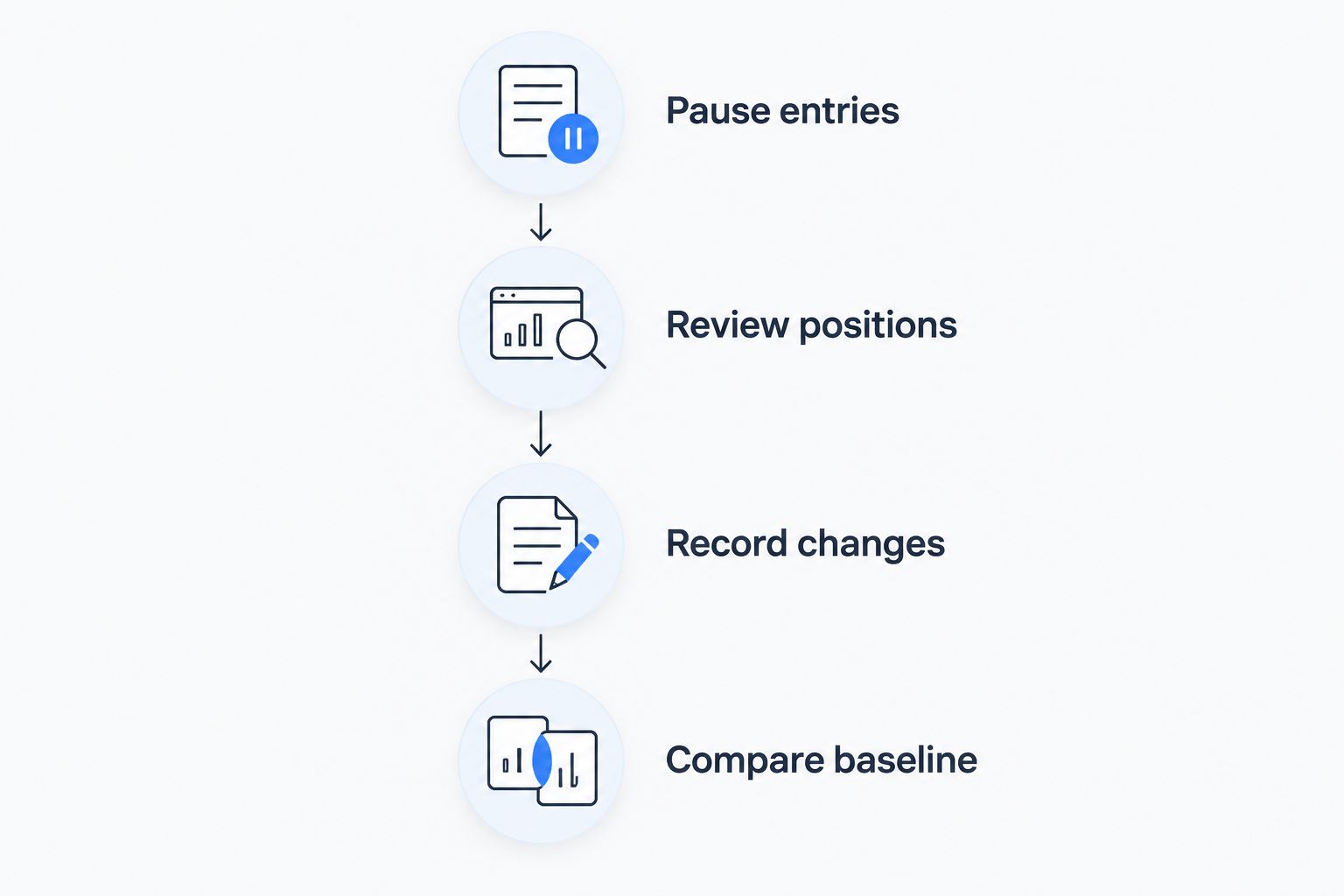
Separate new entry decisions from the review of existing positions and pending orders.
A written review makes the next decision explicit. Either your process conditions are satisfied or an unresolved issue remains. Do not invent a universal break length or trade limit and treat it as a diagnosis. Define session rules before they are needed. Review their usefulness outside the pressure of an active decision.
05
Record actions rather than labels
A useful session note describes something you can inspect. Record that you changed an order before completing your checklist. Do not replace that observation with a broad statement that you traded badly.
Use 3 fields: intended rule, observed action and explanation. Keep the financial result separate. This preserves the distinction between a decision made according to plan and a decision that happened to produce a favourable result.
- Intended rule: the condition or check written before the decision.
- Observed action: what you actually submitted, changed or omitted.
- Explanation: the information supporting the action, or a clear statement that the reason is unknown.
A structured journal gives you a consistent record to revisit. Its limitation is completeness. Notes written after the outcome still depend on what you remember. Preserve available order records and distinguish recorded facts from later interpretation.
Review the same fields across sessions. Look for repeated omissions rather than selecting only memorable losses. If the written rule itself was ambiguous, revise the rule separately. Do not count an unclear instruction as evidence of a personal failing.
06
Questions to resolve before continuing
Does a losing streak mean I have decision fatigue?
A losing streak does not establish decision fatigue. Compare the underlying decisions with your written criteria. Losses and process deviations belong in separate parts of the review. Neither tells the whole story alone.
Does a break mean I am ready to trade again?
A break alone does not establish readiness. Review the unresolved issue that prompted it. If you still cannot explain the proposed decision or complete your checks, elapsed time has not answered the original question.
Should I change my trading rules during the session?
Separate a documented response to new information from an unexplained rule change. Follow the review conditions in your existing plan. Keep broader process revisions for a separate review where you can examine the evidence without needing to justify an immediate entry.
Frequently asked questions
What does decision fatigue look like during trading?
Possible warning signs include skipped checks, repeated reconsideration and unexplained changes to written rules. These actions warrant review but do not establish fatigue as their cause.
Can I recognise decision fatigue from my trading results?
Trading results alone do not establish decision fatigue. Compare the decisions behind those results with your written process and the information available at the time.
How many trades are too many in a session?
A trade count alone does not establish decision fatigue. Review whether each decision met your documented criteria rather than treating a count as a diagnosis.
How long should I take a break from trading?
Elapsed time alone does not establish readiness to resume. Review the issue that prompted the break and whether you can complete your decision checks.
Does stopping new trades remove my existing risk?
Stopping new entries does not remove existing exposure or cancel pending orders. Review open positions and pending instructions separately against your documented plan.
Can a VCG Markets performance score diagnose decision fatigue?
A VCG Markets performance score is not a diagnosis of decision fatigue. Review the underlying actions and session context rather than treating a score as proof of a mental state.
Conclusion
Start with the decision you cannot explain. Record the original rule, the action taken and the information available. Then examine whether the issue was a missed check, an unclear instruction or a documented response to something new.
One final distinction matters: doing nothing is also a decision you can document. Record why an entry did not meet your criteria. A session record that contains only executed trades leaves out the decisions to wait. Include those decisions when reviewing whether you followed your process.
Review the change in your process before assigning a label to it.
Related guides
This article is for educational purposes only and does not constitute investment advice. Trading CFDs and other leveraged products carries a high level of risk and may not be suitable for all investors.


