Trading Process · 2026
Separate trading execution mistakes from strategy results by comparing each trade with the rules recorded before entry. Classify rule adherence independently from profit or loss. Record fills and trading costs separately so market conditions do not automatically become trader errors.
Key takeaways
- Trading execution mistakes are departures from recorded rules, not simply losing trades.
- Separate rule adherence, execution conditions and financial results in your trading journal.
- VCG Markets supports reviewing trading behaviour separately from profit or loss.
- A hypothetical rule-following result is an estimate, not an executed trade.
A profitable trade does not prove that your process worked. A losing trade does not prove that your strategy failed. Start with a written pre-trade decision checklist. Without a record of the intended decision, hindsight can replace the original plan.
01Record the plan
02Classify the execution
03Review comparable results
01
How do you separate execution errors from strategy results?
Use separate labels for behaviour and outcome. First establish whether the trade followed its recorded rules. Then record its financial result after applicable costs. Neither label should determine the other.
| Recorded behaviour | Outcome | Review meaning |
| Rules followed | Profit | An observed strategy result. Not proof of lasting effectiveness. |
| Rules followed | Loss | A strategy loss. Not automatically an execution mistake. |
| Rules broken | Profit | A profitable deviation. The process issue remains. |
| Rules broken | Loss | A loss with a deviation. The deviation's financial effect still needs evidence. |
A rule breach identifies a process problem. It does not establish what the trade would otherwise have earned. Keep that distinction when deciding whether the evidence calls for clearer execution or a strategy review.
02
Why this matters
Mixing execution and strategy makes the diagnosis unclear. If you changed the entry condition during a trade, the result does not directly test the original entry rule. If you followed the rule and lost, there is no execution breach to correct on that evidence alone.
The opposite mistake matters too. Excluding every uncomfortable loss as poor execution creates a flattering strategy record. Define the classification before reviewing the outcome. Apply the same test to profitable and losing trades.
A separate process record makes both questions visible: did you follow the method, and what happened when you did? Neither question disappears when the account result looks encouraging.
03
Build a review record before interpreting results
Your review needs a decision trail. A closing balance cannot show whether the original setup existed or why you changed an order. Keep the intended action beside the action actually taken.
- Record the plan. Save the strategy version, setup conditions, entry rule, position-sizing rule and exit conditions before entry.
- Record the action. Preserve order submissions, amendments, cancellations, fills and closing transactions.
- Record the conditions. Note available evidence about spreads, liquidity, price gaps and relevant contract terms.
- Classify adherence. Mark each rule as followed, broken or unknown. State the evidence behind the label.
- Record the result. Keep the realised outcome and applicable costs separate from the adherence label.
Use specific descriptions. Entered before the recorded trigger is observable. Poor discipline is an interpretation. The observable description gives your next review something concrete to check.
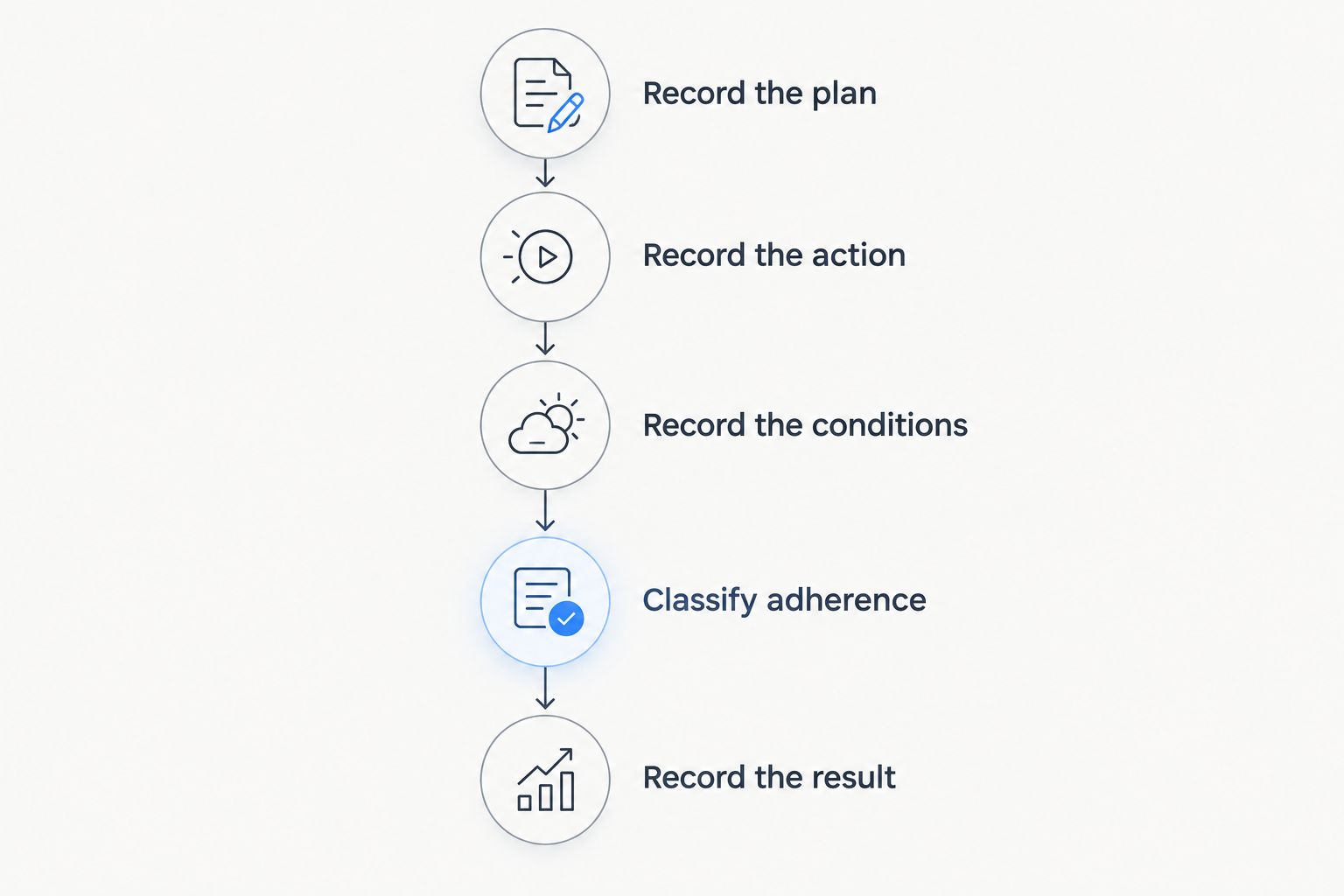
Classify the action against the plan before using the financial result to judge the strategy.
Keep unknowns visible. A missing entry note does not prove that you followed the rules. It also does not prove that you broke them. Mark the evidence gap rather than reconstructing certainty from a chart.
04
Separate trader mistakes from execution conditions
Submitting the wrong order size is different from receiving a different fill price during a fast market. The first concerns your instruction. The second requires a review of the order type, available prices and execution record.
Slippage describes a difference between an expected price and the executed price. It is not automatically evidence of a trader mistake. A stop order also does not guarantee execution at its trigger price.
Separate the decision from its implementation. Choosing an order type that contradicts your recorded plan is a process deviation. A correctly submitted order meeting its documented execution conditions belongs in a different category.
Costs belong in the review even when execution followed the plan. Record applicable spreads, commissions, financing and conversion effects. Do not double-count a spread already reflected in transaction prices. Use the account statement and contract terms to establish how each item is recorded.
05
Why execution-error classifications vary
The same action can have a different classification under a different written method. An early exit breaches a fixed-exit rule. It does not breach a method that explicitly permits that exit condition. The recorded rule decides.
- Rule clarity. Vague instructions leave more room for retrospective interpretation.
- Permitted discretion. A discretionary decision is not automatically an error. Its limits still need documentation.
- Order mechanics. Market, limit and stop instructions have different execution conditions.
- Market conditions. Liquidity and price gaps affect the context of a fill.
- Record completeness. Missing timestamps or amendment records limit what you can establish.
- Strategy version. Changed rules require a separate label so different methods are not treated as identical.
Keep classification definitions stable within the review. If you improve a definition, preserve the earlier version and identify which records changed. Otherwise a change in labelling can look like a change in behaviour.
06
Review the strategy without hiding the account result
Maintain the complete actual-trade record. Then identify the subset that followed the recorded strategy. Keep deviating and unclassified trades visible alongside it. This separates the analytical question without rewriting what happened to the account.
Compare like with like. Use consistent strategy versions and distinguish relevant instruments or trading conditions. A combined result can conceal that the underlying decisions were different.
A rule-following subset has a limitation: it excludes decisions affected by deviations. It is not automatically a complete test of every opportunity the strategy would have generated. Record missed qualifying setups separately rather than inventing executed trades.
Likewise, do not subtract every loss involving a rule breach and call the remainder the strategy result. The breach might have increased or reduced the eventual loss. Its direction and size require evidence.
Use trading rule adherence as a separate process measure. Improvement in adherence means closer agreement with the written rules. It does not, by itself, establish that those rules are profitable.
07
Can you calculate what the trade should have made?
A reconstructed rule-following result is hypothetical. It depends on assumptions about entries, fills, exits and costs. A chart touching a price does not establish that your order would have filled there.
Keep reconstructed results in a separate field. State the assumptions and missing evidence. Use the reconstruction to examine a decision, not to replace the realised account result with a more appealing version.
When should you review the strategy itself?
Review the strategy when the question concerns its rules or their results under documented conditions. Repeated losses despite adherence deserve examination. They do not establish the cause without attention to costs, market context and the available sample.
What should you do when the evidence is incomplete?
Classify the uncertain element as unknown. Preserve what the record establishes and specify what is missing. Improving the next record is more useful than assigning a confident label to an undocumented decision.
FAQ
What counts as a trading execution mistake?
A trading execution mistake is an action that departs from the recorded trading instructions. Examples include an incorrect order size or an entry before the specified trigger. A losing result alone does not establish a mistake.
Can a profitable trade still contain an execution error?
A profitable trade can contain an execution error when its actions broke the recorded rules. Keep the profit in the actual result and record the deviation separately.
Is slippage always a trader mistake?
Slippage is not automatically a trader mistake. Review the submitted instruction, order type and execution conditions before assigning responsibility.
Should I remove rule-breaking trades from my results?
Keep rule-breaking trades in the complete actual-trade record. Use a separately labelled rule-following subset for analysis without presenting it as the complete account result.
How many trades do I need to judge a strategy?
There is no universal trade count that establishes strategy effectiveness. The available evidence depends on variation in outcomes, market conditions, costs and whether the recorded rules stayed consistent.
Can I use a chart to calculate the result I would have achieved?
A chart-based reconstruction is hypothetical, not an executed result. Record assumptions about fills and costs separately, and do not replace the actual account result.
What should my trading journal record first?
Your trading journal should record the intended rules before the trade. Add actual actions, execution conditions, adherence classifications and financial results as separate fields.
Conclusion
Before your next review, classify rule adherence without consulting the profit column. Then examine the financial result. This order makes the distinction explicit without erasing the outcome.
One last check: include profitable rule breaches in the process review. If only losing trades receive scrutiny, the journal is applying different standards to the same behaviour.
Judge execution against the plan. Judge strategy results against the evidence.
Related guides
This article is for educational purposes only and does not constitute investment advice. Trading CFDs and other leveraged products carries a high level of risk and may not be suitable for all investors.


