Forex Education · Starting Capital
There is no universal amount you need to start trading forex. Your starting capital must satisfy the account’s funding requirements and support the margin required for your intended position. A minimum deposit does not account for trading costs, potential losses or the cash buffer needed to keep a position open.
Key points
- How much money do you need to start trading forex? Separate minimum funding from position margin and potential losses.
- VCG Markets provides forex access. Check current account terms before deciding how much capital to commit.
- A smaller margin requirement does not make the same forex position less risky.
- Use only money you can afford to lose. Keep essential spending and emergency savings separate.
01Funding requirements
02Position risk
03Trading readiness
01
How much money do you need to start trading forex?
Your funding decision starts with the account terms and the trade you intend to place. Read the contract specifications before choosing a deposit. They establish the trading unit and minimum order size.
Why does this matter? An account can meet a deposit requirement without supporting your intended position at an affordable level of risk. These amounts answer different questions.
| Amount | What it covers | What it does not establish |
| Minimum deposit | The account’s minimum funding requirement | An affordable position size |
| Required margin | Funds required to support a position | The maximum possible loss |
| Planned loss | Estimated loss at your intended exit | A guaranteed execution result |
02
Work backwards from the position
Do not start by asking how large a position your deposit permits. Start by understanding the position’s potential loss. Then check whether the account can support it without committing money needed elsewhere.
- Contract terms. Confirm the minimum order size, size increments and margin rules.
- Position size. Calculate the value of a price movement at the intended trade size. Check how pip value changes across currency pairs.
- Planned loss. Multiply the intended stop distance by the pip value for that position. Include applicable costs without counting the spread twice.
- Margin buffer. Check what remains available after opening the position. Allow for adverse price movements and applicable charges.
These checks work together. Meeting the margin requirement does not override a planned loss that exceeds your personal limit.
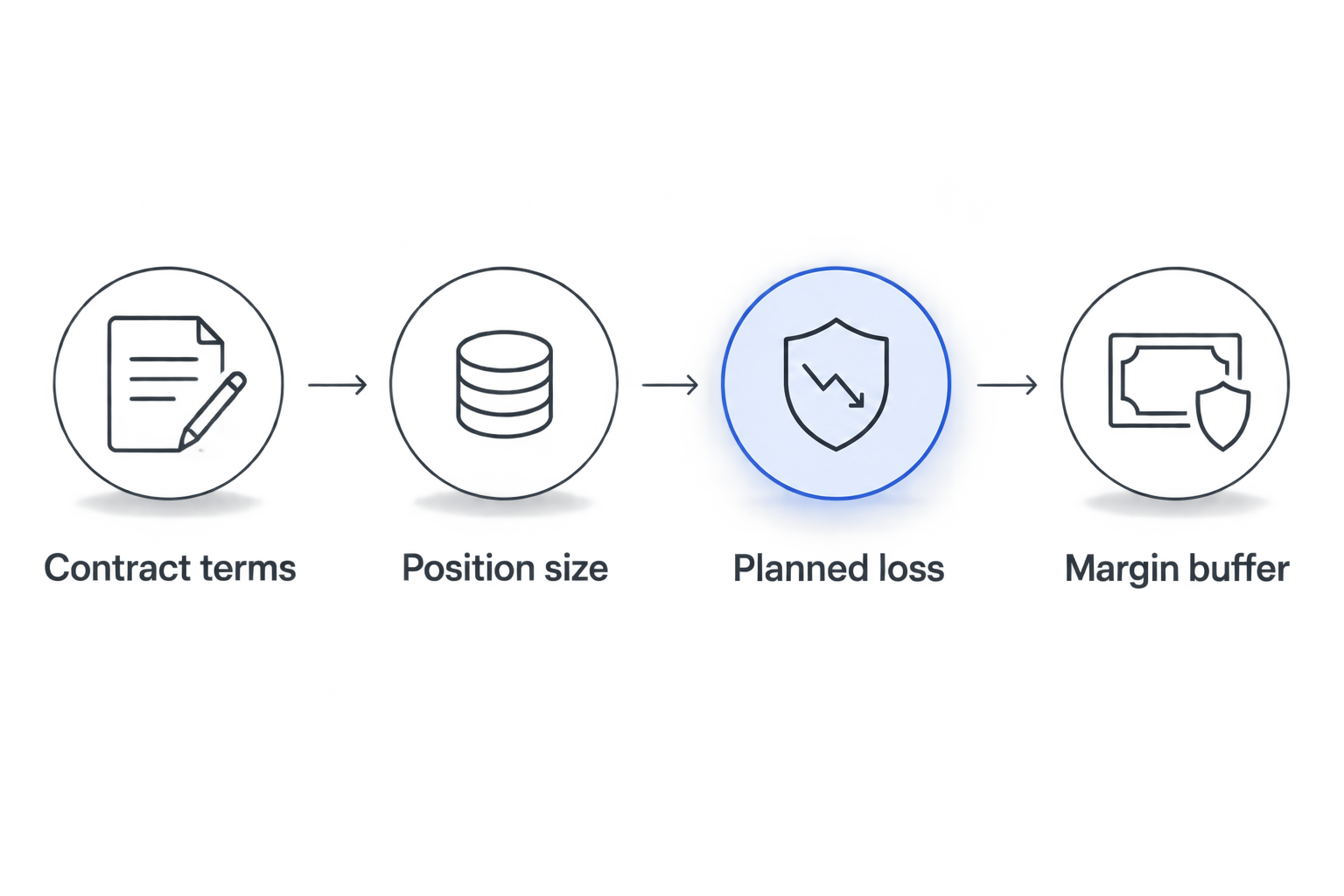
Check potential loss as well as the funds required to open the position.
If the minimum permitted position creates more risk than you can accept, do not force the trade. Adding funds is not automatically the appropriate response. The account or intended position might not fit your financial circumstances.
03
Why the amount varies
Starting capital depends on contract requirements and personal financial limits. A deposit figure on its own cannot describe either.
- Minimum position size. This sets the smallest exposure you can open under the contract.
- Currency pair. Pip value and conversion into your account currency affect the cash result.
- Margin rules. These determine the funds required to support the exposure.
- Exit distance. A wider planned stop increases the estimated loss at an unchanged position size.
- Trading costs. Spreads, applicable commissions and overnight financing affect the account.
- Financial capacity. Money needed for living expenses, debt payments or emergencies is not disposable trading capital.
Assess these factors together. A smaller deposit is not inherently more disciplined. A larger deposit does not make an unsuitable position appropriate.
04
Is the minimum deposit enough to trade?
The minimum deposit satisfies a funding condition. It does not establish that a particular trade fits your loss limit or leaves sufficient free margin.
Check the smallest permitted position first. Calculate the planned loss and required margin separately. Then examine the remaining account capacity after costs and an adverse movement.
Avoid moving a stop closer solely to make an oversized position appear affordable. That changes the trade’s exit conditions. It does not reduce the position’s sensitivity to each price movement.
05
Does a lower margin requirement mean less risk?
A lower margin requirement does not reduce the loss on an unchanged forex position. It reduces the funds required to support that exposure. The position still responds to the same market movement.
Margin is not a loss allowance. Floating losses reduce equity and available margin. Under the account’s rules, a margin shortfall can lead to positions being closed.
A stop order also does not guarantee the planned exit price. Gaps and execution conditions can produce a different result. Check the contract’s account protections rather than assuming the deposit or posted margin caps every possible loss.
06
Account for costs and combined exposure
The spread is the difference between buying and selling quotes. Depending on the account, commissions and overnight financing can also apply. Check the charging method and relevant holding period before estimating the trade’s effect on your balance.
Keep required margin separate from expenses. Margin supports the position. Trading charges affect the account result. Adding those categories without understanding their purpose can distort your funding calculation.
Review open positions together. Different currency pairs can share exposure to the same currency. Separate order tickets do not make those risks independent.
Your review should include the planned losses across positions and their shared market drivers. Also check whether simultaneous adverse moves would leave sufficient margin. Assessing each trade in isolation misses that account-level pressure.
07
Check your readiness before funding
Before depositing, write down what the money is for. Trading capital should not double as an emergency fund or a payment reserve. Do not fund an account around an assumed future profit.
- Identify the money you can afford to lose without disrupting essential commitments.
- Read the current account terms and contract specifications.
- Calculate the smallest intended position’s margin and planned loss.
- Check applicable charges and the rules for forced position closure.
- Set a review point for stopping and reassessing after losses.
Keep those decisions in writing. A loss does not create an obligation to deposit again. Replenishing an account without reviewing the original assumptions increases the total money committed.
Frequently asked questions
Is there a standard starting amount for forex trading?
There is no universal starting amount for forex trading. Account funding requirements, minimum position size, margin and your capacity to absorb losses determine whether an intended trade fits your circumstances.
Is a minimum deposit the same as required margin?
A minimum deposit and required margin serve different purposes. The deposit meets an account funding condition. Margin supports a particular position under the contract rules.
Can I lose more than the margin required to open a forex trade?
A forex position can lose more than its required opening margin. Whether losses can exceed the account balance depends on the contract and applicable protections. Check those terms before funding.
Does a stop-loss order guarantee my maximum loss?
An ordinary stop-loss order does not guarantee the execution price. Market gaps and execution conditions can make the actual loss different from the planned loss.
Should I add money after losing trades?
A losing trade does not create a reason to deposit more money. Review the loss, remaining exposure and financial capacity before making a separate funding decision.
Where should I check VCG Markets funding requirements?
Check the current VCG Markets account terms for funding requirements. Read the relevant instrument specifications separately for minimum trade size and margin rules.
Conclusion
Start with the contract and the potential loss, not a headline deposit figure. Confirm that the smallest intended position fits your financial limits. Then check margin, costs and the effect of other open positions.
One final check: look at the smallest permitted order before transferring funds. If that order already exceeds your acceptable risk, the funding minimum is not the deciding number.
The amount needed to open an account is not the amount you can afford to risk.
Related guides
- How to read margin level
- Why free margin changes
- How correlated currency pairs create hidden exposure
This article is for educational purposes only and does not constitute investment advice. Trading CFDs and other leveraged products carries a high level of risk and may not be suitable for all investors.