Indices Trading · 2026 Guide
There is no universal amount of money you need to trade indices. Your account must meet the deposit and margin requirements for the chosen position. You also need to assess its potential loss and leave room for costs and adverse price moves. The amount required to open a trade is not the amount you can lose.
Key points
- How much money do you need to trade indices? Contract size, margin and potential loss determine the funding requirement.
- Opening margin is not a maximum loss. Check point value and stop distance separately.
- VCG Markets offers indices trading. Check the selected instrument’s contract specifications before calculating account funding.
- A deposit minimum does not establish whether an index position fits your loss limit.
01Contract requirements
02Position risk
03Available funds
01
How much money do you need to trade indices?
Start with the smallest permitted position. Use its contract specifications to identify the point value and required margin. Then assess the planned loss against your account equity. A deposit threshold alone cannot answer the funding question.
For a 2026 funding check, separate these amounts rather than treating them as interchangeable. Each answers a different question.
| Amount | What it establishes | What it excludes |
| Minimum deposit | The account funding threshold | Whether a position fits your loss limit |
| Opening margin | Funds required to support the position | The position’s maximum possible loss |
| Planned loss | Estimated loss at the intended exit | Additional loss from an adverse execution price |
| Free margin | Equity remaining after used margin | Protection against further losses |
Meeting the opening requirement does not establish affordability. Your account must support the exposure after the order opens. Unrealised losses reduce equity even before you close a position.
02
Check the smallest permitted position
An index level is not the cash value of your position. The contract defines how a movement in that level affects profit or loss. The same index name does not establish the same exposure across different contracts.
Check the exact symbol you intend to trade. A minimum volume tells you the smallest permitted order. The volume step tells you how much you can increase or decrease it. Neither tells you the monetary risk without the contract’s point or tick value.
- Minimum volume: identify the smallest order the contract permits.
- Volume step: check the increments available above that minimum.
- Point value: establish the monetary effect of an index-point move at your chosen volume.
- Margin method: check how the platform calculates the opening requirement.
- Account currency: establish whether profit and loss require conversion.
If the specification gives a tick value, check the tick size too. A tick and an index point are not necessarily equivalent. Mixing them produces the wrong loss estimate.
A smaller permitted position gives you more sizing flexibility. It does not remove market risk. If the minimum position already exceeds your stated loss limit at the intended exit, the account and trade do not fit together.
03
Calculate planned loss separately from margin
Margin supports an open position. It is not a spending limit or a maximum loss. Greater leverage reduces the required margin for the same exposure. It does not reduce that exposure’s profit or loss per index point.
Planned price-movement loss = stop distance in index points × monetary value per point at the chosen position size.
Use consistent units throughout. Convert the result into your account currency where required. Then include applicable charges without counting the spread twice if your entry and exit assumptions already include it.
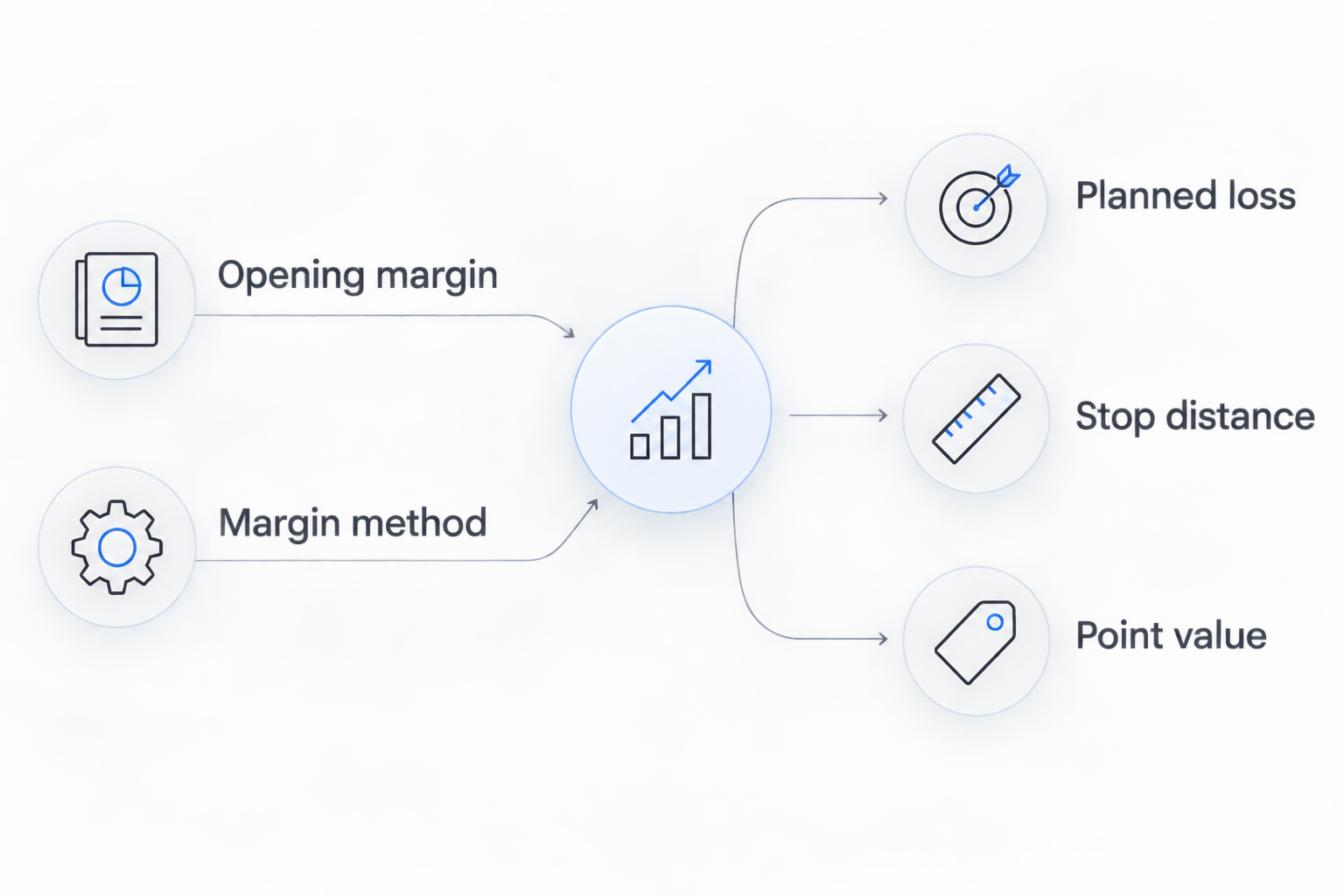
Opening margin and planned loss answer different funding questions.
A stop order does not make the estimate a guaranteed outcome. A market gap or insufficient liquidity can produce execution beyond the stop level. The guide to stop-loss orders during market gaps explains that distinction.
Position sizing works in both directions. A wider stop increases the planned monetary loss at an unchanged point value. Reducing volume reduces that value, subject to the contract’s minimum and volume step.
Do not move an exit closer solely to make the margin calculation look affordable. A change in exit location changes the trade plan. It does not change the underlying contract.
04
Allow for costs and execution
The opening margin shown on an order ticket is not a complete cost estimate. Review the selected contract’s charges and adjustment rules. Apply only the items relevant to that instrument and your intended holding period.
- Spread: the difference between buying and selling quotes affects the result of entering and exiting.
- Commission: include any applicable transaction charge in the loss estimate.
- Overnight financing: check whether holding the position across the specified cutoff creates a charge or credit.
- Currency conversion: check how results and charges translate into your account currency.
- Contract adjustments: review dividend or rollover treatment where applicable.
Do not assume an adjustment is an extra trading gain. Its purpose depends on the contract. For example, a dividend adjustment accounts for the dividend-related treatment of an eligible index position.
Execution also matters. A planned entry is an assumption until the order fills. A different fill changes the distance to your exit and therefore changes the monetary risk.
Use current contract terms when reviewing costs in 2026. A calculation copied from an earlier trade is not a substitute for checking the selected symbol. Holding time and execution conditions belong in the calculation, not in a separate afterthought.
05
Why the starting amount varies
There is no single account balance that fits every index trade. Funding depends on the position you intend to hold and the loss your finances can absorb. These factors explain the difference.
- Contract size: a larger monetary value per point increases exposure at the same stop distance.
- Margin requirements: the selected instrument and applicable account terms determine the funds committed to support the trade.
- Stop distance: a wider distance increases planned loss unless position size falls.
- Holding period: longer exposure changes the financing and market-closure considerations.
- Existing positions: open trades already use margin and contribute unrealised profit or loss.
- Available loss capacity: trading funds must be assessed separately from money needed for living costs and other commitments.
More account equity reduces a fixed monetary loss as a proportion of that equity. It does not make the position more likely to succeed. Increasing both the account balance and position size can leave the relative risk unchanged.
Different index names also do not guarantee independent exposure. Positions can respond to shared economic news or overlapping constituent companies. Assess the combined effect rather than treating each available margin figure as a separate allowance.
06
Check whether the account can support the trade
Use account equity rather than balance alone. Balance excludes the unrealised result of open positions. Equity reflects it, making equity the relevant starting point for assessing current account resources.
- Choose the exact contract. Record its minimum volume, point value and margin method.
- Define the intended exit. Measure the distance from the expected entry in consistent units.
- Calculate the planned monetary loss. Include relevant costs and currency conversion.
- Check the opening requirement. Compare the platform’s margin estimate with current free margin.
- Assess the account after an adverse move. Include other open positions and the applicable margin-closeout rules.
- Compare the result with your stated loss limit. If the minimum size exceeds it, the proposed trade does not fit that limit.
Keep opening margin and planned loss visible as separate figures. Do not describe their sum as a universal minimum deposit. Margin calculations can change with contract terms, prices and account conditions.
For a 2026 pre-trade record, save the assumptions alongside the calculation. Record the symbol, volume, intended entry, intended exit and account equity. That creates a traceable basis for reviewing the eventual result.
A cash buffer is not permission to increase exposure. Its role is to leave funds uncommitted. It does not guarantee that a position avoids forced closure or that losses remain within the planned amount.
Frequently asked questions
Can I trade indices with a small account?
A small account can meet an index contract’s opening requirement without fitting the position’s potential loss. Check the minimum volume, point value and intended exit before assessing affordability.
Is the minimum deposit enough to start trading indices?
The minimum deposit alone does not establish whether you have enough money for an index position. You must also assess margin, planned loss, applicable costs and remaining free margin.
Does higher leverage mean I need less money?
Higher leverage reduces opening margin for the same exposure. It does not reduce profit or loss per index point or make the position affordable within your loss limit.
How do I calculate the risk of an index trade?
Multiply the stop distance in index points by the monetary value per point at your chosen size. Include applicable costs and currency conversion, and recognise that adverse execution can increase the realised loss.
Does a stop-loss order guarantee my loss amount?
An ordinary stop-loss order does not guarantee the execution price. Gaps and liquidity conditions can cause the realised loss to exceed the planned amount.
Should I use balance or equity to assess available funds?
Use equity to assess current account resources because it includes unrealised profit and loss. Then account for used margin and other open positions.
Is there a fixed starting amount for indices trading in 2026?
There is no universal starting amount for indices trading in 2026. The relevant amount depends on the exact contract, position size, margin requirement and your capacity to absorb losses.
Conclusion
The useful funding question is not simply whether an order will open. It is whether the smallest permitted position fits your loss limit while leaving the account able to meet its margin requirements. Contract details come first. A deposit decision follows from them.
One final check matters: unused margin is not a target to spend. A platform showing capacity for another position does not establish that the combined exposure fits your plan. Assess the account after the proposed trade, not just before it.
Calculate the position’s exposure before deciding how much to fund.
This article is for educational purposes only and does not constitute investment advice. Trading CFDs and other leveraged products carries a high level of risk and may not be suitable for all investors.