Order execution
A standard stop order becomes a market order when triggered, exposing you to execution at a different price. A stop-limit order becomes a limit order, restricting the execution price but risking no fill. Neither guarantees that an open position will close.
Key points
- Stop order vs stop limit order is a choice between execution-price uncertainty and the risk of no fill.
- A standard stop order accepts market execution after triggering. Its stop price is not a guaranteed execution price.
- A stop-limit order restricts execution price. Your position remains exposed if the order does not fill.
- VCG Markets traders should check instrument-specific trigger rules and supported order types before placing orders.
01Execution price
02Unfilled orders
03Trigger rules
01
Stop order vs stop-limit order: which risks differ?
The main difference is what happens after the trigger. A standard stop order accepts the available market price. A stop-limit order accepts only its limit price or better. The first exposes you to positive and negative slippage. The second can remain unfilled.
| Risk or feature | Standard stop order | Stop-limit order |
| After triggering | Market order | Limit order |
| Main benefit | Does not restrict execution to a limit price | Restricts execution to the limit price or better |
| Main limitation | Execution price is not guaranteed | Execution itself is not guaranteed |
| Priority served | Seeking execution without a limit-price restriction | Enforcing an execution-price boundary |
Why this matters
An exit instruction is not the same as a completed exit. If a sell stop-limit remains unfilled during a falling market, your position still carries market risk. If a sell stop executes below its trigger, the realised loss can exceed the amount you expected at that trigger.
02
Standard stop order: execution-price risk
A standard sell stop is commonly placed below the current market. Once the specified trigger condition is met, it becomes a market order. The stop level activates the instruction. It does not reserve liquidity at that price.
During a gap lower, the next available execution price can sit below the stop level. A market order can also fill across several prices when sufficient executable quantity is unavailable at one price. The resulting average fill can differ from the trigger.
The benefit is the absence of a limit-price restriction after activation. The limitation is price uncertainty. A standard stop prioritises seeking execution over enforcing a price boundary. It still depends on an executable market and the applicable trading rules.
Do not read the word stop as a maximum-loss guarantee. Trading interruptions and unavailable liquidity can prevent immediate execution. A position remains exposed until the closing quantity has actually filled.
03
Stop-limit order: non-execution risk
A stop-limit order separates activation from the acceptable execution price. The stop condition activates a limit order. For a sell limit, execution must occur at the limit price or higher. For a buy limit, execution must occur at the limit price or lower.
That boundary provides price control. It does not establish a floor beneath the market value of your position. If a falling market passes below your sell limit without a fill, your position stays open while the order remains pending under its validity conditions.
A later price recovery does not make a full fill certain. Executable quantity and the applicable execution rules still matter. Your order can fill partially or not at all.
A stop-limit order restricts the transaction price, not the loss on an unclosed position. That distinction matters when you use it as an exit. Price discipline comes with the possibility that the intended exit never completes.
04
Why stop-order execution varies
The order label explains the instruction. Market conditions and contract rules determine how that instruction proceeds. Check these factors separately rather than treating the stop level as the complete risk calculation.
- Price gaps. The market can move between quoted levels without offering execution at every intervening price.
- Executable liquidity. Available quantity determines how much can fill at an acceptable price. A displayed quote does not guarantee a full fill.
- Bid and ask. Trigger conditions can refer to a different price from the one displayed on your chart. A changing spread can affect when those conditions are met.
- Order quantity. A larger instruction can require more liquidity than is available at one price. Partial execution leaves a remaining quantity to manage.
- Trading sessions. Closures and interruptions affect when execution is possible. Prices can change before trading resumes.
- Validity and trigger rules. Expiry conditions determine how long an order remains active. Instrument-specific rules determine what activates it.
These factors explain why identical-looking stop levels can produce different outcomes. They also explain why a chart touching your level does not, by itself, prove that your entire order should have filled.
05
How do you check an order before submitting it?
Read the order ticket and the relevant execution terms together. Similar names do not establish identical behaviour across instruments or platforms. Use this sequence to separate activation from execution.
- Trigger rule. Identify the price source and condition that activate the order. Confirm whether the instruction opens a position or closes an existing one.
- Order type. Confirm whether activation produces a market order or a limit order. For a stop-limit, check the limit as well as the stop.
- Fill conditions. Check quantity, validity and the treatment of partial fills. Identify what remains open if only part of an exit executes.
After submission, check the accepted order details. After activation, check execution status and the remaining position. An activation notice confirms an event in the order process. It is not proof that your exposure has ended.
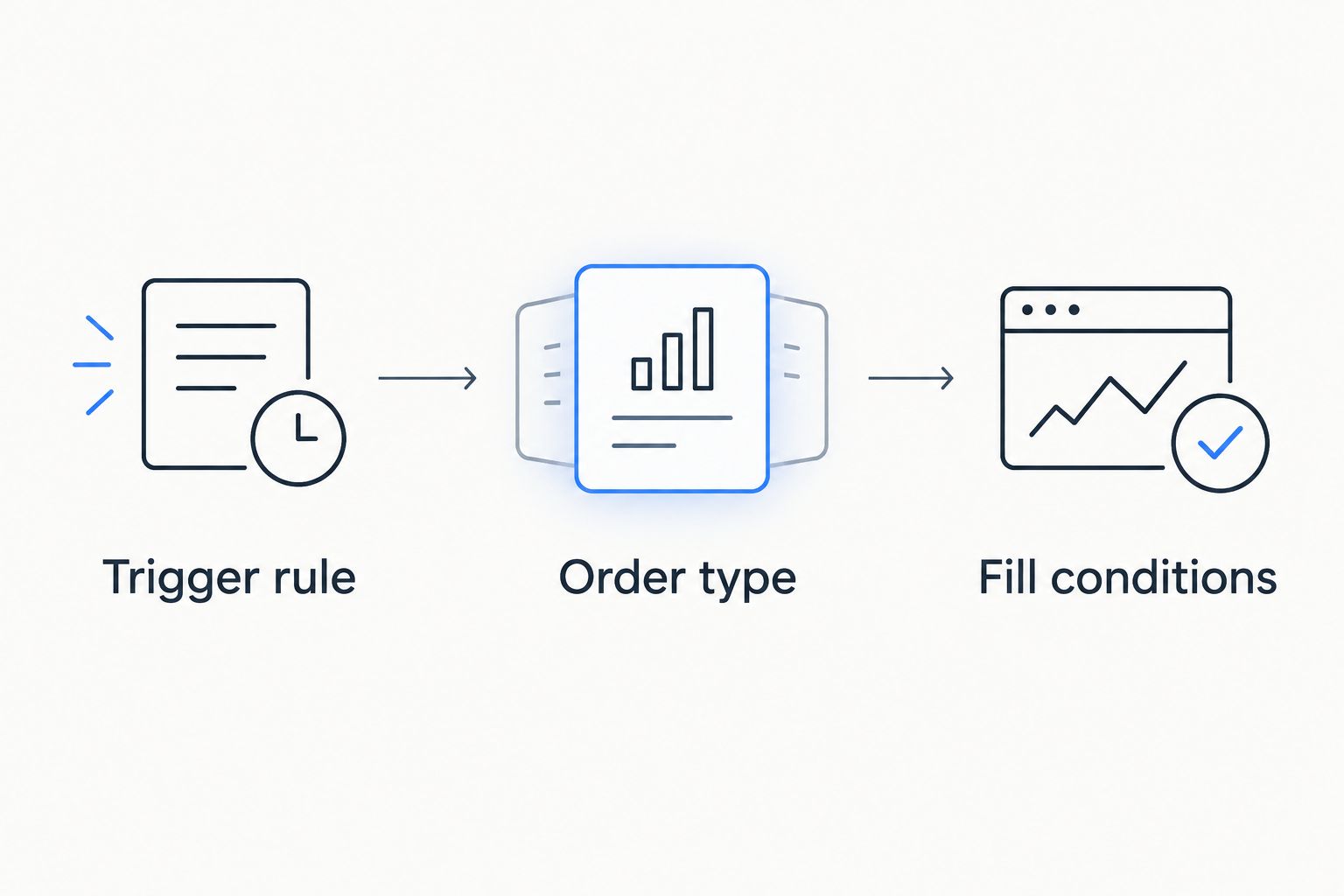
Check activation, resulting order type and fill conditions separately.
Keep the order record separate from the position record. A pending order describes an instruction. An open position describes the market exposure you still hold. Both records matter when an exit remains incomplete.
06
Is a stop-limit order safer than a stop order?
A stop-limit order provides tighter execution-price control. It does not remove trading risk. A standard stop accepts price uncertainty after activation. A stop-limit accepts the possibility of leaving the position open.
For an existing position, compare the consequences of an adverse fill with the consequences of no exit. Those are different risks. Calling either order safer without stating which risk you mean hides the actual trade-off.
Can a stop-limit order remain unfilled after triggering?
A stop-limit order can remain unfilled after triggering when no execution is available at its limit price or better. Activation changes the order state. It does not confirm a transaction or close the position.
Does moving the limit farther from the stop guarantee execution?
Moving the limit farther from the stop does not guarantee execution. It permits a wider range of execution prices. A market gap can still pass beyond that range, leaving the order unfilled.
Frequently asked questions
What is the main risk difference between a stop order and a stop-limit order?
A standard stop order exposes you to execution-price uncertainty. A stop-limit order restricts execution price but can leave your position open if it does not fill.
Does a standard stop order guarantee my exit price?
A standard stop order does not guarantee your exit price. Its stop level activates a market order, which depends on available executable prices.
Can my stop-limit trigger without closing my position?
A stop-limit can trigger without closing your position. If no acceptable execution is available, the resulting limit order remains unfilled under its validity conditions.
What happens to a sell stop-limit during a gap lower?
A sell stop-limit can remain unfilled if the market gaps below its limit price. Your position continues to carry market risk until an exit executes.
Are buy stop-limit rules the same as sell stop-limit rules?
A buy stop-limit permits execution at its limit price or lower. A sell stop-limit permits execution at its limit price or higher. Both depend on their trigger rules.
Can a stop order or stop-limit order fill only partly?
Either order can fill partly when executable quantity or applicable fill rules prevent full execution. Check the remaining order quantity and the remaining position separately.
Why did my chart touch the stop without the result I expected?
A chart touch does not establish that the applicable trigger or full-fill conditions were met. Check the relevant bid, ask or other specified trigger price and the execution record.
Conclusion
A standard stop and a stop-limit address different priorities. The standard stop seeks market execution after activation. The stop-limit enforces a price boundary. Neither removes the need to check whether the intended quantity actually traded.
One final check: review the remaining position after a partial fill. A successful execution message can describe only part of your instruction. The unclosed quantity still carries market risk.
The trigger starts the process. The fill determines what changed.
Related guides
- Stop-loss orders during a market gap
- Partially filled orders
- Liquidity and order execution
- Chart price and execution price
This article is for educational purposes only and does not constitute investment advice. Trading CFDs and other leveraged products carries a high level of risk and may not be suitable for all investors.


