Trading Analysis · Data Quality
Bias in training data can make automated trading analysis favour patterns that do not represent the conditions you trade. Missing losing trades, uneven market coverage and information from the future can distort a model’s conclusions. A strong historical result does not establish that the analysis will work on new data.
Key takeaways
- AI trading model bias can make historical patterns look more dependable than the underlying training data supports.
- Check market coverage, missing observations and information timing before relying on model validation.
- VCG Markets trading analysis readers should distinguish behavioural performance scores from predictions of future returns.
- Testing on later, unseen data helps assess generalisation. It does not guarantee trading outcomes.
01Recognise distorted evidence
02Check the testing process
03Read scores in context
A score summarises what a system measures. It does not explain everything the system excludes. Start with performance scores in context when interpreting a trading review.
01
How can bias in training data affect trading analysis?
Training data shapes the relationships a model learns. If those observations exclude important conditions, the model can learn an incomplete relationship and still produce a precise-looking output. Precision in presentation is not proof of representative evidence.
Consider a model trained mainly on rising share prices. It has less evidence about falling markets. That does not prove its conclusions will fail during a decline. It means the training record provides less support for conclusions about that environment.
For a 2026 review, distinguish how well a model describes its training sample from how well it handles later observations. The following checks address different weaknesses. None substitutes for the others.
| Check | Useful for | Limitation |
| Coverage review | Identifying missing markets or conditions | Does not establish predictive accuracy |
| Unseen-data testing | Checking results beyond model development | The test period can still be unrepresentative |
| Condition-level review | Finding weaknesses hidden by averages | Small groups provide limited evidence |
02
Why this matters
Trading analysis can describe behaviour, estimate a relationship or support a forecast. Those are different tasks. A system that identifies repeated changes to your trading plan has not necessarily established what the market will do next.
The distinction matters when you interpret a favourable score. A behavioural score concerns the behaviour being measured. A forecast concerns a future event. Neither becomes evidence for the other simply because both appear in the same interface.
For any trading analysis you use in 2026, ask what the output actually measures. Then ask which observations support it. Match the conclusion to the evidence, not to the confidence of the wording.
03
Why model bias varies
Bias depends on how observations enter the dataset and how the task is defined. These sources of distortion require separate questions.
- Selection bias. A dataset built only from selected accounts or completed trades excludes other experiences. Ask what qualified a record for inclusion.
- Survivorship bias. A share dataset containing only companies that remain listed omits companies that disappeared. Historical analysis then starts from a filtered view of the past.
- Market coverage. Heavy representation of one instrument, session or market condition can leave other conditions poorly represented. A large total does not establish balanced coverage.
- Missing observations. Missing losses or execution records can distort the picture when their absence relates to the outcome. Filling gaps does not automatically remove that distortion.
- Target design. Labelling every profitable trade as a good decision ignores whether the trade followed its risk rules. The label determines what the model is trained to recognise.
- Information timing. Revised values or future outcomes can enter historical inputs accidentally. The model then receives information that was unavailable at the decision time.
These problems can overlap. Removing missing rows might also change which market conditions remain represented. Review the effect of a cleaning rule rather than treating a cleaner-looking file as proof of better evidence.
04
How to review the evidence behind an output
Use this sequence when reviewing a model report in 2026. It separates the question being asked from the evidence used to answer it. A polished summary should not replace these checks.
- Define the task. Establish whether the model describes behaviour, classifies past trades or predicts an outcome. Identify the target before interpreting its score.
- Check coverage. Ask which instruments, sessions and market conditions appear in training. Identify exclusions and the reasons for them.
- Check timing. Confirm that each input was available when the historical decision occurred. Publication dates and later revisions matter.
- Separate testing. Look for evaluation on later observations kept outside model development. Any data processing learned from observations must respect that separation.
- Review limitations. Examine errors by relevant condition. Record what the analysis does not establish before using its output.
Keep the questions specific. Asking whether a model is accurate invites a broad answer. Asking how it performed on unseen observations during falling markets identifies the evidence you need.
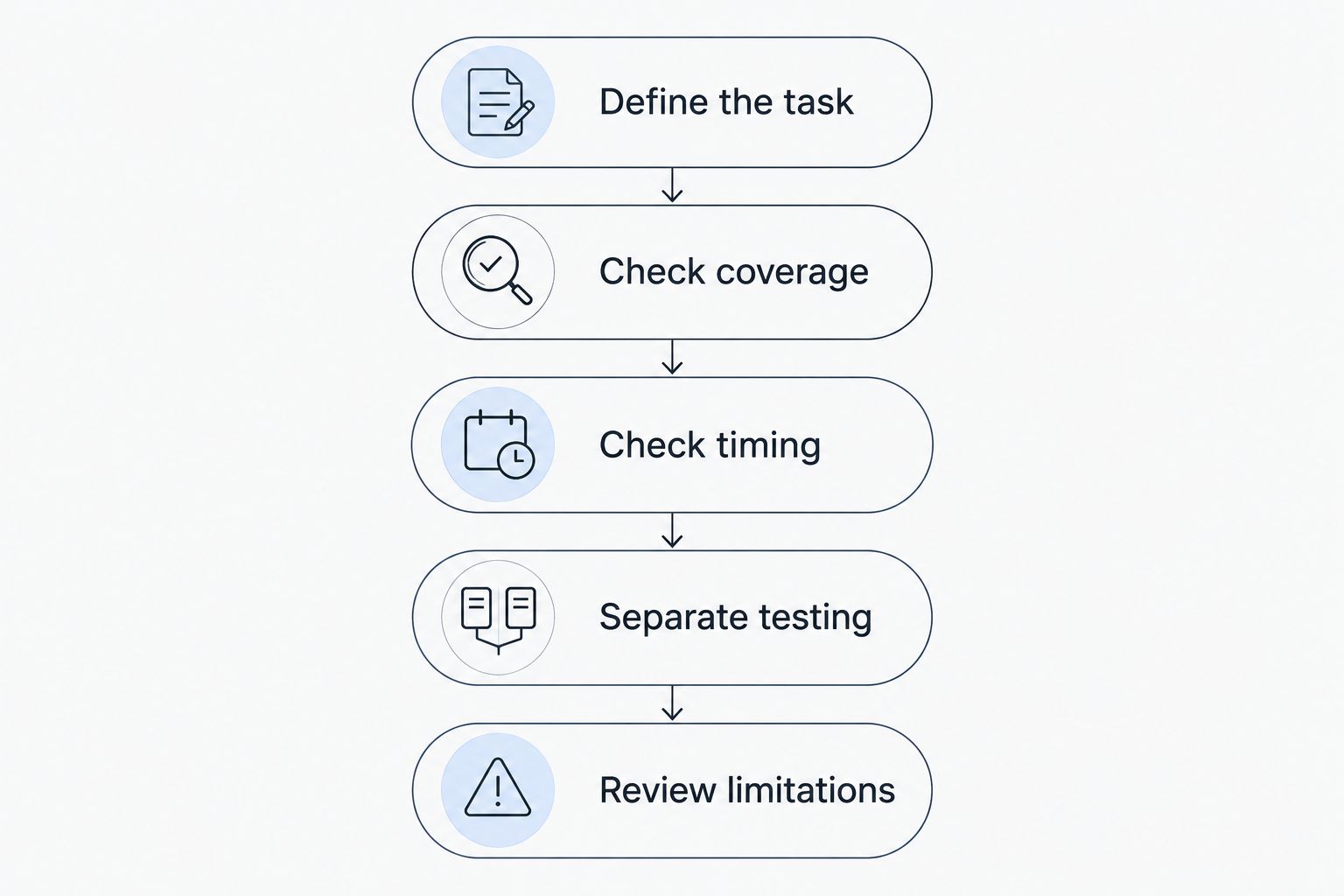
Define what the output measures before assessing the evidence behind it.
Chronological separation is useful because trading decisions occur in time order. It does not solve every problem. Overlapping observations, repeated tuning and changes in market conditions still need attention.
Repeatedly adjusting a model after viewing the same test results weakens the independence of that test. The test begins influencing development. A genuinely untouched evaluation set answers a different question from a repeatedly consulted benchmark.
05
Does more training data remove bias?
More training data does not automatically remove bias. Adding more observations from the same narrow source can preserve the original imbalance. Coverage and relevance matter alongside dataset size.
Older observations can broaden the range of conditions represented. They can also reflect market arrangements that differ from current conditions. The useful question is what the added records contribute to the task.
Is model bias the same as overfitting?
Model bias and overfitting are different problems. An unrepresentative sample can distort learning. Overfitting occurs when a model fits details of its development data that do not generalise to new observations.
Can accurate historical analysis still disappoint later?
Accurate historical analysis does not guarantee accurate future analysis. Relationships can change and a test period can miss important conditions. In a 2026 review, report the scope of the historical evidence rather than treating it as a promise.
Frequently asked questions
What does bias in trading-model training data mean?
Bias in training data means the observations systematically distort the evidence available to a model. Examples include missing failed companies, excluded losing trades and uneven coverage of market conditions.
Can a model have bias even with a large dataset?
A large dataset can still contain bias. More records from the same narrow source do not establish representative coverage of other instruments, sessions or conditions.
What is look-ahead bias in trading analysis?
Look-ahead bias occurs when historical analysis uses information unavailable at the time of the decision. Later revisions and future outcomes must not enter inputs that are supposed to represent what was known then.
Does testing on unseen data prove a trading model works?
Testing on unseen data provides evidence beyond the development sample. It does not prove that the model will remain accurate in different conditions or produce profitable trades.
Can a behavioural score tell me whether my next trade will profit?
A behavioural score does not by itself establish whether your next trade will profit. Check what the score measures rather than treating it as a market forecast.
How often should I review a model for bias?
There is no universal review interval that removes model bias. Review the evidence when the dataset, model, intended use or relevant market conditions change.
Conclusion
For your next 2026 model review, ask which records were excluded. A missing observation can be more revealing than another decimal place in a score. The exclusion rule tells you whose experience and which conditions the analysis represents.
Keep a profitable outcome separate from a sound process. A trade can make money despite breaking its rules. If training labels ignore that distinction, the model learns the label rather than your intended standard.
Check what the data leaves out before relying on what the model puts forward.
Related guides
This article is for educational purposes only and does not constitute investment advice. Trading CFDs and other leveraged products carries a high level of risk and may not be suitable for all investors.


