CasaWhy do requotes occur when placing a trading order?
Why do requotes occur when placing a trading order?
Oct 26, 2026
Requotes occur when an order uses quote-based execution and the requested price is no longer available when the broker processes it. Instead of filling at a different price automatically, the platform presents a new quote for your approval; accepting that quote does not guarantee execution if the price changes again.
TL;DR
- Requotes trading execution: a replacement quote requires approval before the order can proceed at that price.
- A requote requests consent. Slippage describes the difference between a requested price and an actual fill.
- Check the execution mode, quote timing and permitted deviation before resubmitting an order.
- VCG Markets is an international multi-asset broker. Execution conditions still need checking for each instrument.
01. Why do requotes occur when placing a trading order?
A requote appears when the execution process requires agreement on a price that is no longer available. This is associated with instant execution. The platform returns another price rather than treating your original request as permission to fill at any available price.
Your screen displays a quote at one moment. The trading server receives and processes your instruction later. Prices can change between those events. The difference does not need to be visible as a large chart movement.
Available liquidity also matters. A displayed price does not establish that your entire requested quantity can trade at that price. The guide to liquidity and order execution explains that distinction.
The sequence has 4 stages:
- You submit an order with a requested price.
- The server checks the request against the applicable execution conditions.
- The requested price is unavailable or falls outside the permitted deviation.
- The platform presents a replacement quote for approval.
A requote is a request to approve another price, not confirmation of a completed trade. Check the order status before taking another action.
Why this matters
A changed quote affects the decision you originally made. The new entry price changes the distance to an intended stop or target. It also changes the relationship between the planned entry and the current spread.
For your 2026 execution review, separate what you requested from what actually happened. A chart screenshot alone does not establish the order's execution price. You need the order record and the platform message.
02. Is a requote the same as slippage or a rejection?
No. A requote asks you to accept another price. Slippage describes an execution-price difference after a fill. A rejection means the request was not accepted under the applicable conditions.
These are different outcomes. Treating them as interchangeable hides the information you need to investigate the event.
Requote
- What happened: The platform offered a replacement price
- What to check: Whether you accepted it and whether a fill followed
- Main limitation: The replacement quote can change again
Slippage
- What happened: The actual fill differed from the requested or reference price
- What to check: Requested price, fill price and direction of the difference
- Main limitation: The original price was not preserved
Rejection
- What happened: The request was not accepted
- What to check: The return message and order record
- Main limitation: No completed trade follows from that rejected request
Partial fill
- What happened: Only part of the requested quantity executed
- What to check: Filled quantity and remaining order status
- Main limitation: The full intended position was not established
Slippage can be favourable or unfavourable. A requote is not automatically unfavourable either. Read the proposed price rather than judging the outcome from the message label alone.
A rejection also needs context. An invalid order parameter is not the same problem as an unavailable price. The exact server message matters more than a general description such as order failed.
Why can the chart price differ from the order price?
Charts and order tickets do not always display the same side of the market. A buy transaction uses the ask. A sell transaction uses the bid. A chart showing only the bid does not show the buy price directly.
That difference can explain an apparent mismatch without explaining a requote. Keep the two questions separate. The guide to chart price and execution price covers the comparison.
03. How do instant execution and market execution differ?
Instant execution and market execution handle price agreement differently. Neither execution mode guarantees that every order will fill. Your 2026 checklist should identify the mode before interpreting the platform response.
Instant execution
- How price agreement works: The request specifies a price and permitted deviation where supported
- Useful for understanding: Why an unavailable requested price can produce a requote
- Trade-off: A replacement quote adds another approval step
Market execution
- How price agreement works: The instruction accepts execution at available market prices under the applicable conditions
- Useful for understanding: Why the final fill can differ from the displayed quote
- Trade-off: You do not approve each changed price through a requote
Instant execution: requested-price agreement
With instant execution, the requested price is part of the instruction. A permitted deviation setting can allow execution within a defined tolerance. Outside the applicable tolerance, a new quote can require approval.
This gives the requested price an explicit role. The limitation is that a fast-moving market can make that price unavailable before processing finishes. The word instant describes the execution model, not a promise of zero delay.
Market execution: available-price acceptance
With market execution, the final price follows the available execution conditions rather than a separate approval of each changed quote. The absence of a requote does not establish that the requested price was achieved.
An order can still fail under market execution. Available liquidity, order validity and the applicable filling policy remain relevant. Check the instrument specification instead of assuming that a platform uses the same settings for every market.
04. Why does the likelihood of a requote vary?
A requote reflects the interaction between the requested price and the execution rules. Market conditions influence how quickly that requested price becomes outdated.
These 5 factors help explain the event:
- Price movement. The market moves between submission and processing. A previously displayed price is no longer executable under the request's conditions.
- Available liquidity. The quantity available at a price does not necessarily cover the requested order size. Price alone does not describe market depth.
- Transmission delay. Connection and processing time separate the quote you saw from the conditions evaluated by the server.
- Permitted deviation. A narrower tolerance leaves less room for price changes under execution models that use this setting.
- Execution mode. The instrument's configured mode determines whether a changed price requires approval or is handled through another execution process.
These factors interact. A brief delay matters more when quotes change rapidly. A small displayed spread does not establish sufficient liquidity for every order size.
For a 2026 trading journal, record the circumstances rather than assigning a cause from memory. Note the instrument, order type, execution mode and message. Add the relevant platform timestamps where available.
Avoid treating a requote as proof of misconduct. The message describes an execution event. Establishing why it occurred requires the request details and server response.
05. What should you do when a requote appears?
Read the replacement price before accepting it. The original trading decision does not automatically apply to a changed entry. Confirm the order status before submitting another instruction.
Use these 4 checks in order:
- Order status. Check the trade history and open positions. Establish whether the original instruction produced a fill or remains unresolved.
- New quote. Compare the proposed price with your requested price. Confirm which side of the market applies.
- Execution settings. Read the instrument's execution mode and any applicable deviation setting. Do not assume that another instrument uses the same rules.
- Trade record. Save the request details, response message and timestamps. Use those records if you need an explanation from support.
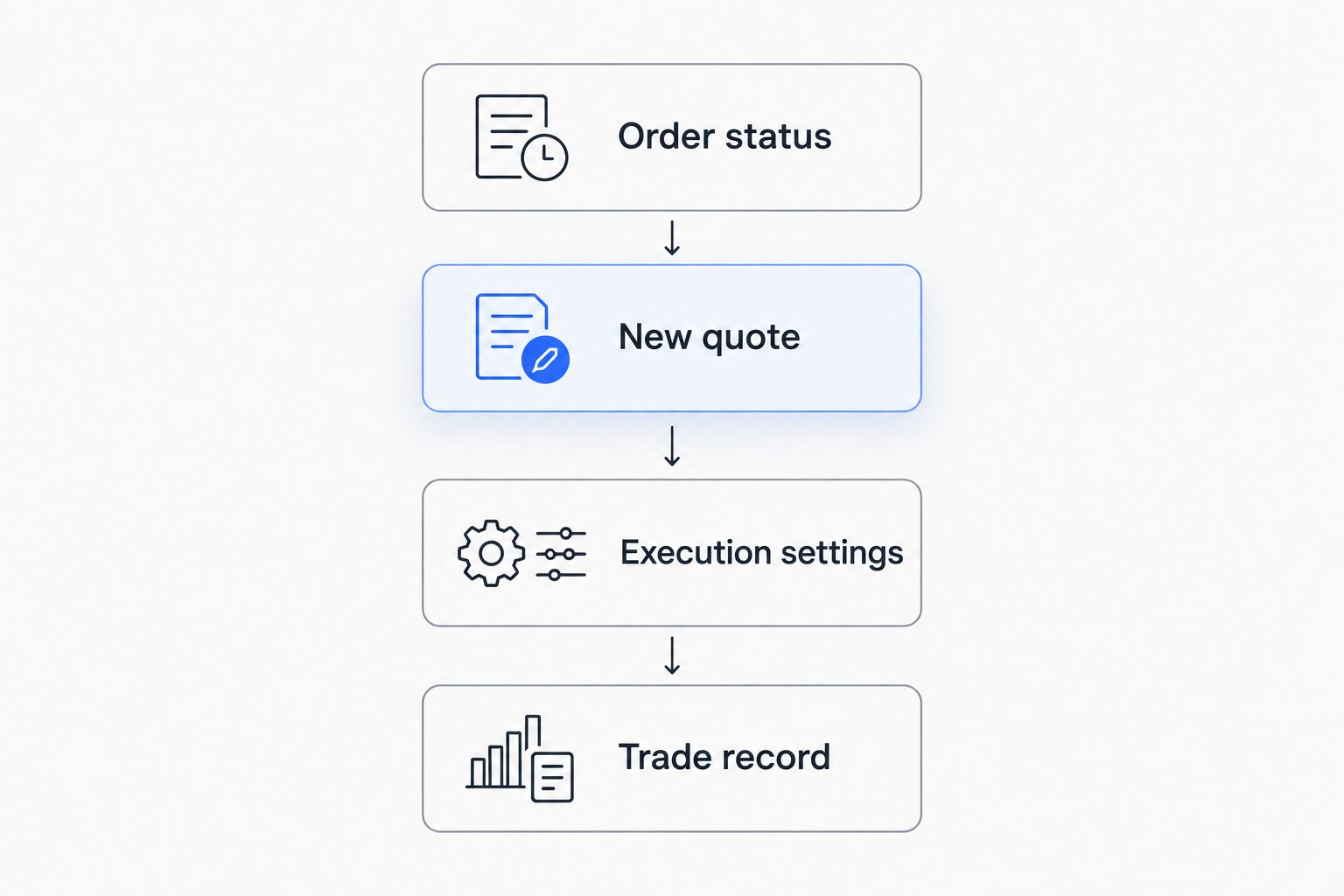
Confirm the order status before deciding whether to submit another instruction.
Do not increase permitted deviation simply to make the message disappear. A wider tolerance changes the price variation you authorise. It does not improve the underlying market price or create liquidity.
Also avoid repeated submissions while an earlier request remains unresolved. Another instruction is a separate action. Check what the platform recorded before adding another order to the sequence.
What should an execution support request contain?
Provide the order identifier, instrument and requested quantity. Include the requested price and any replacement quote shown. Copy the platform message accurately.
Use timestamps with the time zone identified. A screenshot can help show what appeared on screen. The order record remains necessary to establish whether execution followed.
Keep interpretation separate from evidence. Report that the platform displayed a requote rather than asserting that the broker deliberately changed the price. Ask which execution condition produced the response.
06. Does accepting a requote guarantee a fill?
No. Accepting a requote approves the replacement price at that point in the process. The market can change again before the next request is processed.
Check the final confirmation rather than the acceptance action. The trade record establishes the executed quantity and price. A button press does not.
07. Can you prevent every requote?
No setting establishes a universal guarantee against requotes across all instruments and execution models. First identify whether the instrument uses an execution mode that supports them.
Connection checks address avoidable transmission problems. Reviewing deviation settings clarifies the price variation you authorise. Neither step stops market prices from changing.
08. Does a requote mean the broker is unreliable?
A requote alone does not establish broker reliability or misconduct. It shows that the requested price was not accepted under the applicable execution process and that another quote was offered.
Assess the explanation against the execution policy and order record. For your 2026 review, distinguish a documented price-agreement process from an unexplained discrepancy. Keep the evidence attached to the specific order.
The VCG Markets lens
VCG Markets is an international multi-asset broker for traders seeking access to several financial markets. That access does not remove the need to understand how an individual instrument handles orders.
VCG Markets offers MT5 alongside its dedicated mobile app. Check the execution information for the instrument and interface you use. A platform name alone does not establish the applicable execution mode.
Judge an execution event by its recorded outcome, not by the wording of a notification alone. Start with whether the order filled. Then examine the quantity, price and response.
FAQ
What does a requote mean when I place a trade?
A requote means the platform is offering a replacement price instead of executing at the original requested price. You must approve the replacement quote for the request to proceed at that price.
Why do I get requotes when prices move quickly?
Rapid price changes can make the requested price unavailable before the server processes your order. Under instant execution, a change outside the applicable permitted deviation can trigger a replacement quote.
Is a requote worse than slippage?
A requote and slippage describe different execution outcomes. A requote requires another price decision, while slippage describes the difference between a requested or reference price and an actual fill.
Can I turn off requotes by changing deviation?
Changing deviation adjusts the price variation you authorise where that setting applies. It does not guarantee execution or change the instrument's execution mode.
Does market execution mean my order cannot be rejected?
Market execution does not guarantee a fill. Order validity, available liquidity and the applicable filling policy still affect the outcome.
Should I place another order immediately after a requote?
Check the original order status before placing another order. Read the replacement quote and confirm whether any execution has already occurred.
What should I record when investigating a requote in 2026?
Record the order identifier, instrument, quantity, requested price, replacement quote and platform response. Include timestamps and their time zone so the sequence can be checked.
Conclusion
A requote is a price-agreement step. It is not a fill, a slippage measurement or proof that an execution process failed. Read the replacement quote in the context of the instrument's execution rules.
One final distinction matters: an accepted quote and a completed trade are different events. Your final check belongs in the order history. Confirm the executed quantity and price before treating the transaction as complete.
Related guides
- Positive and negative slippage
- Why spreads widen in quiet markets
- Correlated pairs and hidden exposure
This article is for educational purposes only and does not constitute investment advice. Trading CFDs and other leveraged products carries a high level of risk and may not be suitable for all investors.

Informações
A VCG Markets Ltd é a entidade licenciada e autorizada a prestar serviços de investimento. Está constituída na República da Maurícia (N.º da empresa 188485) e autorizada e regulada pela Comissão de Serviços Financeiros da Maurícia sob a Licença N.º GB22200388, com sede registada em The Cyberaty Lounge, Piso Térreo, The Catalyst, Silicon Avenue, 40 Cybercity, 72201 Ebene, República da Maurícia.
A VCG Markets (Seychelles) Ltd é a entidade licenciada e autorizada a prestar serviços de corretagem de valores mobiliários (Securities Dealer). Está constituída na República de Seicheles (N.º da empresa 8438443-1) e autorizada e regulada pela Autoridade de Serviços Financeiros de Seicheles sob a Licença N.º SD243, com sede registada em House of Francis, Room 301(B), Ile Du Port, Mahe, República de Seicheles.
O site é operado pela VCG Tech Limited (N.º da empresa HE452446), com sede registada em Agias Fylaxeos & Zinonos Rossidi, 2, 1.º Andar, 3082 Limassol, Chipre. A VCG Tech Limited atua como empresa responsável pelo processamento de depósitos e saques de clientes.
O trading de Forex com margem e os CFDs são produtos alavancados e podem resultar em perdas superiores aos seus depósitos. O valor dos investimentos pode cair assim como subir, e você pode receber de volta menos do que o valor investido originalmente. Certifique-se de que compreende totalmente os riscos envolvidos e considere se esse tipo de trading é adequado para você.
Ligações telefônicas e comunicações eletrônicas podem ser gravadas e monitoradas para fins de controle de qualidade, conformidade e treinamento.
As informações neste site são fornecidas apenas para fins informativos gerais e não constituem aconselhamento de investimento, uma recomendação ou uma solicitação para participar em qualquer atividade de investimento.
A VCG Markets não presta aconselhamento fiscal. A legislação fiscal pode mudar ou diferir entre jurisdições.
As informações neste site não são direcionadas a residentes dos Estados Unidos da América, Bélgica, Canadá, Singapura, ou qualquer jurisdição onde o acesso a tais informações seja contrário às leis ou regulamentos locais.
VCG Markets © 2026, Inc. Todos os direitos reservados.

Siga-nos


