Indices · Market mechanics
Cash index and index futures prices differ because futures reflect financing, expected dividends and time until settlement. Trading hours and contract specifications also affect the comparison. A gap alone does not establish that either quote is wrong or predict the next market move.
TL;DR
- The cash index vs futures price gap reflects financing, expected dividends, time to settlement and quote timing.
- An equity index futures premium is not automatically a bullish signal. A discount is not automatically bearish.
- The cash index is a calculated benchmark. A broker’s cash-labelled instrument has its own specifications.
- VCG Markets offers multi-asset market access. Compare the exact instrument specifications before interpreting an index price gap.
01Understand the gap
02Check the drivers
03Compare like with like
Why this matters
A futures chart and a cash index chart can show different levels without contradicting each other. They measure different things. Comparing the numbers without checking their construction can turn a normal pricing relationship into a false trading signal.
For traders using VCG Markets for multi-asset market access, the starting point is the instrument specification. A familiar index name does not tell you whether the quote represents the benchmark, a dated futures contract or a broker-defined instrument.
01. Why can cash index and index futures prices differ?
An equity cash index summarises the value of its constituent shares under the index provider’s methodology. An index futures contract references a specified settlement calculation at a future date. Its pricing incorporates the economics of holding exposure until that date.
The central relationship is straightforward. Financing the underlying share basket adds carrying cost. Expected dividends offset that cost because the holder of the shares receives distributions that a futures position does not receive directly.
| Reference | Useful for | Limitation |
| Cash index | Tracking the underlying equity benchmark. | A calculated level is not itself an executable instrument. |
| Dated index futures | Observing exposure tied to a particular settlement date. | Expiry and carrying costs complicate direct cash comparisons. |
| Broker cash-labelled instrument | Following the broker’s specified trading exposure. | Pricing and adjustments depend on the instrument’s terms. |
A futures premium is not a forecast of a rising cash index. A discount is not a forecast of a falling one. First separate the expected carrying relationship from any remaining difference.
The underlying benchmark matters too. A price-return index and a total-return index treat dividends differently. Confirm the index methodology before applying a dividend-based explanation. The guide to index weighting and market performance explains another source of differences between equity benchmarks.
02. Why the cash index vs futures price gap varies
For a conventional equity price index, financing and expected dividends establish the theoretical relationship. Time and market conditions affect how that relationship appears on your screen. Check these drivers before interpreting the gap.
- Financing. Holding a share basket ties up capital. Higher financing rates increase theoretical futures value relative to cash when other inputs stay unchanged.
- Expected dividends. Dividends expected before settlement reduce theoretical futures value relative to cash. The relevant amount is the expected distribution over the contract’s remaining life.
- Time to settlement. A longer remaining term allows more financing and dividends to accumulate. Their net effect determines the direction of the theoretical gap.
- Trading hours. Futures can trade while the underlying share market is closed. A live futures quote and an unchanged cash index level do not represent the same information time.
- Contract specifications. Settlement rules, quote types and broker adjustments determine what the displayed numbers represent. Matching names do not establish matching terms.
Actual trading also involves bid-offer spreads and execution constraints. Those frictions help explain why a displayed difference does not automatically create an executable opportunity. A theoretical relationship is not a guarantee that every screen will show identical adjusted values.
03. What does a futures premium or discount mean?
When futures trade above cash
A premium is consistent with financing costs exceeding expected dividends over the remaining contract term. It does not mean traders collectively expect the benchmark to reach the futures level. Carrying costs alone can produce that relationship.
To interpret the premium, identify the contract month first. Then check whether both quotes are current. A premium calculated from different timestamps mixes the carrying relationship with market movement.
When futures trade below cash
A discount is consistent with expected dividends exceeding financing costs. Dividend timing matters because only distributions relevant to the remaining contract period enter that comparison. A discount is therefore not enough to support a bearish conclusion.
Keep the sign convention explicit. If you define the gap as futures minus cash, a positive result is a premium. Reversing the subtraction reverses the sign without changing the underlying relationship.
04. How do you compare the quotes correctly?
Use the same comparison process each time. Record what each quote measures before examining whether the difference has widened or narrowed. This keeps a change in contract or timestamp from masquerading as a change in market conditions.
- Identify the instrument. Check the benchmark name and whether it is a price-return or total-return index. For futures, record the contract month. For a broker instrument, read the pricing specification.
- Match the timestamp. Check both timestamps and their time zones. Establish whether either feed is delayed. If the cash market is closed, label that mismatch rather than treating the last cash reading as current.
- Match the quote. Compare equivalent quote types where possible. A last trade, an indicative midpoint and an executable bid are different observations. Do not treat the difference between them as pure market basis.
- Check the carry. Consider financing, expected dividends and remaining time. Then review settlement rules and any stated adjustments. The unexplained remainder is the part that needs further investigation.
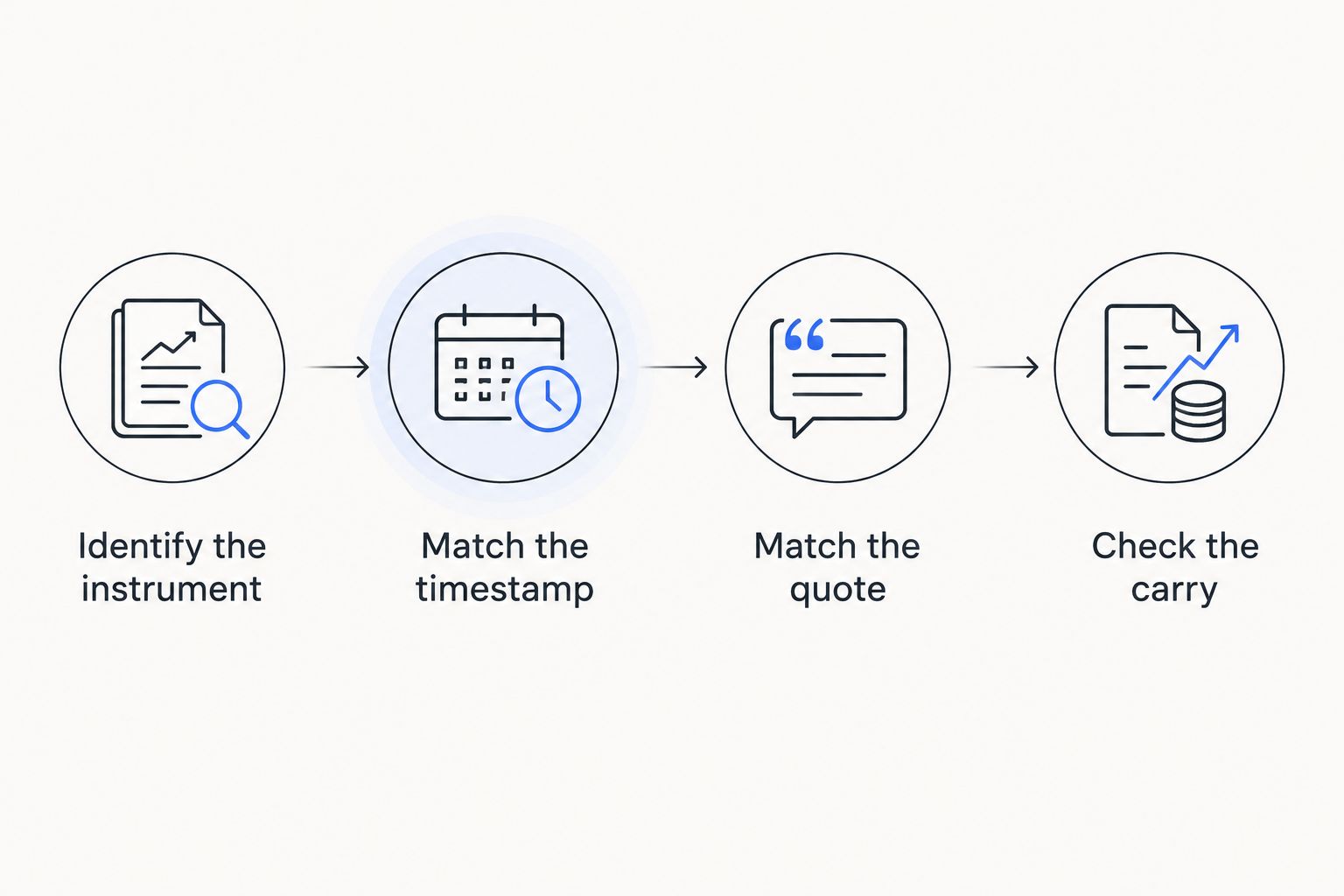
Match the instrument, time and quote type before interpreting the gap.
For a repeated comparison, keep a short record of the symbol, contract month, quote type and observation time. Add a note when the underlying market is closed. That record makes later comparisons interpretable without relying on memory.
Resolve a data mismatch before drawing a market conclusion. If one feed is delayed, the clean next step is to obtain matching observations. A more elaborate explanation cannot repair an inconsistent starting point.
05. What changes near expiry and during a contract roll?
As expiry approaches, less time remains for financing and dividends to affect the expiring contract. The contract settles according to its exchange rules. That endpoint is a specified settlement calculation, not necessarily the last cash index value visible on your chart.
Check how settlement is determined. A settlement based on constituent opening values is not interchangeable with an ordinary closing index reading. Using the wrong reference can make a settled contract appear misaligned when the comparison itself is wrong.
A contract roll introduces a separate issue. Moving from the expiring contract to a later one changes the remaining financing and dividend period. The later contract can therefore show a different level without an equivalent move in the underlying shares.
Continuous futures charts require another check. A chart provider joins successive contracts using a chosen method. Back-adjustment and contract-switching rules affect the historical series, so a chart transition is not automatically a tradable market jump.
FAQ
Why is the futures price higher than the cash index?
Futures can trade above the cash index when financing costs exceed expected dividends over the remaining contract term. Check the contract month and timestamps before interpreting the premium.
Does an index futures discount mean shares will fall?
An index futures discount does not establish that shares will fall. Expected dividends exceeding financing costs can produce a discount without a bearish forecast.
Do cash index and futures prices become equal at expiry?
An expiring futures contract settles against the reference calculation specified in its contract rules. That calculation is not necessarily the latest cash index reading displayed on a chart.
Why do index futures move when the cash market is closed?
Index futures can trade outside the underlying share market’s trading session. Futures can respond to new information while the displayed cash index remains at its last published level.
Is a broker’s cash index quote the official index level?
A cash label does not establish that a broker’s quote is the official index level. Check the instrument’s pricing reference, trading hours and adjustment rules.
Can I compare a continuous futures chart with a cash index?
You can compare the charts only after accounting for how the continuous futures series joins contracts. Contract switching and historical adjustments affect the displayed relationship.
Is the cash index vs futures price gap an arbitrage opportunity?
A displayed gap alone does not establish an arbitrage opportunity. Financing, dividends, executable quotes and execution constraints must all enter the comparison.
Conclusion
The useful question is not simply why the numbers differ. It is whether you are comparing the same underlying benchmark at the same time under compatible terms. Start there before attributing the gap to sentiment or mispricing.
One last check rewards the effort: inspect the chart’s contract-switching method. A historical level can change because the displayed contract changed. The share market does not need to make the same move.
Different quotes need an explanation, not an automatic trading signal.
Related guides
This article is for educational purposes only and does not constitute investment advice. Trading CFDs and other leveraged products carries a high level of risk and may not be suitable for all investors.


