Forex · Risk education
Correlated currency pairs create hidden exposure when separate trades depend on the same currency move. Buying EUR/USD and GBP/USD creates two positions that both benefit from a weaker dollar. Different pair names do not remove that shared risk.
TL;DR
- Forex correlation exposure can concentrate risk across different currency pairs. Count shared currency direction, not just open positions.
- Long EUR/USD and long GBP/USD both carry short-dollar exposure. Separate charts do not make those positions independent.
- Historical correlation describes a measured relationship. It does not guarantee that future gains will offset future losses.
- VCG Markets provides forex access. Portfolio review still requires checking position direction, size and shared currency exposure.
01Shared currency exposure
02Correlation limits
03Portfolio review
01
Why this matters
Your account carries the combined exposure of its positions. It does not treat each chart as an isolated decision. Understanding [changing market correlations](https://vcgmarkets.com/en/blog/changing-market-correlations) helps separate a measured relationship from an assumption about diversification.
In a 2026 portfolio review, start with the currencies behind each trade. A dollar move can affect several positions together. Stop orders on separate tickets do not remove that connection.
The distinction matters before entry and while positions remain open. Adding a different pair changes your portfolio. It does not automatically spread its risk.
02
How can correlated currency pairs create hidden exposure?
Every currency pair expresses one currency relative to another. Buying EUR/USD gives you long-euro and short-dollar exposure. Selling USD/CHF also gives you short-dollar exposure, alongside long-franc exposure.
Those trades have different order directions. Their dollar exposure points the same way. Trade direction and shared currency direction are not the same thing.
| Position combination | Shared dollar direction | What remains |
| Long EUR/USD + long GBP/USD | Short dollar in both | Euro and sterling exposure |
| Long EUR/USD + short USD/CHF | Short dollar in both | Euro and franc exposure |
| Long EUR/USD + short GBP/USD | Opposing dollar components | Relative euro-sterling exposure and sizing differences |
These are exposure examples, not trade recommendations. They show direction rather than hedge size. Equal lot counts alone do not establish equal risk or matching profit-and-loss sensitivity.
03
What a correlation coefficient tells you
Pearson correlation measures linear co-movement across paired observations. Its coefficient ranges from −1 to +1. A reading of 0 means no measured linear relationship in that sample.
- +1 coefficient: Perfect positive linear co-movement within the measured sample.
- 0 coefficient: No linear co-movement detected by this measure. This does not establish independence.
- −1 coefficient: Perfect negative linear co-movement within the measured sample.
For currency analysis, distinguish correlation of returns from correlation of price levels. Returns describe changes between observations. A price-level comparison answers a different question and can produce misleading conclusions about co-movement.
For a 2026 correlation worksheet, record the return interval and sample dates. Use aligned observations. A coefficient without that context leaves you unable to judge what was actually measured.
Correlation is useful for identifying relationships worth investigating. Its limitation is equally important: it does not measure position size, establish causation or predict the loss on your next trade.
04
Why forex correlation exposure varies
The coefficient and your account exposure answer different questions. Historical returns determine the coefficient. Your positions determine how that relationship affects your account.
- Shared currency: A common dollar component can connect otherwise different pairs.
- Position direction: Buying and selling can reinforce the same currency exposure when that currency changes sides in the quote.
- Position size: Larger exposure changes the account impact even when historical correlation stays unchanged.
- Measurement window: Changing the sample changes the observations used to calculate the coefficient.
- Return interval: Intraday and daily observations measure different horizons. Their coefficients need not match.
- Market driver: A shared currency event and a currency-specific event can produce different relationships between the same pairs.
A 2026 reading is therefore a dated measurement. It is not a permanent property of a pair. Keep the observation window attached whenever you save or compare a result.
05
How to review shared exposure before entry
Use a consistent review sequence rather than treating a correlation colour or coefficient as permission to trade. The aim is to describe the positions you hold. It is not to produce a forecast.
- List positions. Include open trades and the proposed trade. Record pair, direction and size.
- Map currencies. For each position, identify the currency you are long and the currency you are short.
- Check sizing. Compare exposure and profit-and-loss sensitivity in a consistent account currency. Do not substitute lot counts for this calculation.
- Test scenarios. Review a shared currency move and a move specific to either remaining currency. Include the possibility that an assumed offset fails.
- Review limits. Compare combined exposure with your documented risk limits. Revisit the calculation when positions or sizes change.
Keep the map beside your trade rationale. That makes the common currency visible before another ticket is added. Your 2026 trading record should distinguish a separate entry signal from a genuinely different source of exposure.
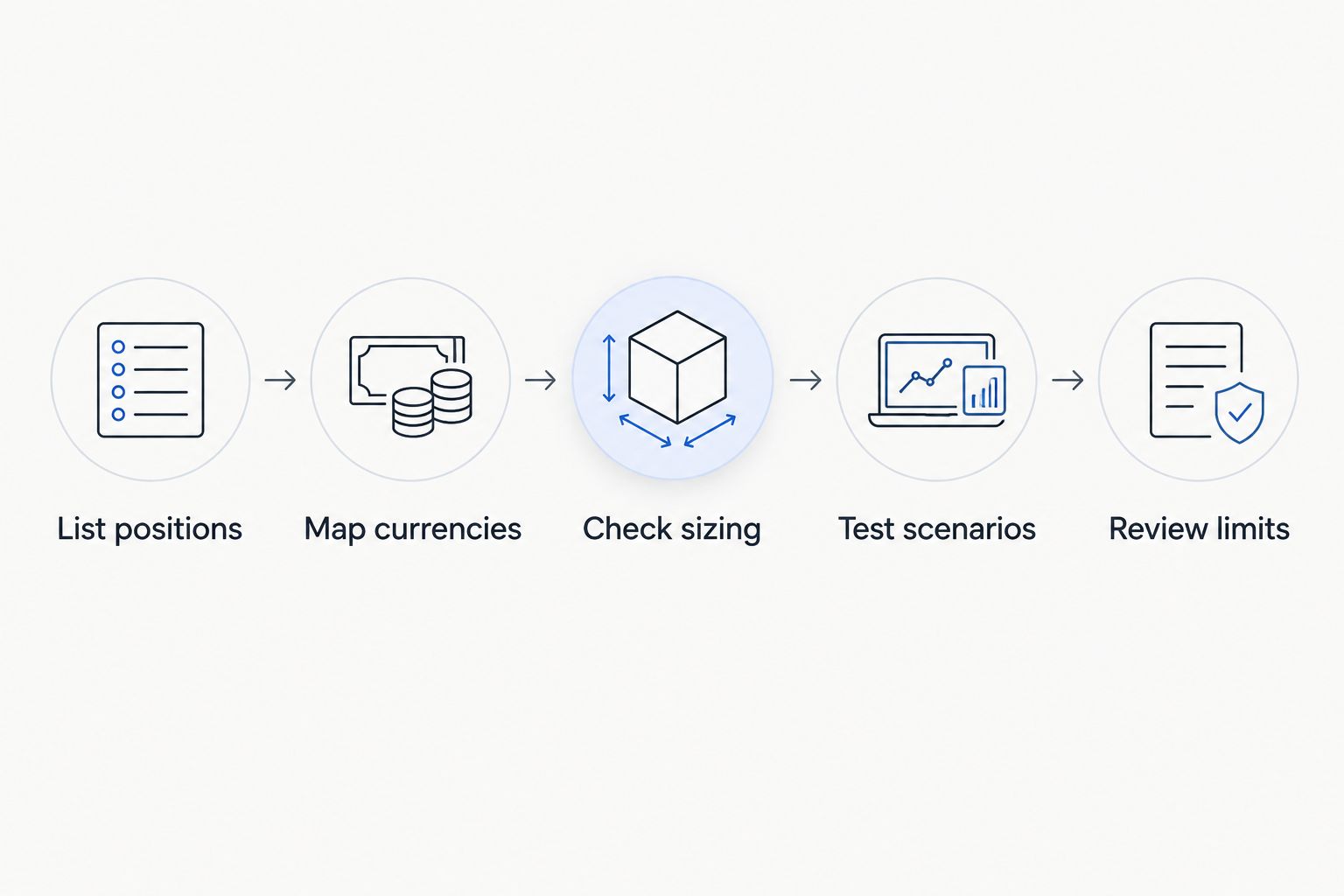
Map shared currencies before treating separate positions as diversified exposure.
This process has a limit. A scenario is an assumption, not a boundary on possible losses. Execution conditions and changing relationships still matter after the review.
06
Does negative correlation make a hedge?
A negative coefficient describes opposing returns in the measured sample. Your trade directions decide whether that relationship offsets or reinforces exposure. Long EUR/USD and short USD/CHF both carry short-dollar exposure.
Do equal lots mean equal risk?
Equal lots do not establish equal risk. Contract specifications, exchange rates and the conversion into your account currency affect monetary exposure. Potential price movement also matters.
Can low correlation still leave shared exposure?
A coefficient near 0 does not remove a shared currency component. It describes the sample’s linear relationship. Currency mapping and correlation analysis should therefore remain separate parts of the review.
FAQ
What is forex correlation exposure?
Forex correlation exposure is the combined risk associated with positions whose returns move together or share currency drivers. Different pair names do not establish independent exposure.
Does buying EUR/USD and GBP/USD double my dollar risk?
Buying EUR/USD and GBP/USD adds short-dollar exposure through both positions. Whether the monetary exposure doubles depends on sizing, exchange rates and how you measure risk.
Is selling USD/CHF a hedge for buying EUR/USD?
Selling USD/CHF does not offset the dollar direction of buying EUR/USD. Both positions carry short-dollar exposure, alongside different long-currency exposures.
What does a currency correlation of zero mean?
A correlation coefficient of 0 means no measured linear relationship within the sample. It does not prove independence or rule out simultaneous losses.
Should I measure correlation using prices or returns?
Use aligned returns when your question concerns co-movement in currency changes. Correlation of price levels measures a different relationship and can mislead an exposure review.
Can stop losses remove correlation risk?
Stop losses do not remove shared currency exposure. Several positions can move toward their stops together, and execution can differ from the requested stop level.
How often should I review currency exposure?
Review currency exposure when you add, remove or resize a position. Reassess assumptions when the market conditions behind the relationship change.
Conclusion
Correlation describes a relationship between observations. Exposure describes what your account carries. Use both views before treating another currency pair as another source of diversification.
One last thing
Hide the pair names on your worksheet. Leave only the long and short currencies visible. If the same currency direction appears repeatedly, the shared exposure becomes easier to see without a correlation chart.
Count shared currency exposure, not just open positions.
Related guides
This article is for educational purposes only and does not constitute investment advice. Trading CFDs and other leveraged products carries a high level of risk and may not be suitable for all investors.


