ShtëpiHow do real yields influence gold prices?
How do real yields influence gold prices?
Oct 20, 2026
Real yields generally influence gold prices through opportunity cost: when inflation-adjusted bond yields rise, holding gold becomes less attractive because gold pays no interest. Falling real yields reduce that disadvantage and can support gold. The gold real yields relationship is not a fixed rule, because currency moves, safe-haven demand and physical buying also affect prices.
TL;DR
- The gold real yields relationship is generally inverse, not a reliable standalone trading signal.
- Compare market real yields with inflation expectations, not just the latest inflation release.
- Gold can rise alongside real yields when other sources of demand outweigh the interest-rate effect.
- VCG Markets provides access to gold alongside other global markets; access does not remove trading risk.
01. How do real yields influence gold prices?
Higher real yields increase the opportunity cost of holding gold. Lower real yields reduce it. That is the central mechanism. Gold does not pay a coupon, so an investor holding it forgoes the income available from interest-bearing assets.
A real yield measures a bond’s return after accounting for inflation. When that return becomes more attractive, gold faces stronger competition for capital. When inflation-adjusted returns decline, the income sacrifice attached to gold becomes smaller.
This explains a tendency, not a mechanical response. Gold holders also seek diversification, protection during uncertainty and exposure to physical demand. Those motivations do not disappear when bond yields change.
For your 2026 market analysis, distinguish the direction of real yields from the direction of gold. Agreement supports the opportunity-cost explanation. Disagreement tells you to examine other drivers rather than assume one market must reverse.
Real yields rise
- Usual pressure on gold: Higher opportunity cost can pressure gold
- What the relationship cannot establish: Whether other demand will outweigh that pressure
Real yields fall
- Usual pressure on gold: Lower opportunity cost can support gold
- What the relationship cannot establish: Whether gold will rise during your observation period
Real yields turn negative
- Usual pressure on gold: Bonds offer a negative inflation-adjusted yield
- What the relationship cannot establish: Whether gold will preserve purchasing power over that period
Real yields remain steady
- Usual pressure on gold: The opportunity-cost impulse is limited
- What the relationship cannot establish: Whether currency moves or new demand will move gold
Why this matters
A rising nominal bond yield does not necessarily mean a rising real yield. Inflation expectations can move at the same time. Reading only the headline yield can therefore give you an incomplete explanation for gold’s response.
Macro context and chart analysis answer different questions. Real yields help explain the incentive to hold gold. Indicators for gold trading help you examine price behaviour. Neither establishes a guaranteed outcome.
02. What is the difference between nominal and real yields?
A nominal yield is the quoted bond yield before adjusting for inflation. A real yield accounts for inflation. For a forward-looking comparison, the relevant adjustment is expected inflation over a matching period, not simply the latest reported inflation rate.
A common approximation is:
Expected real yield = nominal yield minus expected inflation.
The exact relationship also accounts for compounding. The approximation is useful for understanding direction, but it is not a substitute for checking how a published yield series is calculated.
Market yields on inflation-linked bonds offer another way to observe real yields. These securities connect their payments to a specified inflation index. Their yields still reflect market conditions, including liquidity and the terms of the instrument.
Nominal bond yield
- What it tells you: Yield before adjusting for inflation
- Useful for: Tracking the quoted return on conventional bonds
- Main limitation: Does not separate inflation compensation from real return
Inflation-linked bond yield
- What it tells you: Market yield on an inflation-linked security
- Useful for: Following a traded measure of real yields
- Main limitation: Can reflect liquidity and instrument-specific effects
Breakeven inflation
- What it tells you: Difference between comparable nominal and inflation-linked yields
- Useful for: Examining market inflation compensation
- Main limitation: Includes more than a pure inflation forecast
Reported inflation
- What it tells you: Measured change in consumer prices
- Useful for: Understanding recently observed inflation
- Main limitation: Describes past price changes rather than future expectations
Match the maturity
A 10-year nominal yield should be compared with a matching inflation-linked maturity when examining a 10-year breakeven measure. Mixing maturities introduces another difference into the calculation. You would no longer be comparing the same horizon.
A 5-year real yield and a 10-year real yield can move differently. Each reflects a different part of the interest-rate outlook. Choose the horizon before interpreting the move, rather than selecting whichever series fits gold’s latest direction.
For a consistent 2026 review, keep the maturity, source and observation time unchanged. Changing the measure halfway through an explanation makes comparisons harder to interpret.
03. Why does the gold real yields relationship vary?
Real yields describe one incentive to hold gold. They do not measure total demand for it. Several forces can act together, sometimes reinforcing the usual inverse relationship and sometimes weakening it.
- Currency moves. A change in the currency used to quote gold affects its cost for buyers using other currencies. Exchange rates can therefore reinforce or offset the real-yield effect.
- Safe-haven demand. Financial stress or geopolitical uncertainty can increase demand for gold even while inflation-adjusted bond yields rise.
- Central-bank purchases. Reserve-management demand follows objectives beyond the near-term income comparison between gold and bonds.
- Physical demand. Jewellery, bar and coin buying respond to their own conditions. Real yields do not capture all those decisions.
- Market positioning. Futures and investment-product flows can affect short-term price behaviour. Position adjustments need not match the macroeconomic signal immediately.
- Expectations already reflected. Markets respond to changes in expectations. An anticipated rise in real yields is different from an unexpected move of the same direction.
These factors explain why the relationship changes across observation periods. A daily move can reflect an immediate reaction to news. A longer comparison includes changing demand, policy expectations and market conditions.
Correlation is not a price formula
An inverse correlation means two series tended to move in opposite directions over a defined sample. It does not establish a fixed amount by which gold should move when real yields change.
The result also depends on the calculation. Comparing price levels is different from comparing daily changes. Comparing daily changes is different from comparing weekly returns. A useful correlation claim must identify the series, frequency and sample period.
Treat any 2026 claim about a precise gold-to-yield relationship as incomplete unless those details are supplied. A chart alone does not establish a stable forecasting rule.
04. How can you read real yields alongside gold?
Use a repeatable observation process. The purpose is to explain market conditions without turning an economic relationship into an automatic instruction to trade.
Identify the yield
Write down whether you are observing a nominal yield, an inflation-linked yield or a calculated estimate. Include its maturity. A headline describing yields as higher is insufficient if the underlying measure is unclear.
Check inflation expectations
Compare changes in nominal yields with changes in market inflation compensation. If nominal yields rise while inflation expectations rise faster, the real-yield implication differs from a move driven entirely by higher inflation-adjusted returns.
Compare the timing
Align the gold observation with the bond-market observation. A gold move recorded before an announcement should not be explained using a yield move recorded after it. Matching timestamps matters especially around economic releases.
Check other drivers
Review currency direction, major risk events and relevant demand information. Look for evidence that supports the explanation. Do not label every unexplained move as safe-haven buying without a clear event or supporting information.
Record the limitation
State what the comparison establishes and what it does not. Gold rising while real yields fall is consistent with the opportunity-cost mechanism. It does not prove that real yields caused the entire move.
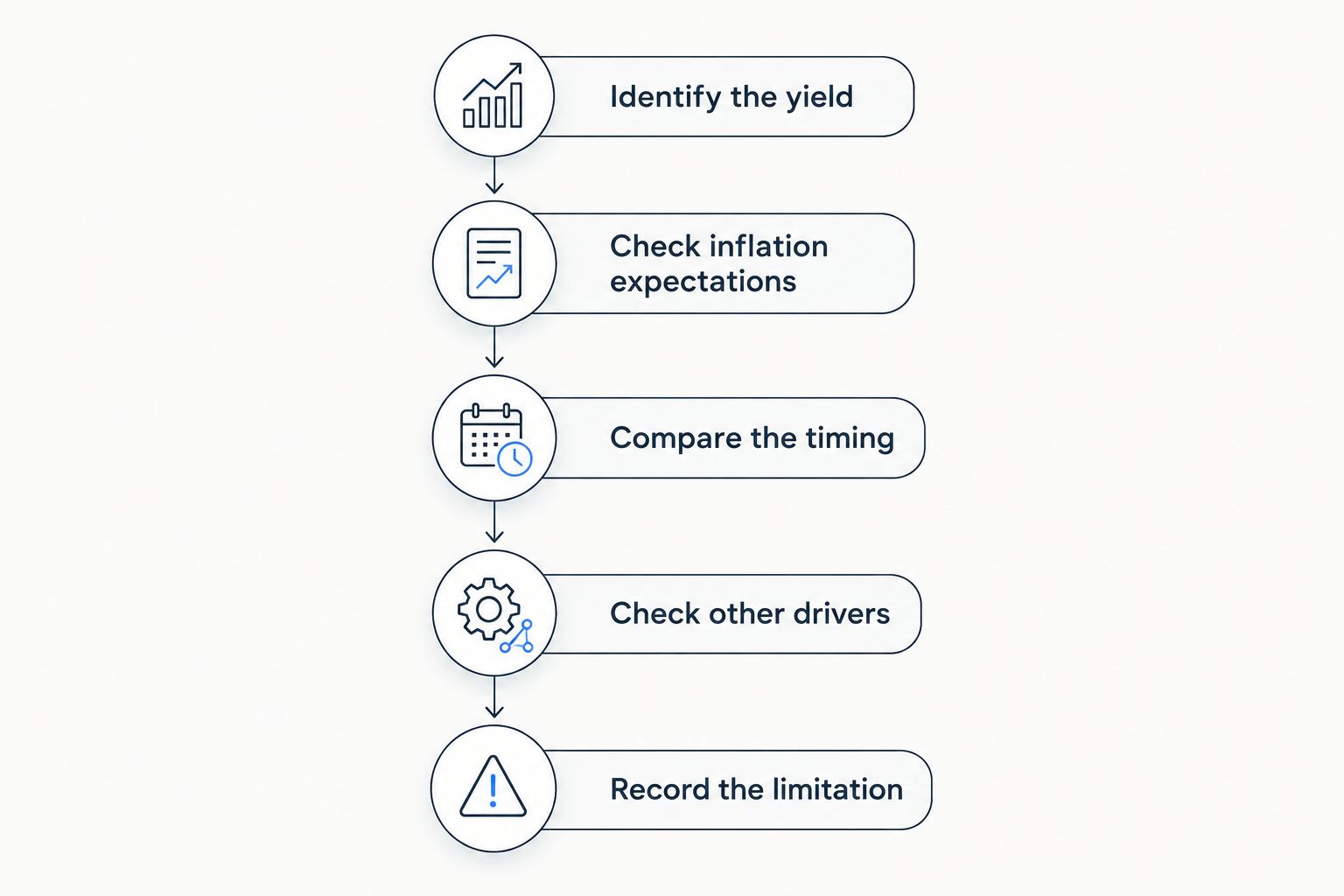
Align the measure and timing before assigning a cause to gold’s move.
Keep this process consistent throughout your 2026 market journal. Record the evidence available at the time. Explanations rewritten after the outcome are less useful for evaluating how you interpreted the original information.
Separate explanation from execution
A macroeconomic explanation does not specify an entry, exit or position size. Even a sound explanation can coexist with an adverse price move. Market exposure introduces risks that a correct directional narrative does not remove.
This distinction matters when you move from observing gold to trading a financial instrument linked to it. Understand the instrument’s terms separately. An economic relationship does not explain all the risks of the position.
05. What do common gold and yield combinations mean?
The same gold move can have different explanations depending on what real yields are doing. Start with the observed combination. Then test the explanation against the surrounding evidence.
Gold rises and real yields fall
- Initial interpretation: Consistent with lower opportunity cost
- What to check next: Currency moves and whether expectations changed
Gold falls and real yields rise
- Initial interpretation: Consistent with higher opportunity cost
- What to check next: Other demand changes and the timing of the moves
Gold rises and real yields rise
- Initial interpretation: Other demand is outweighing the usual headwind
- What to check next: Risk events, physical demand and investment flows
Gold falls and real yields fall
- Initial interpretation: Lower opportunity cost is not supporting the price enough
- What to check next: Currency strength, selling pressure and demand conditions
Can gold rise when real yields rise?
Gold can rise when real yields rise because the opportunity-cost effect is only one influence. Stronger demand elsewhere can outweigh it. The combination is a reason to investigate additional drivers, not proof that the relationship has stopped existing.
Does falling inflation make gold fall?
Falling inflation alone does not determine gold’s direction. If nominal yields fall faster than inflation expectations, real yields can decline. If inflation expectations fall faster, real yields can rise.
Are negative real yields always positive for gold?
Negative real yields reduce the appeal of inflation-adjusted bond income, but they do not guarantee gains in gold. The change in expectations and other sources of demand still matter. A negative yield that becomes less negative is also a rise in real yields.
06. The VCG Markets lens
VCG Markets is a multi-asset broker for traders seeking access to gold alongside other global markets. That access supports observing different markets together. It does not make the real-yield relationship a trading recommendation.
When reviewing markets through VCG Markets, separate the explanation from the decision. Gold and bond yields can tell a coherent macro story while the instrument you trade carries additional risks.
The useful question is not whether real yields predict every gold move. It is whether the evidence supports the explanation you are using. Keep the yield measure explicit. Keep competing explanations visible.
Conclusion
For 2026, use the gold real yields relationship as a framework for interpreting opportunity cost. Higher inflation-adjusted bond returns generally create a headwind for gold. Lower returns generally reduce that headwind.
One last thing: the level and the change tell different stories. Real yields can remain negative while rising sharply. In that situation, bonds still offer a negative inflation-adjusted yield, but the direction of change is making their relative appeal stronger.
Write down both before drawing a conclusion. A label such as negative real yields is not enough to explain the latest move.
FAQ
What is the gold real yields relationship?
The gold real yields relationship is generally inverse. Higher inflation-adjusted bond yields increase the opportunity cost of holding gold, while lower real yields reduce it. Other demand can outweigh that effect.
Why do higher real yields put pressure on gold?
Higher real yields make interest-bearing assets more attractive relative to gold, which pays no interest. That creates an opportunity-cost headwind rather than a guaranteed price decline.
Can gold and real yields rise together?
Gold and real yields can rise together when other demand outweighs the opportunity-cost effect. Currency moves, safe-haven demand and physical buying are among the factors to examine.
Should I subtract current inflation from a bond yield?
Subtracting current inflation produces a different measure from a forward-looking real yield. For market expectations, use a matching inflation horizon and understand how the chosen series is calculated.
Is a 10-year real yield enough to explain gold?
A 10-year real yield is not enough to explain every gold move. It provides a long-horizon interest-rate reference, but currency changes, demand and market positioning also matter.
Does a negative real yield guarantee that gold will rise?
A negative real yield does not guarantee that gold will rise. The direction of real-yield changes and other demand conditions remain relevant.
Can I use real yields as a standalone gold trading signal?
Real yields are not a reliable standalone gold trading signal. They explain one macroeconomic incentive but do not specify trade timing, position size or the risks of a particular instrument.
Related guides
This article is for educational purposes only and does not constitute investment advice. Trading CFDs and other leveraged products carries a high level of risk and may not be suitable for all investors.

Informacion
VCG Markets Ltd është entiteti i licencuar i autorizuar për të ofruar shërbime investimi. Është e regjistruar në Republikën e Mauritiusit (Nr. i Kompanisë 188485) dhe e autorizuar dhe e rregulluar nga Komisioni i Shërbimeve Financiare të Mauritiusit nën Licencën Nr. GB22200388, me zyrën e saj të regjistruar në The Cyberaty Lounge, Kati Përdhes, The Catalyst, Silicon Avenue, 40 Cybercity, 72201 Ebene, Republika e Mauritiusit.
VCG Markets (Seychelles) Ltd është entiteti i licencuar i autorizuar për të ofruar shërbime të ndërmjetësimit të letrave me vlerë (Securities Dealer). Është e regjistruar në Republikën e Seychelles-it (Nr. i Kompanisë 8438443-1) dhe e autorizuar dhe e rregulluar nga Autoriteti i Shërbimeve Financiare të Seychelles-it nën Licencën Nr. SD243, me zyrën e saj të regjistruar në House of Francis, Room 301(B), Ile Du Port, Mahe, Republika e Seychelles-it.
Faqja e internetit operohet nga VCG Tech Limited (Nr. i Kompanisë HE452446), me zyrën e saj të regjistruar në Agias Fylaxeos & Zinonos Rossidi, 2, Kati 1, 3082 Limassol, Qipro. VCG Tech Limited vepron si kompania tregtare për përpunimin e depozitave dhe tërheqjeve të klientëve.
Tregtimi i Forex me marzh dhe CFD-të janë produkte me levë dhe mund të rezultojnë në humbje që tejkalojnë depozitat tuaja. Vlera e investimeve mund të bjerë ashtu si mund të rritet, dhe mund të merrni mbrapsht më pak se investimi juaj origjinal. Ju lutemi të siguroheni që i kuptoni plotësisht rreziqet e përfshira dhe të shqyrtoni nëse një tregti e tillë është e përshtatshme për ju.
Thirrjet telefonike dhe komunikimet elektronike mund të regjistrohen dhe monitorohen për qëllime të sigurimit të cilësisë, pajtueshmërisë dhe trajnimit.
Informacioni në këtë faqe interneti ofrohet vetëm për qëllime të përgjithshme informative dhe nuk përbën këshillë investimi, rekomandim apo ftesë për t'u angazhuar në ndonjë aktivitet investimi.
VCG Markets nuk ofron këshilla tatimore. Legjislacioni tatimor mund të ndryshojë ose të ndryshojë ndërmjet juridiksioneve.
Informacioni në këtë faqe interneti nuk është drejtuar rezidentëve të Shteteve të Bashkuara të Amerikës, Belgjikës, Kanadasë, Singaporit, ose çdo juridiksioni ku qasja në informacione të tilla do të ishte në kundërshtim me ligjet ose rregulloret lokale.
Tregjet2026 VCG © , Inc. Të gjitha të drejtat e rezervuara.

Na ndiqni


