Margin education · 2026
Free margin changes while a trade is open because your equity changes and your required margin can change. Free margin equals equity minus used margin. Floating profit or loss moves equity as market prices update. Financing charges, currency conversion and changes to margin requirements can also move the figure.
Key points
- Floating profit and loss explain why free margin changes even when you place no new orders.
- Free margin equals equity minus used margin. A stable balance does not mean stable trading capacity.
- Check contract specifications and account transactions before treating a change as a platform error.
- VCG Markets traders should separate account equity, used margin and margin level when reviewing an open position.
01Read the calculation
02Identify the change
03Check the account rules
01
Why does free margin change while a trade is open?
An open position keeps being valued against current market prices. That valuation affects account equity before you close the trade. If equity falls while used margin stays unchanged, free margin falls by the same amount.
Free margin = equity minus used margin. This calculation explains why an unchanged account balance can sit beside a moving free-margin figure. Balance mainly records booked account transactions. Equity also reflects the current result of open positions.
For a 2026 account review, start with the instrument’s actual rules. The guide to reading contract specifications explains where to look for margin and financing terms. Do not assume that every instrument follows the same calculation.
| Account field | What it tells you | What it does not tell you |
| Balance | Booked account transactions | The current floating result |
| Equity | Account value including open-position results | How much margin positions require |
| Used margin | Margin allocated under account rules | The maximum possible trading loss |
| Free margin | Equity remaining after used margin | A guaranteed withdrawal amount |
Read these fields together. Free margin is useful for understanding current account capacity. Its limitation is that it is a moving snapshot, not a forecast of what the account will withstand.
02
Why this matters
Free margin can shrink without a new trade or a withdrawal. Watching balance alone leaves out unrealised losses. Watching only the chart leaves out margin requirements and booked charges.
The distinction matters when an order is rejected or an account approaches a risk threshold. Those events depend on the account’s rules. A falling free-margin figure deserves investigation, but it does not identify the cause by itself.
Use this 2026 guide to separate the calculation from the explanation. First establish which field moved. Then identify the position, transaction or contract rule behind it.
03
Why free margin varies
The immediate drivers sit on either side of the formula. Some change equity. Others change used margin. Several can occur together.
- Floating results. Open profits add to equity. Open losses subtract from it. The account total reflects all open positions, not just the trade you are watching.
- Spread changes. Positions are valued using the applicable closing side of the quote. A wider spread can worsen a floating result even when the displayed chart appears relatively steady.
- Booked charges. Financing, commissions and other applicable account entries affect account value when charged. Check transaction records rather than assuming that every change came from market direction.
- Currency conversion. Results and margin expressed in another currency need conversion into the account currency. Exchange-rate changes can therefore affect the account display.
- Margin requirements. Contract rules, position value and margin-currency conversion can affect required margin. Some calculations hold margin relatively steady. Others recalculate it as relevant prices change.
- Account activity. Another order filling, a position closing or a booked cash movement can change the account total. An unchanged individual trade does not mean an unchanged account.
A chart is not a complete account statement. The explanation of chart price and execution price helps distinguish the displayed price from the quote used for a transaction. Check the bid and ask alongside the account figures.
04
How do you check what changed?
Compare account fields from the same moment. Mixing an earlier equity figure with a current used-margin figure creates an apparent discrepancy. Keep the account currency visible throughout the check.
- Check equity. Compare the current floating result across all open positions. If used margin is unchanged, the equity movement explains the free-margin movement.
- Check margin. Look for a change in required margin. Match it to the relevant instrument and contract calculation rather than assuming a fixed requirement.
- Review transactions. Inspect financing entries, commissions, cash movements and recently executed orders. Their timestamps help separate booked activity from price updates.
- Read specifications. Confirm the margin currency, calculation method and applicable trading conditions. Use the terms attached to your account and instrument.
- Record timing. Save the account figures and relevant transaction identifiers if the calculation remains unexplained. Give support the account currency and instrument name as well.
For a 2026 account query, a timestamped record is more useful than an isolated screenshot of a chart. It connects the account calculation to the prices and entries that applied at that moment.
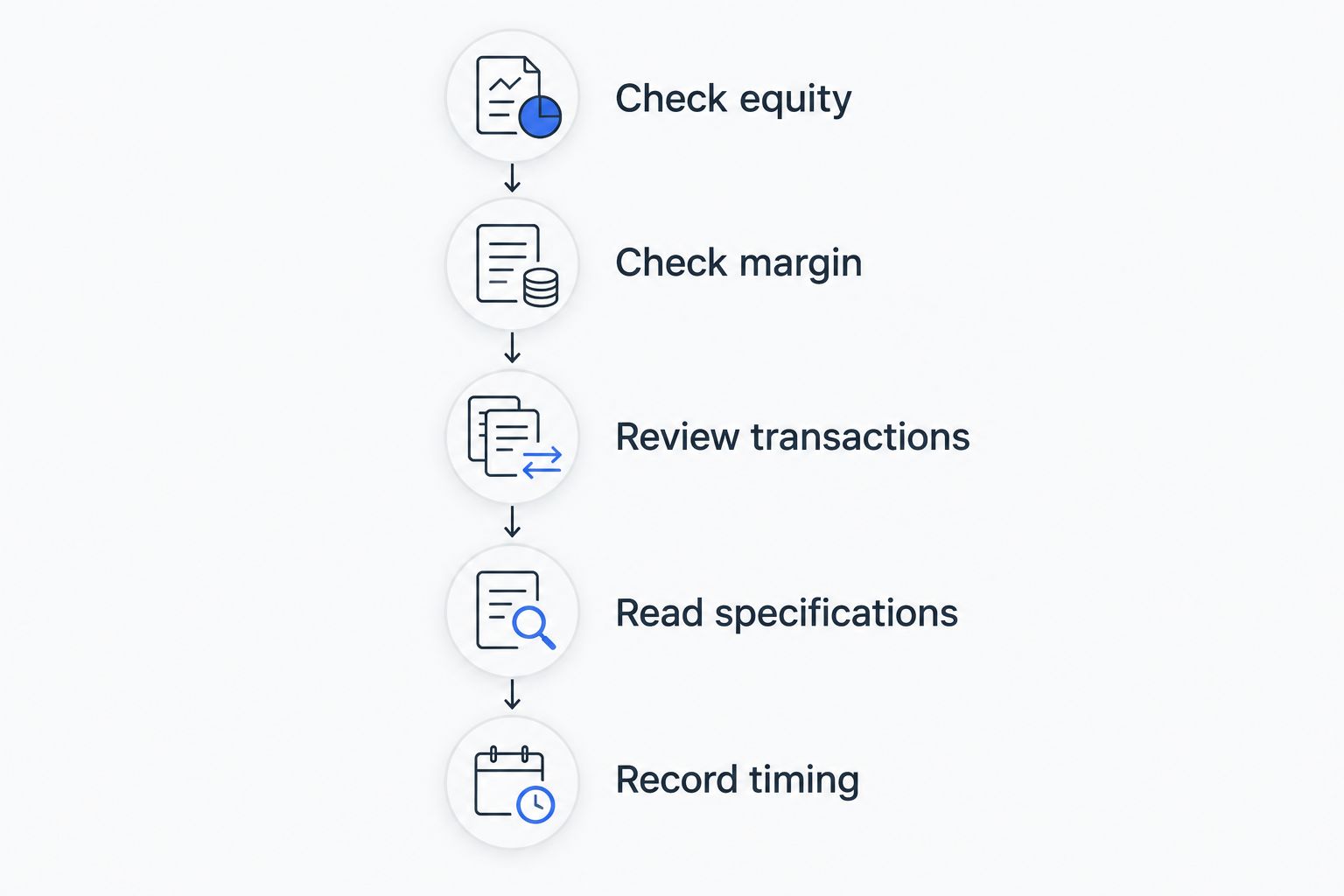
Separate changes in equity from changes in required margin before checking individual transactions.
Do not use an unexplained change as a reason to increase exposure. Establish the calculation first. An account display describes current conditions, not the suitability of another trade.
05
Why does free margin fall when my trade is profitable?
Free margin can fall during a profitable trade because the figure belongs to the whole account. Losses elsewhere, booked charges or higher used margin can outweigh that position’s profit. Review the account total rather than treating a profitable position as proof that free margin must rise.
Does setting a stop loss release free margin?
Setting a stop loss does not normally release used margin while the position remains open. It adds an exit instruction. It does not close the position or guarantee the final execution price.
Is free margin the same as margin level?
Free margin is an amount in the account currency. Margin level expresses equity relative to used margin as a percentage. Account-specific margin-call and stop-out rules determine how that relationship is used.
FAQ
Why does my free margin change when I have not placed another trade?
Free margin changes because open positions keep affecting equity as prices update. Required margin, currency conversion and booked account entries can also change without a new order.
Why is my balance unchanged but my free margin lower?
An unchanged balance can sit beside lower free margin because floating losses reduce equity before a position closes. Compare equity and used margin rather than balance alone.
Does higher free margin mean I have made a realised profit?
Higher free margin does not prove a realised profit. Unrealised gains, lower margin requirements or a deposit can increase the figure without a profitable trade being closed.
Can a wider spread reduce free margin?
A wider spread can reduce free margin by worsening the current valuation of an open position. Check both sides of the quote rather than relying on the chart alone.
Does closing a trade always increase free margin?
Closing a trade releases the margin assigned to that position, but execution costs and other account movements affect the final result. Realising an existing floating loss does not deduct that same loss from equity a second time.
Which margin threshold applies to my account in 2026?
The applicable threshold comes from your current account terms and trading conditions. Check the margin-call and stop-out rules rather than assuming one percentage applies to every account.
Conclusion
One final distinction: closing a losing position does not charge the existing floating loss twice. Equity already reflects that loss before closure. Execution differences and closing costs still affect the final account figures.
For VCG Markets account checks, keep equity, used margin and transaction history together. Those fields explain the movement more clearly than balance or price direction alone.
Identify which side of the free-margin calculation changed before interpreting the result.
Related guides
- How currency conversion affects trade results
- How correlated pairs create hidden exposure
- Understanding trailing stop limitations
This article is for educational purposes only and does not constitute investment advice. Trading CFDs and other leveraged products carries a high level of risk and may not be suitable for all investors.


