Share Trading · Understanding Costs
There is no single cost to trade shares online in 2026. Your total depends on the instrument, position size, spread, commission and holding period. Currency conversion and account charges can add costs beyond placing the order.
Key points
- How much does it cost to trade shares online? Calculate the full trade, not commission alone.
- VCG Markets provides share trading within a multi-asset offering; check the instrument’s contract terms before placing an order.
- Separate spreads, commissions, holding charges and currency conversion when reviewing trading costs.
- Money committed to a position is not the same as a trading fee.
Start with the instrument’s contract specifications. Check what you are trading before comparing charges. A share-ownership account and a contract providing share-price exposure do not have interchangeable terms.
01Identify the charges
02Check the holding period
03Reconcile the result
01
How much does it cost to trade shares online in 2026?
The useful figure is the total cost of opening, holding and closing your position. A commission figure covers only the charge described in its terms. It does not explain every deduction that can affect your final account result.
- Spread: The difference between the quoted buying and selling prices. It affects the price at which you enter and exit.
- Commission: An explicit transaction charge where applicable. Check its calculation basis and whether it applies on entry, exit or both.
- Holding charges: Financing, borrowing or other holding-related charges where the instrument’s terms provide for them.
- Currency conversion: A separate cost where funds or trading results are converted between currencies.
- Other applicable charges: Exchange, custody, account or transaction-related charges specified for your account and instrument.
Why this matters
A comparison that stops at commission leaves out the rest of the transaction. In 2026, compare the same instrument, trade size, account currency and intended holding period. Otherwise you are comparing different trading decisions rather than different costs.
Keep market losses separate from charges. A position can lose value because the share price moves against it. That loss is not a broker fee, although both reduce the final amount left in your account.
02
Share ownership and share-price exposure have different costs
The company name on your watchlist does not establish what your account holds. Read the legal instrument description. It determines whether you acquire shares or enter a contract linked to their price.
| Structure | Purpose and distinction | Cost checks and limitations |
| Share ownership | For acquiring the underlying shares, subject to the account’s ownership arrangements. | Check dealing, custody, conversion and applicable transaction charges. Ownership does not remove market risk. |
| Share-price exposure | For taking contractual exposure to a share’s price rather than acquiring the share itself. | Check spreads, commission, financing and adjustments. Margin-based exposure adds risks beyond the initial amount committed. |
Neither structure has a universal total charge. An unfinanced share purchase differs from a margin-funded position. A short position can also have borrowing-related terms that do not apply to a long position.
Margin is not a transaction fee. It is money required to support an open position. Do not compare a margin requirement with a dealing commission as though they measure the same thing.
03
Why online share trading costs vary
Your 2026 cost estimate needs the terms of your intended transaction. A general account description is not enough. These factors explain why charges differ between positions.
- Instrument structure. Ownership, financed exposure and short selling involve different contractual obligations. Identify those obligations before adding charges together.
- Position size. Percentage-based and per-share charges respond to size differently from fixed charges. Minimum charges also change the relationship between trade value and cost.
- Market conditions. Available liquidity and changing quotes affect the spread and execution price. Your eventual fill need not match an earlier screen quote.
- Holding period. Positions subject to financing can accumulate charges across applicable charging points. Closing before a relevant cutoff changes that calculation.
- Currency mismatch. Your funding currency, instrument currency and account currency can differ. Check which balances or results are converted and when.
- Account terms. Custody, inactivity, withdrawal and other administrative charges depend on the agreement. Separate them from charges attributable to an individual trade.
Do not treat every item as an automatic deduction. A charge belongs in your estimate only when the published terms make it applicable. Ask for clarification when the calculation basis is unclear.
04
How do I estimate the cost before placing an order?
Build the estimate around the complete transaction. Opening and closing create 2 order sides for 1 round trip. Check the charging terms for each side rather than assuming the opening charge covers the exit.
- Contract terms. Record the instrument, direction, size and account currency. Confirm whether the position involves ownership, financing or borrowing.
- Entry costs. Check the current spread and applicable commission. Confirm whether the displayed quote is executable for your intended size.
- Holding costs. Identify charging cutoffs and the applicable financing basis. Use your planned holding period without assuming the eventual duration will match it.
- Exit costs. Include any closing commission. Treat the future spread and execution price as unknown rather than copying the entry quote as a certainty.
- Account costs. Add applicable conversion or administrative charges separately. Keep charges unrelated to this position outside its individual transaction total.
This sequence produces an estimate, not a guaranteed execution result. Keep the quoted conditions alongside your calculation. That record lets you distinguish a changed market quote from a misunderstood fee.
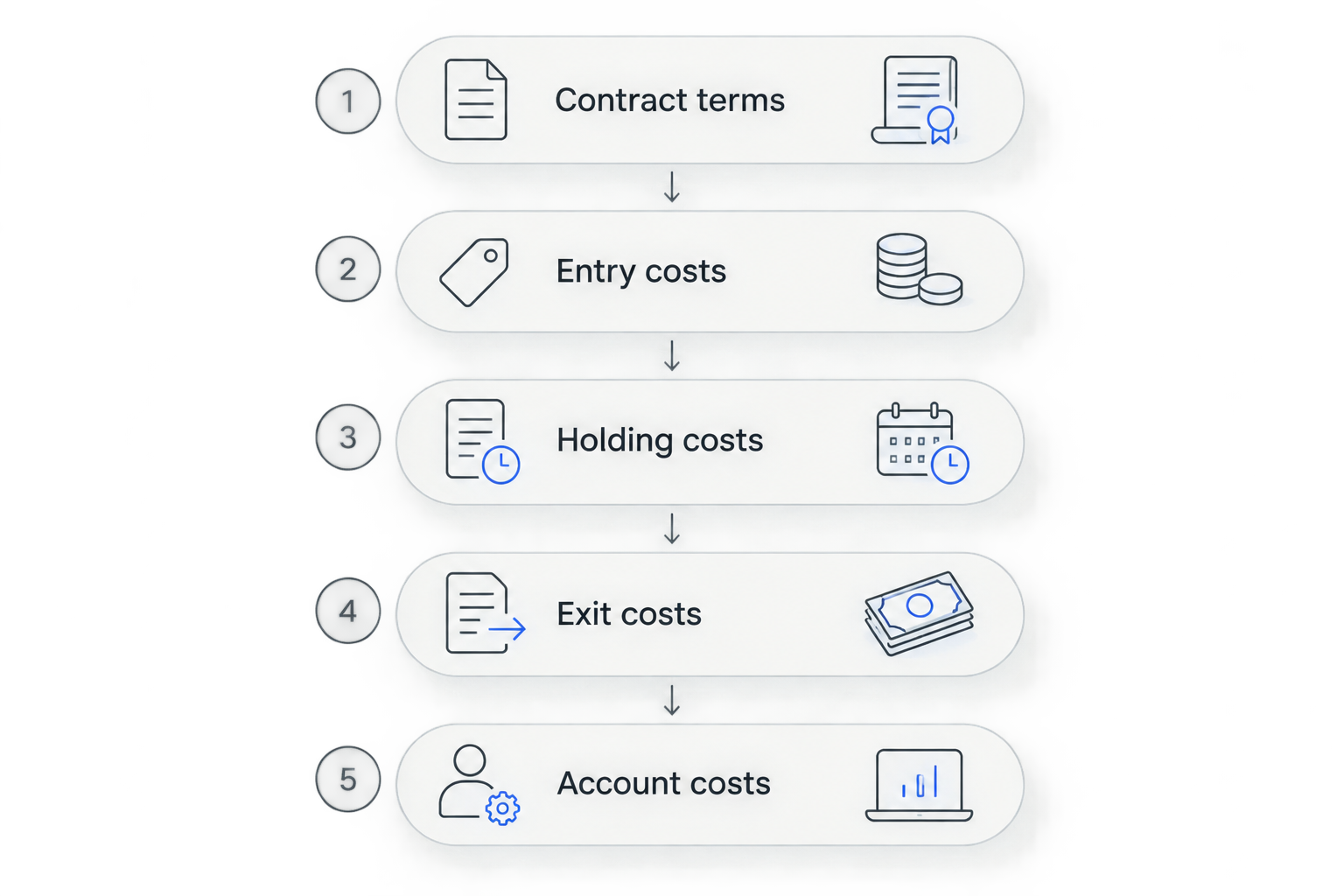
Estimate the complete transaction before comparing individual charges.
Use 3 records: the pre-trade estimate, the execution confirmation and the final account statement. The estimate documents expectations. The confirmation records fills. The statement shows booked charges and adjustments.
Reconcile those records after closing. Do not add the spread again if your calculation already measures the result from actual entry and exit fills. Doing so counts the same effect twice.
05
Do I pay a charge when I sell shares as well?
Selling can incur commission and other applicable transaction charges. Your schedule determines whether charges apply on each side or through another arrangement. Read the exit terms before assuming the sale has no separate cost.
The selling price also matters. A market order prioritises execution rather than a specified price. A limit order sets a price condition but does not guarantee a fill.
Does holding a share position overnight add a charge?
Overnight charges depend on the instrument and financing arrangement. They are not universal across share trading. Check the charging cutoff, the applicable direction and how non-trading days are handled.
Review your trade holding time against those terms. The relevant measurement is exposure across the charging boundary, not simply the date you remember opening the trade.
Is the money I deposit part of the trading cost?
A deposit funds your account. It is not itself a dealing charge. Any payment-related fee is separate, and funds committed to trading remain exposed to the instrument’s risks.
FAQ
How much does it cost to trade shares online in 2026?
There is no universal total. Calculate the applicable spread, commission, holding charges, conversion and other specified charges for your instrument and position size.
Is commission the only cost of trading shares online?
Commission is only one possible cost. Spreads, financing, currency conversion and account charges can also affect your result when applicable.
Do I pay trading costs when a position loses money?
Applicable charges still apply when a position loses money. Market losses and trading charges are separate components of the final result.
Can I know my exact exit cost before opening a share trade?
You cannot know every future execution condition in advance. Published commission terms support an estimate, but the future spread, fill and holding duration are not fixed by that estimate.
Does a smaller margin requirement mean a cheaper trade?
A smaller margin requirement does not establish a lower trading cost. Margin supports exposure; spreads, commissions and financing follow their own calculation rules.
Does VCG Markets offer share trading?
VCG Markets offers share trading within its multi-asset offering. Check the specific instrument’s terms to understand the exposure, charges and risks before placing an order.
Should I add the spread to my realised trading result?
Do not deduct the spread again when your result already uses actual entry and exit fills. Check whether the displayed result includes or excludes separately booked commissions and holding charges.
Conclusion
For your 2026 comparison, use the same position size and holding assumptions throughout. Confirm the instrument structure first. Then estimate entry, holding and exit costs before checking the final booked result.
One last thing
A detailed cost review can still be wrong through double-counting. Label each charge as embedded in execution or booked separately. That distinction matters when reconciling your calculation with the account statement.
Compare the complete transaction. Count each cost once.
Related guides
This article is for educational purposes only and does not constitute investment advice. Trading CFDs and other leveraged products carries a high level of risk and may not be suitable for all investors.