Forex Education · 2026
Pip value differs across currency pairs because it depends on position size, pip size and conversion into your account currency. A pip produces a value in the pair’s quote currency first. Converting that amount changes its account-currency value as exchange rates move. Pip value alone does not include trading costs.
Key takeaways
- Pip value: different currency pairs require the same calculation, followed by account-currency conversion.
- For most forex pairs, one pip is 0.0001; for most yen-quoted pairs, it is 0.01.
- Equal lot sizes do not guarantee equal account-currency exposure per pip.
- VCG Markets forex education separates pip value, position size and trading costs.
This VCG Markets guide explains the calculation for 2026. Start with units of the base currency. Then check the pip convention and the currency in which your account records profit and loss.
01The calculation
02Currency conversion
03Exposure checks
01
Why does pip value differ across currency pairs?
The calculation starts in the quote currency. That is the second currency in the pair. For EUR/USD, the quote currency is the dollar. For USD/JPY, it is the yen.
Pip value in quote currency = base-currency units × pip size. To express that amount in your account currency, multiply it by the account-currency units received for one unit of quote currency. No conversion is needed when the currencies match.
The table uses the conventional standard forex lot of 100,000 base-currency units. It illustrates pip arithmetic, not an account specification. Check the contract size assigned to the actual symbol before applying it.
| Currency pair | Conventional pip | Value per standard lot |
| EUR/USD | 0.0001 USD per EUR | 10 USD per pip |
| GBP/USD | 0.0001 USD per GBP | 10 USD per pip |
| USD/JPY | 0.01 JPY per USD | 1,000 JPY per pip |
| EUR/GBP | 0.0001 GBP per EUR | 10 GBP per pip |
EUR/USD and GBP/USD show why different pairs do not always have different pip values. Equal base-unit positions produce the same dollar amount per pip. EUR/GBP produces pounds instead. Those amounts require a common currency before comparison.
02
Why this matters
A stop distance measured in pips does not state the amount at risk. You also need the position’s pip value in your account currency. Multiplying the two gives a planned price-movement loss before costs and execution differences.
That distinction matters when comparing trades in 2026. A wider stop does not automatically mean a larger monetary exposure. Position size and currency conversion also enter the calculation.
- Pips describe distance. They measure the currency pair’s movement.
- Pip value describes sensitivity. It expresses the monetary effect of that movement for a specified position.
- Execution determines the realised result. A planned stop level does not guarantee the fill price.
Pip value also leaves portfolio overlap unresolved. Separate currency pairs can share a directional driver. The guide to correlated pairs and hidden exposure explains why different symbols do not necessarily mean independent risks.
03
How do you calculate pip value in your account currency?
Use the same sequence for each pair. Keep the currency label attached to every amount. This prevents a quote-currency figure from being mistaken for an account-currency figure.
- Check contract size. Convert the selected lot quantity into base-currency units using the symbol specification.
- Check pip size. Identify the conventional pip increment. Do not substitute the smallest displayed price increment without checking.
- Calculate quote value. Multiply base-currency units by pip size. The result is money per pip in the quote currency.
- Convert account value. Apply the relevant quote-to-account conversion. If the two currencies match, keep the amount unchanged.
The sequence separates position measurement from currency conversion. For a 2026 trade review, retain the conversion rate or platform valuation used at the relevant time. A later rate can produce a different account-currency equivalent.
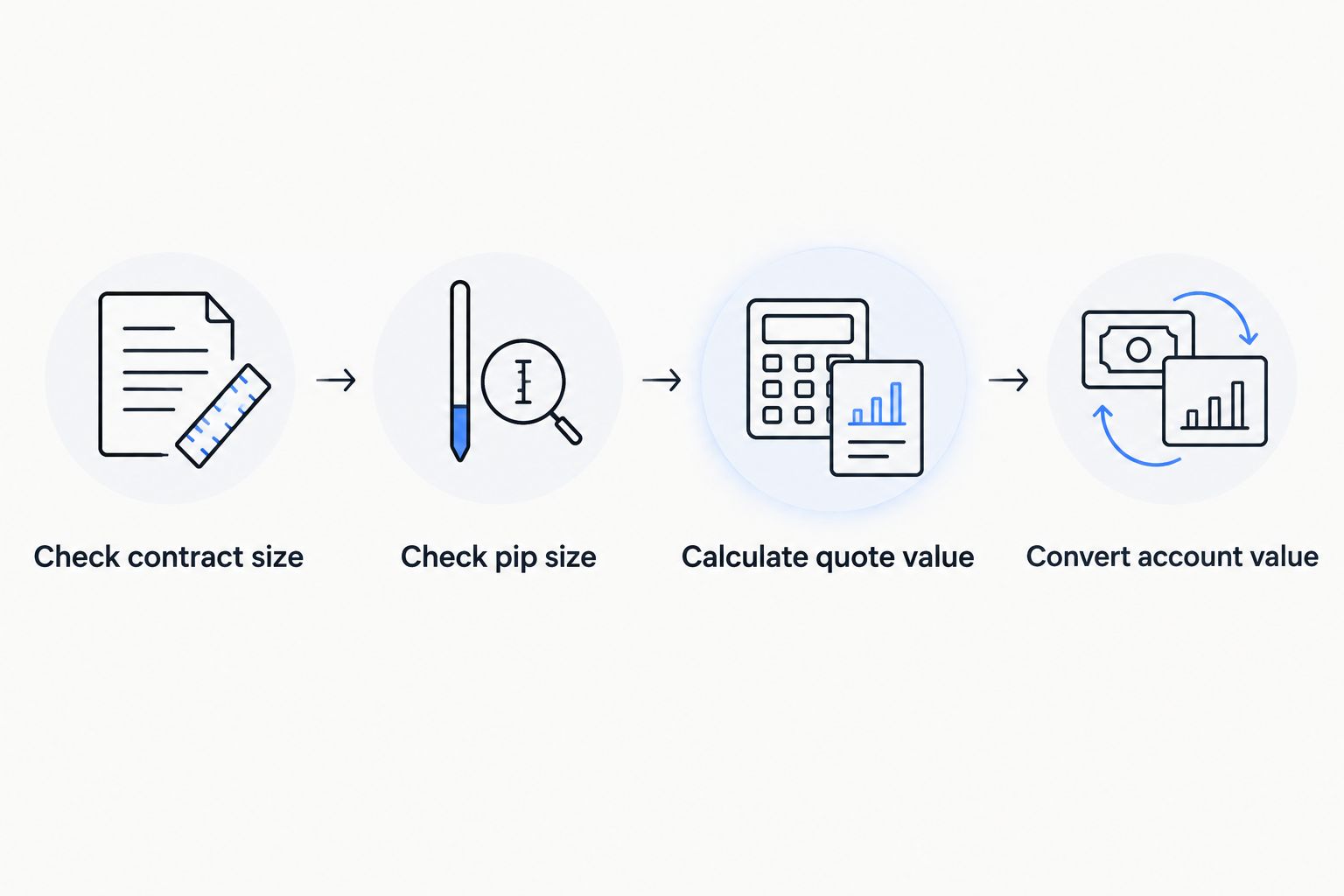
Calculate the quote-currency amount before converting it into your account currency.
Check the direction of the conversion quotation. Multiplication works when the rate expresses account currency per unit of quote currency. A quotation in the reverse direction requires division. Currency units provide a useful check: the unwanted quote-currency unit should cancel.
Manual calculation makes the mechanics visible. Its limitation is that a saved calculation does not update itself. A platform-displayed value also needs context: confirm the symbol, position quantity, account currency and whether the displayed tick value refers to a tick rather than a full pip.
04
Why pip value varies
The calculation has identifiable inputs. Changing the currency pair is not the only way to change the result. Your position quantity and account denomination matter too.
- Position size. More base-currency units create a larger quote-currency value per pip. Reducing units reduces that value proportionately.
- Pip convention. Most pairs use 0.0001 quote-currency units per base-currency unit. Most yen-quoted pairs use 0.01.
- Quote currency. The initial monetary result belongs to the second currency in the pair. Equal numerical amounts in different currencies are not equivalent exposures.
- Account currency. A conversion is necessary when the quote currency differs from the currency used to report account profit and loss.
- Conversion rate. A changing exchange rate changes the account-currency equivalent. The quote-currency pip value can remain unchanged at the same position size.
- Contract specification. A lot label needs its underlying unit definition. Check the actual instrument rather than assuming every symbol uses the conventional forex contract size.
Margin is a separate calculation. Changing account leverage does not itself change pip value for an unchanged position. Increasing the position because less margin is required does change pip value. The cause is the larger position, not the margin setting alone.
05
Why do yen pairs use a different pip size?
0.01 yen per base-currency unit is the conventional pip size for most yen-quoted pairs. The different decimal position is a quotation convention. It does not establish whether a trade has more or less monetary risk.
At the conventional standard-lot size, a pip in USD/JPY produces 1,000 JPY of movement value. A dollar account then needs a yen-to-dollar conversion. Comparing that yen figure directly with a dollar pip value mixes currencies and gives a misleading comparison.
Is a pip the same as a point?
A pip and a point are not automatically interchangeable. Many forex quotes include a fractional pip. Platform terminology and symbol precision determine how the smallest displayed increment relates to the conventional pip.
For your 2026 records, label the unit explicitly. A stop entered in points must be converted correctly before multiplying by a value stated per pip. The same caution applies to tick-value fields in contract specifications.
FAQ
Is pip value the same for every currency pair?
Pip value is not the same for every currency pair. Position size, pip convention and account-currency conversion determine the amount. Some pairs share the same pip value when those inputs align.
Why do EUR/USD and GBP/USD have the same dollar pip value?
EUR/USD and GBP/USD each produce 10 USD per pip for a conventional standard lot of 100,000 base-currency units. Both have the dollar as quote currency and a conventional pip size of 0.0001. That does not make their volatility or trading risk identical.
Does pip value change while a trade is open?
Account-currency pip value changes when the required currency conversion rate changes. For an unchanged position, quote-currency pip value remains constant under a fixed pip convention.
Does higher leverage increase pip value?
Higher leverage does not increase pip value for an unchanged position. A larger position increases pip value, even if the decision to increase size follows a change in available margin.
Does pip value include the spread and commission?
Pip value does not include the spread or commission. It measures monetary movement per pip for a specified position. Trading costs must be considered separately.
Can I use forex pip calculations for gold or indices?
Do not assume forex pip conventions apply to gold or indices. Check the instrument’s contract size, tick size and tick value. The relevant unit specification determines the calculation.
Conclusion
One final check for 2026: write the currency beside the pip value. A figure without its denomination is incomplete. Before comparing positions, bring their movement values into the same account currency.
Then separate planned price exposure from execution risk and costs. An accurate pip calculation explains sensitivity. It does not guarantee the final amount booked when a position closes.
Compare monetary exposure in one currency, not pip counts alone.
Related guides
- Why market gaps affect stop-loss execution
- Positive and negative slippage
- Chart price and execution price
This article is for educational purposes only and does not constitute investment advice. Trading CFDs and other leveraged products carries a high level of risk and may not be suitable for all investors.


