Gold trading · Ownership and exposure
Yes. You can trade gold without owning physical gold through gold-linked contracts, exchange-traded funds, futures or options. These routes remove the need to store bullion yourself, but they introduce different ownership rights, costs and risks.
Key points
- Can you trade gold without owning physical gold? Yes. Gold-linked instruments provide exposure without personal bullion storage.
- Gold funds, futures and options differ in ownership rights, expiry and settlement.
- Gold-mining shares add company risks. They do not reproduce gold’s movements directly.
- VCG Markets offers gold trading through its multi-asset brokerage. Trading exposure does not mean owning bullion.
01Compare the instruments
02Understand ownership
03Check the risks
01
Can you trade gold without owning physical gold?
Yes. The distinction is between owning metal and holding a financial instrument linked to it. Before comparing charts, read the contract specifications. The instrument determines your legal rights and how your position settles.
Why this matters: a gold label does not identify what you own. A fund share, a futures contract and a mining share create different exposures. The same gold move can produce different account results.
| Route | What you hold | Suited to | Main limitation |
| Gold-linked trading contract | Contractual exposure to gold movements | Traders seeking exposure without bullion custody | Margin, financing and counterparty terms |
| Physically backed gold fund | Shares in a fund holding gold | Investors seeking fund-based exposure | Fund expenses and redemption restrictions |
| Gold futures | A dated contract with settlement obligations | Traders managing expiry and margin | Delivery rules and rollover exposure |
| Gold options | A contractual right or obligation | Traders managing expiry and option behaviour | Time decay and exercise consequences |
| Gold-mining shares | Equity in a mining company | Investors seeking mining-business exposure | Company performance can diverge from gold |
02
Gold-linked contracts: exposure without bullion ownership
A cash-settled gold trading contract records gains or losses from changes in its quoted value. You do not receive coins or bars. Your rights are against the contract provider under the agreement.
The practical benefit is avoiding personal storage and delivery. The trade-off is contractual exposure rather than ownership of metal. Financing charges and the difference between buying and selling quotations can affect your result.
A margin requirement is not the full economic exposure. Margin supports a larger position under the instrument’s terms. An adverse move can trigger additional funding requirements or position closure. Review how to read margin level alongside the contract rules.
03
Gold funds: owning shares rather than bars
A physically backed gold fund holds metal through its custody arrangements. You buy fund shares. That does not automatically give you the right to collect a bar from a vault.
This structure separates your investment from personal storage. Its limitations include fund expenses, trading spreads and differences between the share quotation and the value of underlying assets. Read the prospectus for redemption eligibility and custody arrangements.
Check the underlying holdings. A fund linked to gold futures is not the same as a fund holding bullion. A mining-company fund adds business exposure. The word gold in a fund name does not resolve those differences.
04
Gold futures: expiry changes the decision
Gold futures provide exposure through a contract with a specified expiry and settlement method. You can hold a futures position without holding bullion. However, physically deliverable contracts create delivery obligations if they remain open into the relevant settlement process.
Futures offer standardised contract terms. They also require active attention to margin and settlement deadlines. Your broker can impose closing deadlines before the exchange’s delivery process begins.
Maintaining exposure beyond expiry normally requires closing the expiring contract and opening another maturity. This is a rollover. Different maturities can trade at different levels, so rolling is not simply extending the same position unchanged.
05
Gold options: direction is only part of the result
Buying an option gives you a contractual right under specified terms. It does not immediately transfer ownership of gold. The underlying instrument might be a futures contract or fund shares rather than physical metal.
An option buyer can define the premium at risk on the option itself. The limitation is that direction alone does not determine the result. Time remaining and expected volatility also affect an option’s value.
Selling options creates different obligations and potentially substantial losses. Exercise or assignment can establish an underlying position. Check those consequences before treating an option as exposure that ends automatically at expiry.
06
Gold-mining shares: exposure to a business
Buying mining shares gives you equity in a company. You do not own its extracted gold directly. Gold movements influence the business, but production costs and operational decisions also affect shareholder returns.
Mining shares provide exposure to a company’s assets and operations without bullion storage. That is also their limitation as a substitute for gold. Debt, production disruptions and changes in the wider share market can outweigh movements in the metal.
Mining shares are not direct gold exposure. A rising gold market does not guarantee a rising mining share. Assess the business separately from your view on the commodity.
07
Why gold exposure varies between instruments
Removing personal storage does not remove risk. These contract features explain why gold-linked positions can behave differently.
- Underlying exposure. Bullion, futures and mining businesses respond to different influences.
- Margin requirements. A margin-funded position creates exposure beyond the cash committed as margin.
- Holding costs. Financing, fund expenses and rollover affect results differently.
- Expiry and settlement. A dated contract introduces deadlines that an open-ended fund does not share.
- Currency conversion. Your account currency can change the translated result.
- Execution conditions. Spreads, liquidity and gaps affect where an order fills.
Compare the instrument over your intended holding period. A position designed for a brief trade and an investment held over an extended period face different cost and settlement considerations.
08
What should you check before trading gold?
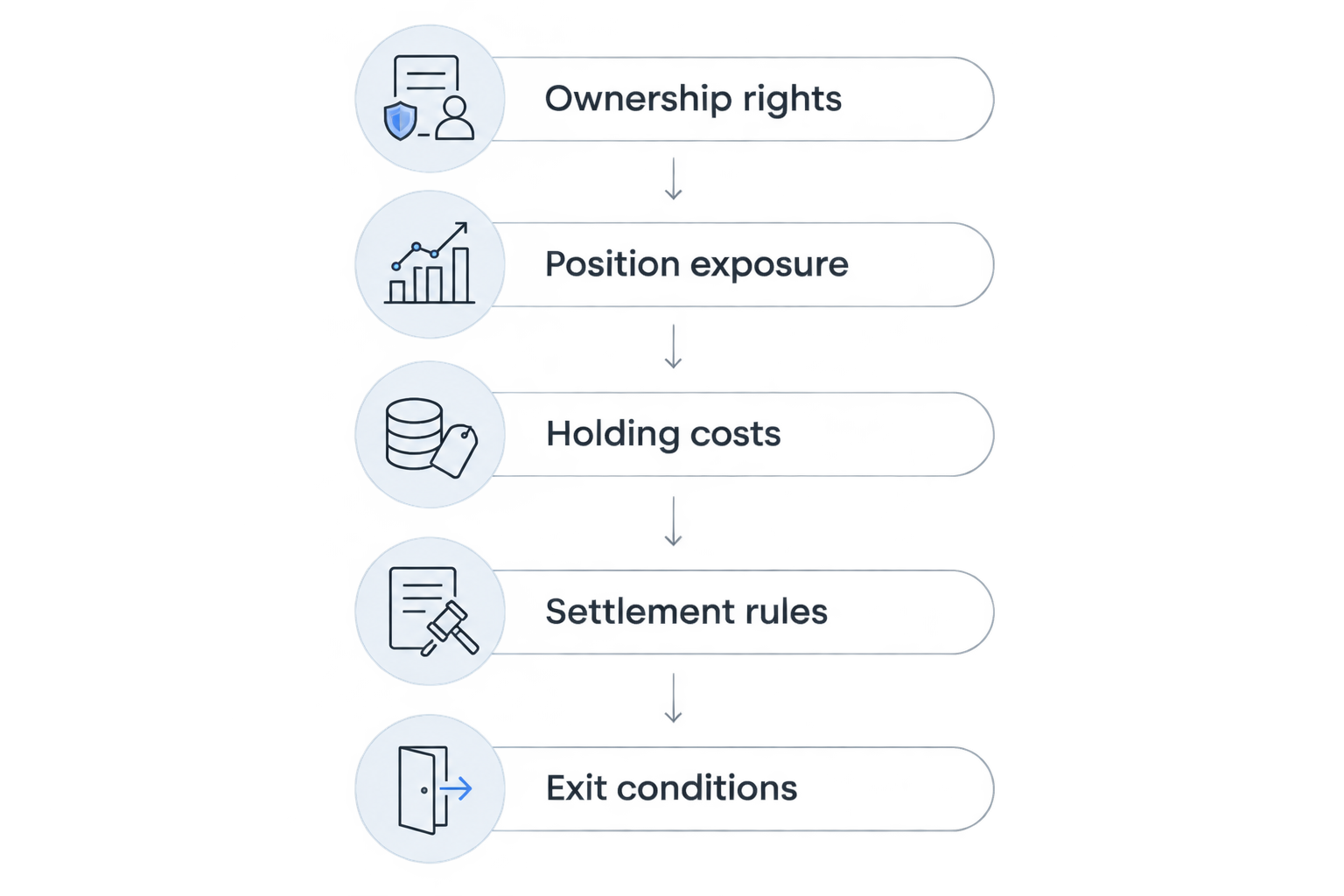
Read the legal instrument description before placing an order. Use this sequence to separate the gold quotation from the obligations attached to your position.
- Ownership rights. Identify whether you hold fund shares, company equity or a trading contract.
- Position exposure. Check the contract size and total exposure. Do not substitute the margin deposit for position value.
- Holding costs. Read the applicable charges and how they accrue.
- Settlement rules. Check expiry, delivery provisions and any broker closing deadline.
- Exit conditions. Review trading hours, order handling and what happens during a market gap.
These checks answer different questions. Ownership establishes your rights. Exposure establishes the scale of the position. Settlement and exit rules establish how the obligation ends.
A gold quotation does not describe the obligations attached to the position.
Do not assume that closing an app closes a position. An open trade remains subject to its contract terms until it is closed, expires or settles. Check the position record rather than relying on the chart alone.
Frequently asked questions
Do I own gold when I open a gold trading position?
Not necessarily. A gold trading contract gives you the rights specified in that contract, not automatic ownership of bullion. Check the legal instrument description.
Can I trade gold without arranging storage?
Yes. Gold-linked contracts, fund shares, futures and options do not require you to arrange personal bullion storage when opening the position. Physically deliverable contracts still require attention to settlement rules.
Does a physically backed gold fund let me collect gold bars?
Not automatically. Physical redemption depends on the fund’s rules and investor eligibility. Owning fund shares is not the same as holding a specific bar in your own name.
Can I lose money trading gold without owning it?
Yes. Gold-linked instruments can lose value, and margin-funded positions can face forced closure. Removing storage requirements does not remove market risk.
Are gold-mining shares the same as trading gold?
No. Mining shares represent ownership in a company. Production costs, debt and operational performance can cause the shares to move differently from gold.
Can a gold futures position lead to physical delivery?
Yes, if the contract is physically deliverable and remains open into the relevant settlement process. Check both the exchange rules and your broker’s deadlines.
Can I sell gold exposure without already owning bullion?
Some gold-linked contracts permit short positions without prior ownership of bullion. Permission, margin requirements and potential losses depend on the instrument and account terms.
Conclusion
You can trade gold without owning physical metal. What replaces ownership is the important question. For gold trading through VCG Markets or any financial instrument you assess, read what you hold and how the position ends.
One final check: look for delivery language even when you never intend to receive gold. Intention does not override a contract’s settlement obligations.
No personal storage does not mean no contractual obligations.
Related guides
- How real yields affect gold prices
- Review your trade holding time
- Why a stop-loss can fill beyond its level during a market gap
This article is for educational purposes only and does not constitute investment advice. Trading CFDs and other leveraged products carries a high level of risk and may not be suitable for all investors.