Trading Psychology · Trade Review
Hindsight bias changes your trade review by making a finished market move seem more predictable than it was before entry. You remember stronger signals and less uncertainty once you know the result. Review the decision against what you recorded at the time, not what the completed chart now suggests.
Key takeaways
- Hindsight bias trading reviews confuse knowing the result with having predicted it.
- VCG Markets: assess decisions against recorded evidence before judging the outcome.
- A profitable trade can break your rules. A losing trade can follow them.
- Keep original trade journal entries separate from later explanations.
01Recognise rewritten evidence
02Separate process from outcome
03Keep a reviewable record
Why this matters
A trade review should examine how you decided. Hindsight bias replaces that task with explaining a result you already know. The explanation can sound convincing while missing the uncertainty you actually faced.
This VCG Markets guide focuses on decision records. For your 2026 trading journal, preserve the original entry and add later observations separately. That distinction keeps learning from becoming a rewrite.
01
How does hindsight bias change the way you review trades?
Hindsight bias makes the known outcome feel inevitable. A signal that looked uncertain before entry becomes decisive after the move. Information that challenged the trade becomes easier to dismiss.
Compare these 2 review approaches. Outcome-led review explains the finished move. Evidence-led review asks what the available information justified before the move happened.
| Approach | Useful for | Limitation |
| Outcome-led review | Describing what happened | Cannot establish what you knew beforehand |
| Evidence-led review | Checking decisions against contemporaneous records | Depends on what you actually recorded |
Use evidence-led review to assess decision quality. Keep outcome analysis too. It helps explain what followed, but it cannot turn later knowledge into an earlier signal.
Apply the same standard to gains and losses. Otherwise, a favourable outcome excuses a broken rule while an unfavourable outcome makes a reasonable decision look careless.
02
Why hindsight bias varies between reviews
The review format determines what evidence stays visible. Use these 5 checks when examining a 2026 journal entry. They identify places where a later explanation can displace the original reasoning.
- Record timing. Notes written after the exit already contain knowledge of the result. Label them as retrospective.
- Chart visibility. A completed chart shows candles that did not exist at entry. Hide that later section when assessing the initial setup.
- Reason specificity. A vague entry rationale leaves room for reinterpretation. Record the actual condition behind the decision.
- Alternative explanations. A review that records only supporting evidence loses the uncertainty present at entry.
- Outcome emphasis. A prominent profit or loss figure can become the whole verdict. Assess rule adherence separately.
These checks do not measure a personal bias score. They identify weaknesses in the review record. An incomplete record calls for a narrower conclusion, not a more confident story.
03
Build a review that preserves the decision
Use a 4-step sequence. Start with the evidence available before entry and finish with the outcome. The order prevents the final result from setting the meaning of every earlier observation.
- Evidence snapshot. Save the chart as it appeared at the decision point. Record the instrument and observation time. Include the information you actually consulted.
- Decision record. Write the entry rationale and the condition that would contradict it. Record your intended risk limit and exit logic without editing them after the result.
- Execution check. Compare the intended action with the action taken. Separate a change of plan from an execution difference.
- Outcome review. Examine the result last. Describe what happened without treating the outcome as proof that the entry was justified.
The sequence separates observation from explanation. Your pre-trade decision checklist supplies the starting record. The review checks that record rather than inventing a more persuasive replacement.
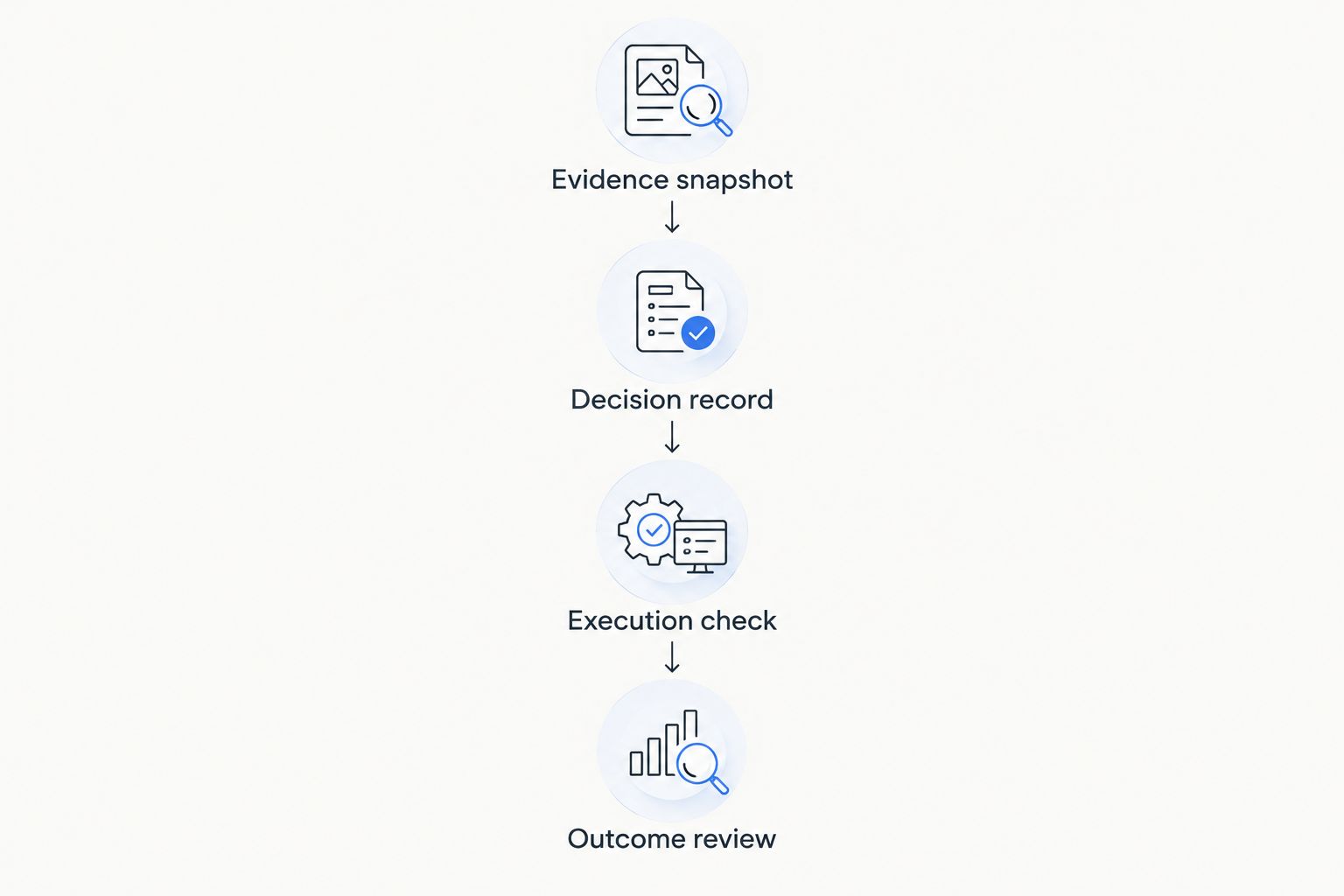
Review the original evidence before assessing the finished result.
Keep 3 fields in each 2026 review: original rationale, observed action and later interpretation. Preserve the original field. Add corrections in a dated note so you can distinguish a factual correction from a changed explanation.
A screenshot is useful but incomplete. It does not necessarily preserve your reasoning or the information you considered. Pair it with a short decision note. Do not treat a chart image as a complete account of the decision.
04
Recognise the bias in winning and losing trades
A profitable trade with an unsupported explanation
Consider a hypothetical trade entered without a recorded signal. The market moves favourably. During review, a feature on the finished chart becomes the explanation for entry.
That feature might deserve further study. It does not establish why you took the original trade. Mark it as a later observation and keep the missing rationale visible.
A losing trade with a rewritten warning
Now consider a documented setup that ends in a loss. A later review identifies a warning and treats it as decisive. Check whether that warning was visible and part of your stated rules before entry.
If the warning emerged later, it cannot explain an earlier decision. If it was visible but not part of the plan, it raises a question for future evaluation. It does not automatically establish that the original trade broke your rules.
For a 2026 review archive, label these observations by when they became available. Keep entry evidence separate from later market developments. Both matter, but they answer different questions.
05
What if I did not write down my entry reason?
Mark the entry reason as unrecorded. You can still examine the order history and any saved charts. You cannot establish your original reasoning from the result alone.
A retrospective explanation remains useful as a hypothesis. Label it clearly. Avoid filling an empty journal field as though the explanation existed before the trade.
Is hindsight bias the same as outcome bias?
Hindsight bias concerns perceived predictability. Outcome bias concerns judging a decision by its result. They overlap when a profitable trade appears both justified and inevitable simply because it worked.
Should I change my rules after a losing trade?
A loss alone does not establish that a rule needs changing. First check whether you followed the rule. Then examine comparable records before treating a later explanation as a reason to revise the process.
FAQ
What does hindsight bias mean in trading?
Hindsight bias makes a completed market move seem more predictable than it was before the result. It can change how you remember the signals and uncertainty around a trade.
How can I recognise hindsight bias in my trade journal?
Compare your original entry note with your later explanation. A later claim of certainty that is absent from the original record deserves scrutiny.
Can a winning trade still involve a poor decision?
Yes. A profitable outcome does not establish that you followed your process or had evidence for the entry. Review the decision and result separately.
Does saving a chart screenshot remove hindsight bias?
No. A screenshot preserves visible chart information but does not necessarily preserve your reasoning. Add a contemporaneous decision note and keep later interpretations separate.
What should I do when my original trade notes are missing?
Mark the original reasoning as unrecorded. Review the evidence that remains without presenting a retrospective explanation as a fact about your earlier thinking.
Can behavioural performance scores tell me whether a trade was predictable?
No. Behavioural performance scores do not establish whether a market move was predictable. Interpret them alongside the original decision record and the information available at entry.
Conclusion
One useful final check: read the entry note before revealing the outcome. Write your process assessment first. Then reveal the result and check whether it changes your judgment without adding any evidence about the original decision.
For your next 2026 trade review, preserve the uncertainty as carefully as the conclusion. An honest record includes what you did not know. That is information, not a gap to fill with hindsight.
Assess the recorded decision before the known result.
Related guides
This article is for educational purposes only and does not constitute investment advice. Trading CFDs and other leveraged products carries a high level of risk and may not be suitable for all investors.


