BahayHow index weighting changes the view of market performance
How index weighting changes the view of market performance
Oct 13, 2026
A market cap weighted index gives larger companies more influence. An equal weighted index gives each constituent the same starting weight, so the same group of shares can show different performance depending on which companies move and how the index resets its weights.
TL;DR
- Market cap weighted vs equal weighted index comparisons reveal how company size changes benchmark performance.
- Market cap weighting reflects company size; equal weighting reduces dependence on the largest constituents at rebalancing.
- Equal weighted performance provides another view of market breadth, not a direct count of rising shares.
- VCG Markets offers access to index markets; understanding benchmark construction comes before interpreting an index move.
Weighting rules · Concentration · Performance interpretation
01 How does index weighting change the view of market performance?
Index performance is a weighted result, not a vote by every company. A rising benchmark does not establish that all its constituents rose. A falling benchmark does not establish that most fell.
Starting influence
- Market cap weighted index: Larger companies receive larger weights
- Equal weighted index: Each constituent receives the same weight
Useful for
- Market cap weighted index: Reading size-weighted market performance
- Equal weighted index: Comparing performance with less largest-company concentration
Main strength
- Market cap weighted index: Represents companies in proportion to their eligible market value
- Equal weighted index: Distributes starting influence across constituents
Main limitation
- Market cap weighted index: Large companies can dominate the result
- Equal weighted index: Smaller companies receive more influence than under cap weighting
Between reviews
- Market cap weighted index: Weights change with market values and index adjustments
- Equal weighted index: Weights drift as constituent prices change
Maintenance
- Market cap weighted index: Follows the provider's eligibility and adjustment rules
- Equal weighted index: Requires scheduled resets to restore equal weights
When reviewing index markets through VCG Markets, identify the benchmark's weighting rule before interpreting its movement.
Why this matters
In 2026, a headline index return still needs a construction check. The name of the benchmark tells you which market it represents. Its methodology tells you how that market becomes a single result.
Compare weighting methods to understand the result's composition. Do not treat either method as an automatic signal to enter a trade.
02 How are market cap weighted and equal weighted returns calculated?
An index combines constituent returns according to their weights. A constituent with a larger weight contributes more to the result for the same percentage price movement.
The simplified relationship is:
Index return = the sum of each constituent's return multiplied by its starting weight.
That relationship explains the difference without relying on a particular market forecast. Actual index calculations also follow provider rules for corporate actions, constituent changes and other adjustments.
Follow the calculation in this order:
- Weighting rule. Establish whether weights follow eligible market value or start equally.
- Price returns. Identify how each constituent moved over the same measurement period.
- Weighted returns. Multiply each return by its starting influence in the index.
- Index return. Combine those contributions using the benchmark's calculation rules.
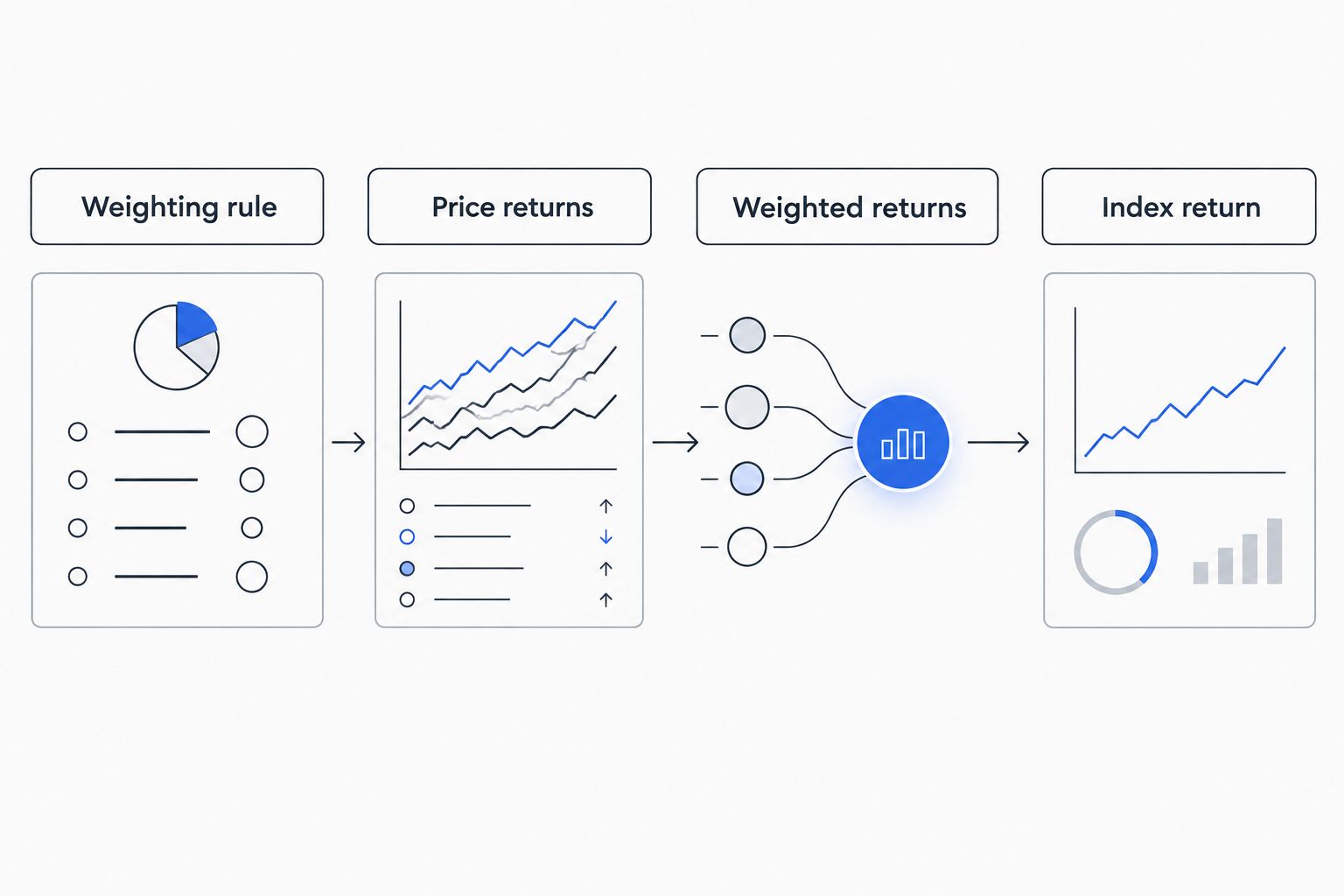
The same share-price movements produce different index results when starting weights differ.
The constituent weights collectively represent 100% of the index allocation. Equal weighting changes how that allocation is divided. It does not change the underlying companies' market values.
For a 2026 comparison, match the return convention too. A price return index excludes dividends. A total return index includes their reinvestment under the provider's methodology. Comparing different conventions introduces another explanation for the gap.
03 What does a market cap weighted index show?
A market cap weighted index assigns influence according to company size. Many widely followed equity benchmarks use free-float-adjusted market capitalisation. That approach considers shares available for public trading rather than treating every issued share identically.
Check the specific methodology. Some benchmarks apply weight caps or other adjustments, so the largest company does not always receive an unrestricted weight.
Useful for: understanding performance weighted toward larger companies. This is a direct way to observe how movements in larger constituents affect a benchmark.
The strength is also the limitation. A strongly performing large constituent can offset weakness elsewhere. The headline result then describes the weighted portfolio accurately without describing a typical constituent's experience.
Cap weighting also allows weights to change as market values change. A company whose price rises relative to others generally gains influence, subject to the benchmark's rules.
That does not make the index incorrect or misleading. It answers a particular question: how did this market perform when influence followed eligible company size? A different weighting rule answers a different question.
04 What does an equal weighted index show?
An equal weighted index assigns the same weight to each constituent when the index is reset. After that reset, prices move and weights diverge.
Useful for: comparing the same constituents with less starting concentration in the largest companies. Equal weighting prevents company size alone from setting each constituent's influence at the reset.
The benefit is a broader distribution of starting influence. The limitation is a larger relative allocation to smaller constituents than a cap weighted version would hold.
Equal weighting does not necessarily produce lower risk. Company-specific exposure becomes more evenly distributed, but sector exposure, volatility and liquidity characteristics still depend on the constituent list.
Rebalancing restores the equal allocation. In a portfolio tracking that index, this typically means reducing positions that gained relative weight and increasing positions that lost relative weight.
The index methodology is not the same thing as a tracking product's realised return. Trading costs, implementation and tracking differences belong to the product comparison. Read those separately from the benchmark's published performance.
05 Why do market cap weighted and equal weighted results vary?
Different weighting methods create different exposures even when the constituent list matches. The performance gap follows those exposures and the way they change through time.
- Largest-company performance. Large constituents have more influence in the cap weighted version. Their relative returns can drive a gap.
- Smaller-company performance. Equal weighting increases smaller constituents' influence relative to cap weighting. Their movements therefore matter more.
- Sector weights. Equal constituent weights do not create equal sector weights. Sectors with more constituents retain more starting influence.
- Rebalancing. An equal weighted index resets its weights according to a schedule. Those resets change subsequent return contributions.
- Constituent changes. Additions and removals alter the companies represented. Use matching versions of the same benchmark family for a cleaner comparison.
- Return conventions. Dividend treatment and reporting currency can change the published result. Match them before attributing the difference to weighting.
A performance gap is an observation, not an explanation by itself. Start with the largest return contributors. Then check sectors and the latest weight reset.
This keeps the comparison specific. It avoids labelling an entire market strong or weak from a headline that reflects only one construction method.
06 How should you compare the indexes in 2026?
Use a consistent comparison before drawing a conclusion. A matched pair separates the weighting question from differences in market coverage.
Match the constituents
Compare cap weighted and equal weighted versions drawn from the same constituent universe. Otherwise, differences in company selection become mixed with differences in weighting.
Do not assume that indexes covering the same market contain identical shares. Check the constituent lists or the provider's stated relationship between the benchmarks.
Match the period
Use the same starting date and ending date. A recent session and a longer holding period answer different questions.
Review the rebalancing dates within that period. Equal weighting describes the reset allocation, not a permanently fixed daily weight.
Match the return definition
Compare price return with price return, or total return with total return. Also check reporting currency and the treatment of dividend withholding when relevant.
A mismatched convention does not invalidate either published series. It makes the comparison unsuitable for isolating weighting effects.
Inspect the contributors
Read the constituent and sector contributions alongside the index return. Identify whether the gap came from the largest companies, smaller constituents or sector exposure.
Keep the conclusion narrow
Record what the comparison establishes. For example, stronger cap weighted performance establishes that its weighted allocation performed better over the selected period.
It does not establish that larger companies will keep outperforming. Nor does it establish how many constituents advanced. Those require separate evidence.
07 What can different performance patterns tell you?
The relationship between the indexes adds context to the headline. It does not replace a contribution analysis.
Cap weighted version outperforms
- What it establishes: The size-weighted allocation produced the stronger result
- What still needs checking: Largest-company and sector contributions
Equal weighted version outperforms
- What it establishes: The equal-reset allocation produced the stronger result
- What still needs checking: Smaller-company contributions and rebalancing effects
Both versions rise
- What it establishes: Both allocations gained over the period
- What still needs checking: How widely constituent gains were distributed
Both versions fall
- What it establishes: Both allocations lost over the period
- What still needs checking: Which constituents and sectors drove the losses
Results are similar
- What it establishes: Aggregate returns were close
- What still needs checking: Whether different contributions offset each other
A small aggregate difference can conceal substantial differences underneath. Strength in one group can offset weakness in another, leaving similar headline returns.
The opposite also matters. A large gap does not identify its cause without examining the contributions.
For your 2026 review, keep the interpretation attached to the evidence. Write down the observed result first. Add a cause only after checking the constituent and sector data.
This separates measurement from narrative. The weighting comparison becomes a way to ask better questions about market performance rather than a shortcut to a trading decision.
08 Is an equal weighted index the same as market breadth?
No. An equal weighted index measures a portfolio return. Market breadth describes participation across constituents through measures such as advancing and declining shares.
Equal weighting provides a useful alternative view because the largest companies have less starting dominance. But the result remains sensitive to the size of individual price moves.
A smaller group of strong gains can offset a larger group of modest losses. The resulting index return does not tell you the count on either side.
Use equal weighted returns alongside breadth measures, not as a substitute. Match the constituent universe and measurement period so the measures describe the same market.
09 Does equal weighting remove concentration risk?
Equal weighting reduces largest-constituent concentration at the reset. It does not remove every form of concentration.
Companies can share sector exposures, customers or economic sensitivities. Equal position weights do not erase those relationships.
Sector concentration also depends on the number of constituents in each sector. A sector containing more companies receives more aggregate starting weight than a sector containing fewer companies.
The practical check is straightforward. Inspect constituent weights and sector weights separately. Treat equal weighting as a specific construction choice, not a guarantee of diversification across every risk.
The VCG Markets lens
VCG Markets gives traders access to index markets alongside other financial instruments. Reading an index starts with knowing what its headline measures.
VCG Markets reports 10M+ trades executed, $2T+ in trading volume and a presence across 80+ countries. Those figures describe the broker's activity and reach. They do not predict your trading results or determine which index methodology suits your analysis.
Keep those distinctions intact. Platform access, benchmark construction and personal risk are separate questions.
Conclusion
A market cap weighted vs equal weighted index comparison changes the lens, not the underlying shares. One gives company size more influence. The other starts with equal constituent influence and resets that allocation according to its methodology.
Neither view is complete on its own. Compare matching constituents, periods and return conventions. Then inspect the contributions before describing what drove the difference.
One last check for 2026: find the latest rebalancing date. Equal weights describe a reset, not a permanent condition. That detail helps explain why a benchmark called equal weighted does not show identical constituent weights every day.
Takeaway: read the weighting rule before reading the headline as a statement about the whole market.
FAQ
What's the difference between a market cap weighted and an equal weighted index?
A market cap weighted index gives larger companies more influence, while an equal weighted index gives each constituent the same starting weight. Equal weights drift between scheduled resets as prices change.
Is an equal weighted index better than a market cap weighted index?
Neither weighting method is better for every purpose. Market cap weighting measures size-weighted performance; equal weighting offers a comparison with less starting dependence on the largest constituents.
Why can a market cap weighted index rise when many shares fall?
A market cap weighted index can rise when gains in heavily weighted constituents outweigh losses elsewhere. Its return measures weighted contributions rather than the number of advancing shares.
Does equal weighting mean the weights stay equal every day?
Equal weighting does not mean weights stay equal every day. Constituents start with equal weights at a reset, then their weights change as their prices move.
Does an equal weighted index measure market breadth?
An equal weighted index measures a portfolio return rather than market breadth directly. Use advancing and declining constituent data to measure participation.
What should I check before comparing index performance in 2026?
Before comparing index performance in 2026, match the constituent universe, dates, return convention and reporting currency. Then check rebalancing dates and constituent contributions.
Does equal weighting remove sector concentration?
Equal weighting does not remove sector concentration. Sectors containing more constituents receive more aggregate starting weight, and shared economic exposures remain.
Related guides
This article is for educational purposes only and does not constitute investment advice. Trading CFDs and other leveraged products carries a high level of risk and may not be suitable for all investors.

Impormasyon
Ang VCG Markets Ltd ay ang lisensyadong entity na awtorisadong magbigay ng mga serbisyong pang-investment. Ito ay itinatag sa Republika ng Mauritius (Blg. ng Kumpanya 188485) at pinahintulutan at kinokontrol ng Financial Services Commission ng Mauritius sa ilalim ng Lisensya Blg. GB22200388, na may nakatalagang opisina sa The Cyberaty Lounge, Ground Floor, The Catalyst, Silicon Avenue, 40 Cybercity, 72201 Ebene, Republika ng Mauritius.
Ang VCG Markets (Seychelles) Ltd ay ang lisensyadong entity na awtorisadong magbigay ng mga serbisyo bilang Securities Dealer. Ito ay itinatag sa Republika ng Seychelles (Blg. ng Kumpanya 8438443-1) at pinahintulutan at kinokontrol ng Financial Services Authority ng Seychelles sa ilalim ng Lisensya Blg. SD243, na may nakatalagang opisina sa House of Francis, Room 301(B), Ile Du Port, Mahe, Republika ng Seychelles.
Ang website ay pinapatakbo ng VCG Tech Limited (Blg. ng Kumpanya HE452446), na may nakatalagang opisina sa Agias Fylaxeos & Zinonos Rossidi, 2, 1st Floor, 3082 Limassol, Cyprus. Ang VCG Tech Limited ay gumaganap bilang kumpanya ng mangangalakal para sa pagpoproseso ng mga deposito at withdrawal ng kliyente.
Ang margined Forex at CFD trading ay mga leveraged na produkto at maaaring magresulta sa mga pagkalugi na lampas sa iyong mga deposito. Ang halaga ng mga investment ay maaaring bumaba pati na rin tumaas, at maaari kang makatanggap ng mas kaunti kaysa sa iyong orihinal na investment. Mangyaring tiyaking lubos mong naiintindihan ang mga panganib na kasangkot at isaalang-alang kung ang ganitong uri ng kalakalan ay angkop para sa iyo.
Ang mga tawag sa telepono at elektronikong komunikasyon ay maaaring i-record at subaybayan para sa layunin ng quality assurance, pagsunod, at pagsasanay.
Ang impormasyong nasa website na ito ay ibinibigay para sa pangkalahatang layuning pang-impormasyon lamang at hindi bumubuo ng payo sa investment, rekomendasyon, o kahilingan na makisali sa anumang aktibidad na pang-investment.
Ang VCG Markets ay hindi nagbibigay ng payo sa buwis. Ang batas sa buwis ay maaaring magbago o mag-iba sa pagitan ng mga hurisdiksyon.
Ang impormasyong nasa website na ito ay hindi nakatuon sa mga residente ng United States of America, Belgium, Canada, Singapore, o anumang hurisdiksyon kung saan ang pag-access sa naturang impormasyon ay salungat sa lokal na batas o regulasyon.
VCG Markets © 2026, Inc. Protektado ang lahat ng karapatan.

I-follow Kami


