BahayWhy can a trading order be only partially filled?
Why can a trading order be only partially filled?
Oct 26, 2026
A trading order is only partially filled when some of your requested volume executes but the rest cannot execute under the order’s conditions. Available liquidity, competing orders and price limits affect the result. The filled portion creates or changes your position immediately; the remainder stays active or is cancelled according to the applicable instructions.
TL;DR
- A partial fill trading order executes some requested volume, not the entire order.
- Liquidity and order instructions determine whether the remaining volume can execute.
- Check filled volume before submitting another order or requesting cancellation.
- VCG Markets provides multi-asset trading access; this guide explains partial fills without assuming instrument-specific execution rules.
01 · Why orders split
02 · What happens next
03 · What to check
01. Why can a trading order be only partially filled?
A partial fill occurs when an executable match exists for part of your order rather than its entire requested size. An order can receive several separate executions. Each execution contributes to the total filled volume.
The distinction is between a price being visible and enough volume being executable under your instructions. A quote is not a promise that your entire order can transact at that level. The explanation of liquidity and order execution covers that connection.
The basic sequence is:
- You submit an instruction. It specifies an instrument, direction and volume. Other conditions depend on the order type and execution system.
- Eligible volume executes. The execution system processes the quantity that satisfies the applicable conditions.
- The remainder receives its own treatment. It continues working, expires or is cancelled under the order’s rules.
A partial fill is an execution result, not proof of an execution error. To assess it, compare the requested volume with the execution record and the remaining order status.
For your 2026 order review, start with that record. A chart alone does not show what quantity was available to your instruction when it reached the execution system.
Why this matters
A partially filled order has already done something. An entry has opened some exposure. An exit has closed some exposure but has not necessarily closed the entire position.
That creates 2 separate risks to check: exposure already executed and instructions still capable of executing. Treating the whole order as unsuccessful overlooks the first. Treating it as complete overlooks the second.
02. Why partial fills vary
Several execution conditions explain why one order fills completely while another fills in parts. These are general mechanisms. They do not establish which execution policy applies to a particular account or instrument.
- Available liquidity. The executable quantity at eligible prices can be smaller than your requested volume. The remaining amount needs further eligible liquidity.
- Requested size. A larger instruction requires more matching volume. Compare order size with executable depth rather than assuming the displayed price covers the whole request.
- Price limits. A limit order restricts acceptable execution prices. Remaining volume cannot execute outside that restriction simply to complete the order.
- Competing instructions. Other orders can consume available quantity. Priority rules determine which eligible orders receive executions.
- Changing conditions. Quotes and available quantities can change while an order is processed. Earlier visible depth is not a guarantee of later execution.
- Execution instructions. Time-in-force and filling rules determine whether partial execution is permitted and what happens to unfilled volume.
These factors interact. A strict price condition can leave an order partially filled even when additional liquidity exists at an unacceptable price. A short-lived instruction can cancel its remainder before more eligible liquidity arrives.
In 2026, the check is still specific: read the instrument’s applicable execution conditions rather than assuming every market handles remaining volume identically.
03. What happens to the unfilled part?
The unfilled portion does not have one universal outcome. Its treatment depends on the order’s validity period and filling policy. These are related instructions, but they answer different questions.
A validity period determines how long an instruction remains eligible. A filling policy determines whether partial execution is acceptable. An order interface can present these controls separately.
Day validity
- Suitable use: Keeping an instruction within the applicable trading day
- What happens to the remainder: Any active remainder expires at the defined day-end boundary
- Benefit: Limits how long the instruction remains active
- Limitation: The boundary depends on the market and platform rules
Good-till-cancelled validity
- Suitable use: Keeping an instruction active beyond a single session where supported
- What happens to the remainder: The remainder stays active until filled, cancelled or otherwise expired under applicable rules
- Benefit: Avoids resubmitting solely because a session ends
- Limitation: Requires continued monitoring and can have a maximum validity period
Immediate-or-cancel filling
- Suitable use: Accepting immediately executable volume
- What happens to the remainder: Any portion that cannot execute immediately is cancelled
- Benefit: Prevents the remainder from waiting for later execution
- Limitation: The resulting position can be smaller than requested
Fill-or-kill filling
- Suitable use: Requiring complete immediate execution
- What happens to the remainder: The instruction executes completely or is cancelled without a partial fill
- Benefit: Prevents an incomplete execution under that instruction
- Limitation: The order does not execute if the full quantity cannot meet its conditions
These 4 order instructions illustrate different controls, not a menu available on every instrument. Check what your order ticket supports. Do not infer availability from a familiar label on another platform.
An order can also complete through several executions before you inspect its history. Multiple execution records therefore do not necessarily mean an order still has an outstanding remainder.
Use the current order status to establish what remains active. Use execution history to establish what has already happened. Neither view replaces the other.
04. Which order details should you check first?
Start with 3 volume fields: requested volume, filled volume and remaining volume. Then read the order status. Together, those 4 fields distinguish an incomplete request from an active instruction.
Requested volume
Requested volume is the amount you originally instructed the system to transact. Keep the unit attached. Shares, contracts and lots are not interchangeable descriptions of size.
Check the original order record rather than reconstructing the request from memory. An amended order also needs its amendment history if you are comparing earlier and current instructions.
Filled volume
Filled volume is the amount already executed. Inspect the individual execution records when the order has multiple fills. Those records establish the executed quantities and their respective execution prices.
A platform can show an average execution price for the combined fill. That summary does not mean every portion executed at the same price.
Remaining volume
Remaining volume is the unexecuted quantity. Read it alongside the status. An unexecuted quantity is not necessarily still working if the remainder has already been cancelled or expired.
Do not submit a replacement solely because the filled volume looks smaller than expected. First establish whether another instruction can still execute.
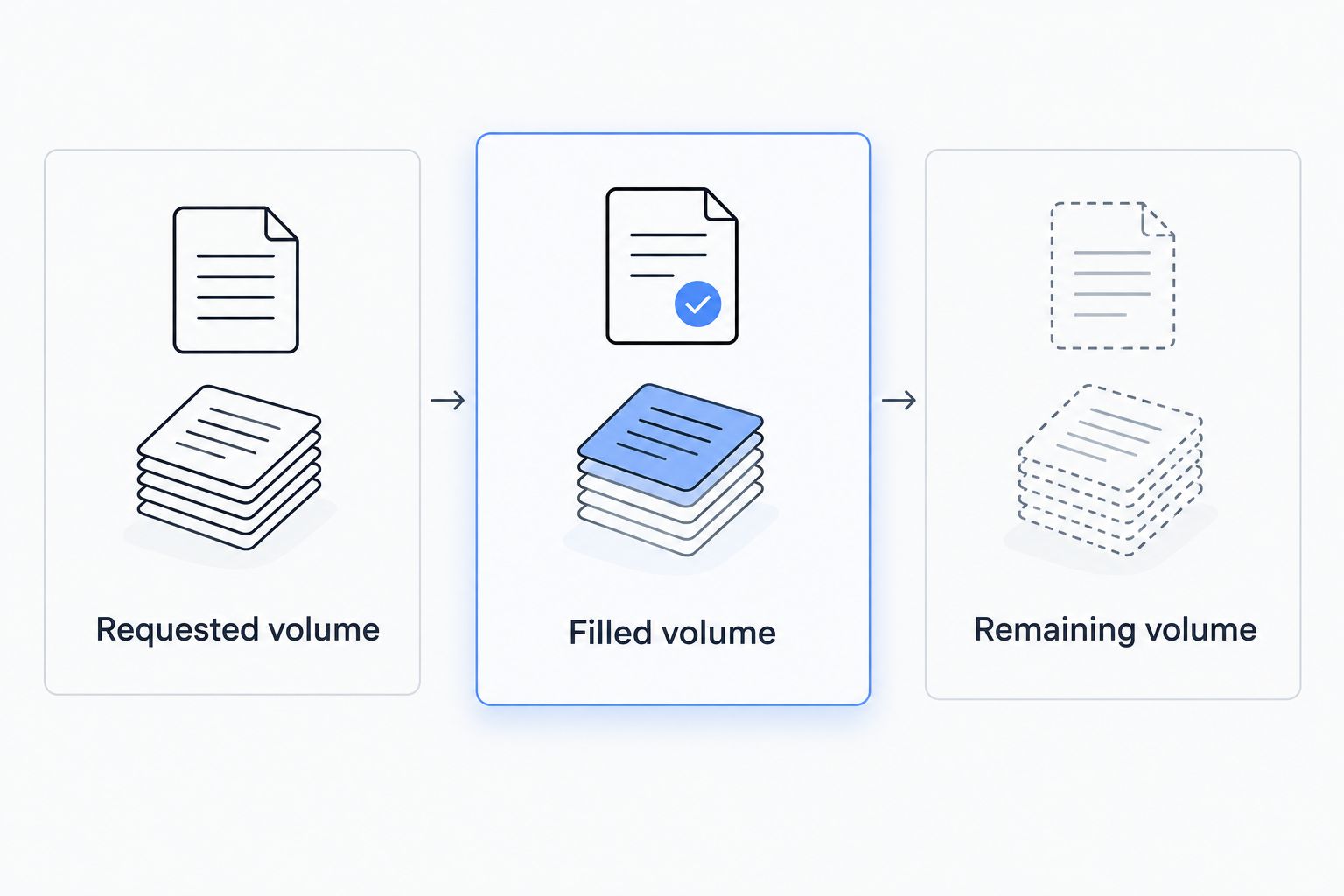
Check remaining volume alongside the order status before submitting another instruction.
Order status
Check whether the order is active, completed, cancelled or expired. The exact labels depend on the platform. A cancellation request also needs confirmation; submitting the request is not the same as receiving a completed cancellation.
For a 2026 execution query, retain the order identifier, instrument, timestamps and execution records. These details make the question specific without assuming what caused the result.
05. Does a partial fill mean you received a worse price?
A partial fill describes quantity, not price quality. Slippage describes the difference between an expected execution price and the actual execution price. They are different observations.
An order can fill completely and still experience slippage. An order can also fill partially without a difference between the specified limit and the executed price. For a limit order, executions must respect the limit price or improve on it.
A market order does not place the same price restriction on execution. Depending on available liquidity and applicable rules, its volume can transact at different prices. That is why the execution details matter more than a single chart point.
Keep the questions separate:
- Quantity: How much of the requested volume executed?
- Price: At which prices did each execution occur?
- Status: Can any remaining instruction still execute?
A partial fill also does not establish why an order took longer than expected. To investigate timing, compare submission, acceptance and execution timestamps where those records are available.
06. What should you do after a partial fill?
Confirm the position and the remaining instruction before taking another action. This is an order-management check, not a recommendation to increase or reduce exposure.
For a 2026 review, use this sequence:
- Read the execution history. Establish the total filled quantity and the execution prices.
- Read the current position. Confirm the exposure created or left open by those executions.
- Read the remaining order. Check whether unfilled volume is active, cancelled or expired.
- Check linked instructions. Verify how any stop-loss or take-profit instruction relates to the position that actually exists.
- Confirm any cancellation. Recheck executions and status after the cancellation response.
A fill can occur while a cancellation request is being processed. Cancelling the remainder does not reverse executions that have already completed. The final confirmed state matters.
If you request clarification from support, identify the order and the specific discrepancy. Ask whether the result followed its filling policy, available executable quantity or another documented condition. Avoid treating a screenshot of the chart as the complete execution record.
Can a closing order be partially filled too?
A closing order can be partially filled when only part of its requested volume executes. The remaining position stays open unless another completed execution closes it.
Check the position itself after the execution. A submitted closing instruction is not evidence that the entire position has closed.
Is a partially filled order the same as a rejected order?
A partially filled order contains executed volume. A rejected instruction has not been accepted for execution in the form submitted.
Read the full event history when a request has several associated messages. An unsuccessful amendment or cancellation request does not erase earlier fills.
The VCG Markets lens
VCG Markets serves traders seeking multi-asset market access. That includes forex, shares and commodities. The execution question remains instrument-specific: what filled, what remains and which instructions still apply?
Use the 2026 checklist above with the order information available in your account. No general explanation should be read as a statement that every instrument uses the same filling policy.
FAQ
What does a partial fill trading order mean?
A partial fill trading order means some requested volume executed while some remained unexecuted. The remainder stays active or is cancelled or expired according to the applicable instructions.
Can an order receive more than one partial fill?
An order can receive multiple partial fills as eligible volume becomes executable. Check the combined filled quantity and current status to see whether the order is complete.
Will the rest of my order automatically fill later?
The rest of an order does not automatically fill later. It needs eligible liquidity and must remain active under its price conditions, validity period and filling policy.
Can I cancel the unfilled part of an order?
You can request cancellation of an active remainder where the applicable rules permit it. Wait for confirmation and check for executions that occurred while the request was processed.
Does cancelling a partial fill undo the completed trades?
Cancelling the remaining instruction does not undo completed executions. The filled portion has already changed your position.
Does fill-or-kill allow a partial fill?
Fill-or-kill does not allow a partial fill under that instruction. It requires complete immediate execution or cancellation, where that filling policy is supported.
Conclusion
A partial fill tells you how much executed. It does not, by itself, tell you whether the remaining instruction is active or whether execution followed the applicable rules. Read volume, price and status separately.
One last check: a cancelled order can still have completed fills. A cancellation can end the remainder without removing the position created earlier. Review the final position as well as the final order status.
Related guides
- Why chart prices and execution prices differ
- Understanding positive and negative slippage
- Why spreads widen in quiet markets
This article is for educational purposes only and does not constitute investment advice. Trading CFDs and other leveraged products carries a high level of risk and may not be suitable for all investors.

Impormasyon
Ang VCG Markets Ltd ay ang lisensyadong entity na awtorisadong magbigay ng mga serbisyong pang-investment. Ito ay itinatag sa Republika ng Mauritius (Blg. ng Kumpanya 188485) at pinahintulutan at kinokontrol ng Financial Services Commission ng Mauritius sa ilalim ng Lisensya Blg. GB22200388, na may nakatalagang opisina sa The Cyberaty Lounge, Ground Floor, The Catalyst, Silicon Avenue, 40 Cybercity, 72201 Ebene, Republika ng Mauritius.
Ang VCG Markets (Seychelles) Ltd ay ang lisensyadong entity na awtorisadong magbigay ng mga serbisyo bilang Securities Dealer. Ito ay itinatag sa Republika ng Seychelles (Blg. ng Kumpanya 8438443-1) at pinahintulutan at kinokontrol ng Financial Services Authority ng Seychelles sa ilalim ng Lisensya Blg. SD243, na may nakatalagang opisina sa House of Francis, Room 301(B), Ile Du Port, Mahe, Republika ng Seychelles.
Ang website ay pinapatakbo ng VCG Tech Limited (Blg. ng Kumpanya HE452446), na may nakatalagang opisina sa Agias Fylaxeos & Zinonos Rossidi, 2, 1st Floor, 3082 Limassol, Cyprus. Ang VCG Tech Limited ay gumaganap bilang kumpanya ng mangangalakal para sa pagpoproseso ng mga deposito at withdrawal ng kliyente.
Ang margined Forex at CFD trading ay mga leveraged na produkto at maaaring magresulta sa mga pagkalugi na lampas sa iyong mga deposito. Ang halaga ng mga investment ay maaaring bumaba pati na rin tumaas, at maaari kang makatanggap ng mas kaunti kaysa sa iyong orihinal na investment. Mangyaring tiyaking lubos mong naiintindihan ang mga panganib na kasangkot at isaalang-alang kung ang ganitong uri ng kalakalan ay angkop para sa iyo.
Ang mga tawag sa telepono at elektronikong komunikasyon ay maaaring i-record at subaybayan para sa layunin ng quality assurance, pagsunod, at pagsasanay.
Ang impormasyong nasa website na ito ay ibinibigay para sa pangkalahatang layuning pang-impormasyon lamang at hindi bumubuo ng payo sa investment, rekomendasyon, o kahilingan na makisali sa anumang aktibidad na pang-investment.
Ang VCG Markets ay hindi nagbibigay ng payo sa buwis. Ang batas sa buwis ay maaaring magbago o mag-iba sa pagitan ng mga hurisdiksyon.
Ang impormasyong nasa website na ito ay hindi nakatuon sa mga residente ng United States of America, Belgium, Canada, Singapore, o anumang hurisdiksyon kung saan ang pag-access sa naturang impormasyon ay salungat sa lokal na batas o regulasyon.
VCG Markets © 2026, Inc. Protektado ang lahat ng karapatan.

I-follow Kami


