Trading data · Privacy
Before sharing trading data with artificial intelligence, check what leaves your account and who receives it. Confirm access permissions, model-training use, retention and deletion. Share only the information needed for the task. Permission to analyse your history should not automatically mean permission to place trades.
Key checks
- AI trading data privacy starts with knowing what you share, who receives it and why.
- Check model training, retention and deletion separately. A deleted upload does not establish that every copy disappears.
- VCG Markets provides trading access. Review the applicable data terms before connecting any account.
- Keep trading records separate from passwords, identity documents and permissions to place orders.
01Data scope
02Access permissions
03Retention and deletion
01
What should you check before sharing trading data with AI?
Start with the purpose. A review of entry timing needs different information from an explanation of account performance. Understanding performance scores in context helps you decide which records the analysis actually requires.
- Define the question you want answered.
- Inspect the export or connection permissions.
- Remove unnecessary identifiers and sensitive attachments.
- Read the terms for training, access and retention.
- Confirm how to disconnect and request deletion.
- Check the output against your original records.
Treat these as separate checks. A clear privacy notice does not establish that an upload contains only relevant fields. A limited upload does not establish that the recipient excludes it from model training.
Do not connect an account until you understand both the data access and the account permissions. Keep the current terms and your selected settings together. They give you a record of what you accepted.
02
Why trading data privacy matters
A trading statement can contain more than results. Inspect it for your name, account identifier, balances, positions and transaction history. Screenshots deserve the same attention. Look beyond the chart to account menus and notifications.
Separate analytical context from personal identity. Trade direction and execution time can explain a trading decision. Your address or identity document does not explain the same decision. Remove those details when they have no role in the task.
Preserve information that makes the analysis meaningful. Keep instrument names, time zones and account currency when the question depends on them. Record what you removed. Otherwise you risk treating an incomplete analysis as a complete account review.
Removing your name is not proof of anonymity. A file can still contain account references or identifying notes. Review the whole export rather than relying on a changed filename.
03
Choose the sharing method around the task
Compare the scope before choosing convenience. An isolated example and a continuing account connection create different review tasks. Neither label tells you the recipient’s retention policy.
| Method and suitable use | Benefit | Limitation |
| Typed extract: a narrow question | You select each detail. | Manual copying can omit context. |
| Reviewed export: a defined history review | You inspect the dataset before sending. | Hidden columns or extra sheets need checking. |
| Account connection: continuing analysis | It supports repeated data access within its permissions. | You must review access scope and revocation. |
Ask whether the task needs a continuing connection at all. For a question about one completed trade, start by identifying the relevant fields. Do not send a complete account history simply because the upload accepts it.
04
Read permissions separately from privacy terms
Look for an explicit distinction between reading information and taking action. Read access concerns the records a service can retrieve. Order access concerns actions it can perform. Check each permission rather than accepting a general connection label.
For analysis alone, seek access limited to the information required. Check whether the permission includes balances, open positions or transaction history. Also check whether the connection reaches more than the intended account.
Do not paste account passwords, authentication codes or secret access keys into a conversation. Use the provider’s documented connection process. Confirm the destination before entering credentials.
Locate the disconnection control before connecting. Then establish what disconnection does. Stopping future retrieval and removing previously received records are separate questions. Ask for both answers in clear language.
05
Why AI trading data privacy varies
A product label does not answer the privacy questions. Review the terms that apply to your particular service and account. Check these factors individually:
- Data scope: Which records, attachments and identifiers does the service receive?
- Purpose: Is the information used only to deliver your requested analysis?
- Training use: Can inputs or outputs be used to train or improve models?
- Human access: Who can inspect records for support, review or other stated purposes?
- Other recipients: Which processing partners receive information and for what work?
- Retention: What remains after you delete a conversation or close the account?
Look for the exact scope of any training control. Ask whether it applies to future uploads only. Check whether feedback submissions follow different terms. Do not interpret a training setting as a promise of immediate deletion.
If an answer is unclear, reduce the proposed dataset or pause the transfer. A privacy decision needs an understandable explanation. It does not need a larger upload.
06
Trace the workflow beyond the upload
Map the full route: source file, receiving service, generated output and saved copy. Apply secure use of artificial intelligence to the whole workflow. Checking the upload alone leaves the report’s destination unexamined.
Check shared folders, conversation links and exported reports. An analysis can repeat details from its source. Review the output before sending it to someone else. Remove account identifiers that the recipient does not need.
Use a simple record of the transfer. Note the source, fields shared, purpose and destination. Include the relevant account settings. This makes the later review specific rather than dependent on memory.
Separate an approved destination from an approved dataset. Permission to use a service does not mean every trading record belongs there. Repeat the scope check when the task changes or you add another account.
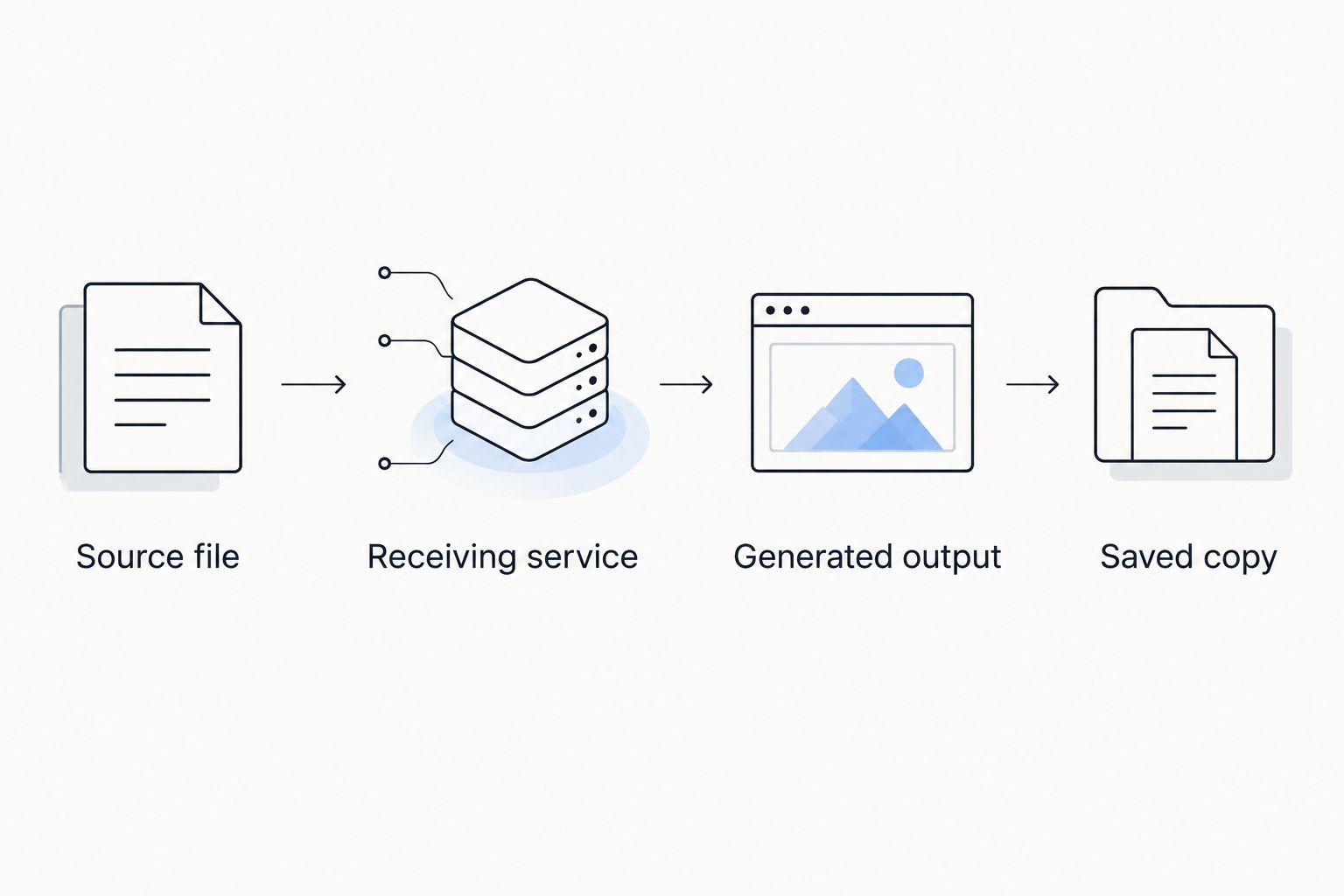
Review the destination of the analysis as well as the original upload.
07
Check what deletion actually covers
Read the deletion explanation before uploading. Look for separate treatment of source files, conversations, generated reports and account data. Ask what remains in logs or backups. Request the applicable retention period rather than assuming one.
Check whether the terms describe exceptions for legal or security purposes. Establish which information those exceptions cover. A broad statement about deleting your account does not answer every question about retained records.
When ending a connection, stop future access first. Then use the documented process for existing data. Keep any confirmation. Review copies you saved elsewhere because a deletion request to one service does not remove files you separately exported.
Does disconnecting an account delete its trading history?
Disconnection is not proof of deletion. Confirm whether it stops future access, removes existing records or requires a separate deletion request.
Can you remove identifiers without weakening the analysis?
Remove identifiers that do not serve the question. Preserve the trade details needed to interpret results. State any omissions so the analysis does not silently treat a partial record as complete.
Conclusion
Before sending a trading record, write down the question it should answer. Then identify the fields that answer it. Review the destination, permissions and deletion process before making the transfer.
One final check: inspect the generated report as carefully as the upload. A summary that repeats account details is another document to control. Decide who needs that copy before sharing it.
Share for a defined purpose. Keep access limited to that purpose.
FAQ
What should I check first before sharing trading data with AI?
Check the exact information being shared and the purpose it serves. Then review the recipient, permissions, model-training terms and deletion process before transferring it.
Should I upload my complete trading statement?
Upload only the information needed for the question. Inspect a statement for personal identifiers, account references and unrelated transactions before sharing it.
Does read-only access mean my trading data is private?
Read-only access limits actions within the permission granted. It does not explain storage, human access, model training or onward sharing. Review those terms separately.
Can my trading data be used to train an AI model?
Check the service terms and the settings that apply to your account. Confirm whether any exclusion covers inputs, outputs and feedback before sharing records.
Is removing my name enough to anonymise trading data?
Removing your name does not establish anonymity. Inspect account identifiers, notes, attachments and other details that still connect the record to you.
Does deleting a conversation remove every copy of my trading data?
Do not assume conversation deletion removes every copy. Check the treatment of uploads, reports, logs and backups in the applicable retention policy.
Should a trading-analysis connection have permission to place orders?
For analysis alone, seek permissions limited to the information required. Review order permissions separately and do not grant them simply to obtain a historical analysis.
Related guides
- Missing data in a trading review
- Automation bias in trading decisions
- Reading contract specifications
This article is for educational purposes only and does not constitute investment advice. Trading CFDs and other leveraged products carries a high level of risk and may not be suitable for all investors.


