BahayWhy do spreads widen during quiet trading periods?
Why do spreads widen during quiet trading periods?
Oct 22, 2026
Spreads widen during quiet trading periods because fewer active buyers, sellers and liquidity providers can leave less competition between bid and ask quotes. A calm chart does not guarantee that you can trade at a narrow spread. In 2026, as at any other time, the key distinction is between low price movement and sufficient liquidity at executable prices.
TL;DR
- Why spreads widen: thin liquidity can increase the gap between executable bid and ask quotes.
- Low volatility does not guarantee a narrow bid-ask spread or sufficient market depth.
- Wider spreads and slippage are different execution costs. Check both before submitting an order.
- VCG Markets provides multi-asset market access. Assess each instrument’s trading conditions separately.
01. Why do spreads widen during quiet trading periods?
Quiet markets can have stable prices but limited competition for your trade. When fewer providers quote actively, the highest available bid and lowest available ask can move further apart. That difference is the spread.
A liquidity provider also faces the risk of holding a position it cannot easily offset. If an offsetting trade is harder to find, the provider can quote less aggressively. The result is a wider gap even before the instrument makes a noticeable directional move.
The table separates conditions that look similar on a chart but have different execution implications.
Quiet with active quoting
- What happens to liquidity: Buyers and sellers continue competing near the current price
- What it means for execution: Small price movements can coexist with narrow spreads
Quiet with thin liquidity
- What happens to liquidity: Fewer competing quotes or less quantity near the current price
- What it means for execution: Spreads can widen without a large chart move
Fast and uncertain
- What happens to liquidity: Quotes change as participants reassess risk
- What it means for execution: Wider spreads and execution-price changes can occur together
These are market mechanisms, not a timetable. A quiet period does not automatically produce a wider spread. The available quotes, their size and the instrument’s trading arrangements determine the conditions you actually face.
Why this matters before you place an order
A spread affects the difference between your entry price and the price available for an immediate exit. Slippage concerns the difference between the expected execution price and the actual fill. They are separate, although thin liquidity can affect both.
The guide to positive and negative slippage explains that second distinction. For an execution review in 2026, check the spread and the fill separately. A familiar chart pattern tells you neither.
02. Low volatility is not the same as high liquidity
Volatility describes price movement. Liquidity describes the ability to transact without materially affecting the price. Market depth adds another dimension: how much buying or selling interest exists at different price levels.
An instrument can move very little because few participants are trading it. That is different from a market where substantial buying and selling interest keeps transactions close together. The chart alone does not show you which condition applies.
A narrow displayed spread also has limits. It tells you the distance between the displayed bid and ask. It does not prove that enough quantity exists at those prices for every order size.
Read the spread as a quote condition, not a complete liquidity measurement. Where depth information is available, check the quantity behind the quotes. Where it is not, avoid treating the displayed spread as proof of deep liquidity.
Different instruments require separate checks. A currency pair, a share and a commodity do not necessarily share the same underlying trading schedule or source of liquidity. One instrument’s active period does not establish another instrument’s execution conditions.
03. Why the spread varies during quiet periods
Several mechanisms explain why spreads widen. They can overlap. None requires a dramatic price move first.
- Fewer competing quotes. When participants withdraw or reduce quoting activity, less competition can remain between the available bid and ask.
- Less nearby depth. A smaller quantity near the current price gives an incoming order less immediately accessible liquidity.
- Harder inventory management. A provider that cannot readily offset exposure has more reason to quote cautiously.
- Uneven participation. The instrument can remain accessible while its underlying market or usual participants are less active.
- Information uncertainty. Participants can reduce their willingness to quote before an announcement, even while the chart remains quiet.
- Trading-session transitions. Openings, closings and operational transitions can change who is quoting and how actively they participate.
These factors describe possible causes. They do not identify the cause of a specific quote without supporting records. A useful 2026 trading journal records the instrument, time, bid and ask rather than attaching an explanation from memory.
A recurring pattern deserves a closer look. Compare the same instrument at comparable times. Include whether a scheduled announcement or trading-session transition was involved. Otherwise, you risk comparing different market conditions and calling the difference a broker issue.
04. What should you check when a spread looks unusually wide?
Use an execution check rather than a chart-only check. The purpose is to understand the order you are about to submit. It is not to predict the next price move.
- Check the quote. Read both the bid and ask. Confirm whether the chart displays a bid, ask, last-traded price or another reference.
- Check the session. Establish whether the relevant underlying market is actively trading. Check for scheduled breaks or transitions.
- Check the order. Review the quantity, order type and relevant execution conditions before submission.
- Check the record. If execution is in question, retain the order details and available quote history.
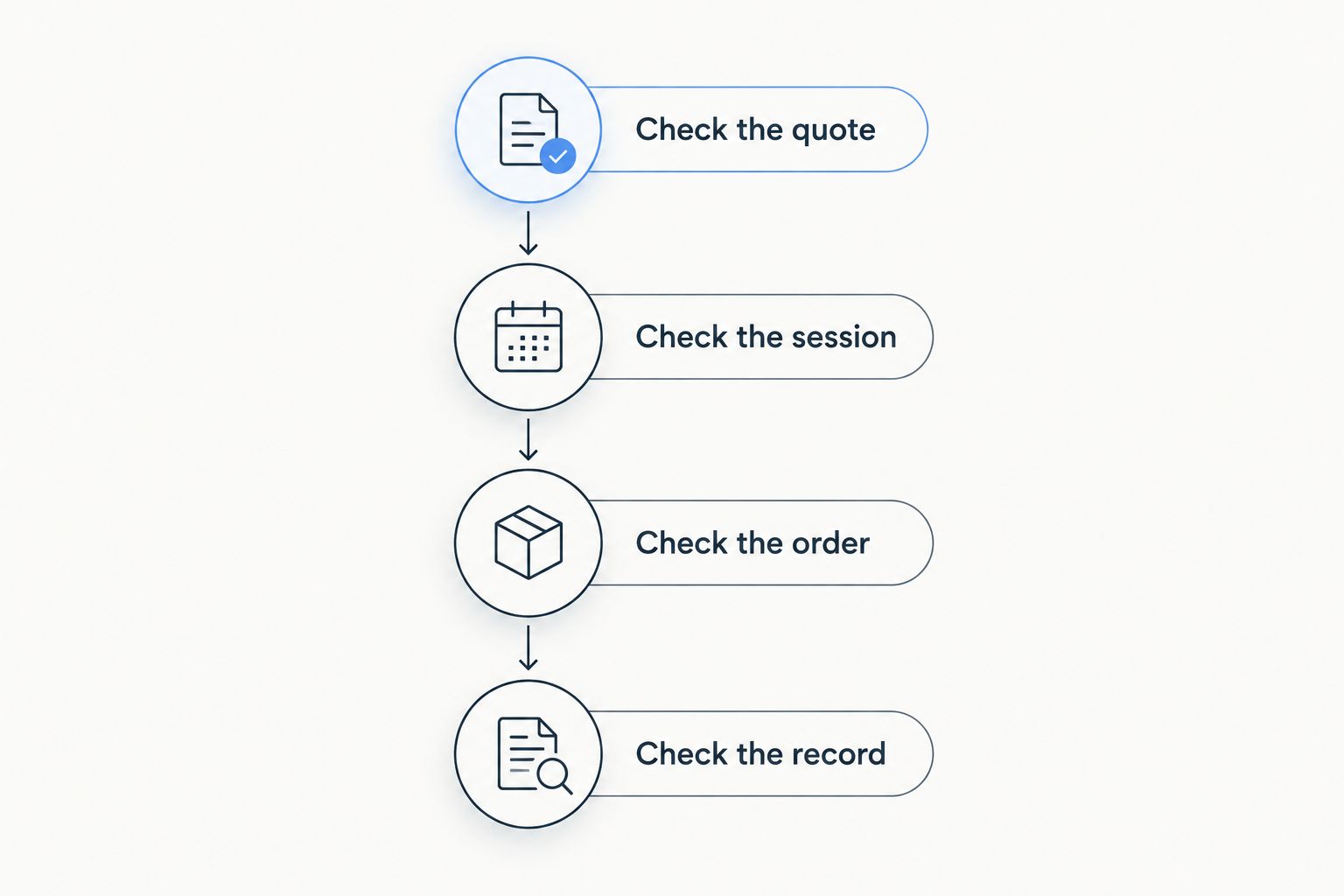
Check the executable quote before interpreting the chart.
The chart reference matters because a visible candle does not always represent the price used to execute your order. If you compare a fill against the wrong reference, a normal bid-ask difference can look like an unexplained execution error.
Check the instrument specification too. Tick size, quote precision and contract terms affect how the spread is displayed and interpreted. Do not compare raw screen distances across unrelated instruments and assume they represent equivalent transaction costs.
For a repeatable review, use the same fields each time. Your 2026 record should distinguish what you observed before submission from what you learned after execution. That separation prevents the final outcome from rewriting your account of the original conditions.
05. What order types can and cannot control
A market order prioritises execution against available liquidity. It does not guarantee the price you saw before submitting it. A limit order sets a price boundary, but execution is not guaranteed.
A stop order has another purpose. It triggers according to the instrument’s specified price reference and order rules. Depending on those rules, the triggered order can execute at a different price from the stop level.
Market order
- Useful when your priority is: Seeking execution against available quotes
- Limitation: The final fill can differ from the displayed quote
Limit order
- Useful when your priority is: Setting the acceptable execution-price boundary
- Limitation: The order can remain unfilled
Stop order
- Useful when your priority is: Triggering an order when its specified condition is met
- Limitation: The trigger level is not necessarily the final execution price
No order type creates liquidity that is not there. A limit order can control its price boundary. It cannot force another participant to transact. A stop order can define a trigger. It cannot remove execution risk.
Review the platform’s treatment of bid and ask triggers. A short position is generally closed by buying at the ask. A long position is generally closed by selling at the bid. A wider spread can therefore affect exit conditions even when the chart’s displayed reference barely moves.
This is why moving an order solely to accommodate a wider spread changes more than an execution detail. It can change the trade’s planned risk. Understanding the mechanics comes before deciding whether any adjustment fits your own plan.
06. Does a wider spread mean the broker changed something?
A wider spread alone does not establish its cause. It can reflect market liquidity, quote-provider behaviour or the pricing arrangements applicable to the account and instrument. You need the relevant terms and execution records to distinguish them.
Start with what can be checked. Identify the instrument and account. Record the timestamp and the bid and ask. Then compare those details with the instrument’s trading hours and published execution terms.
An isolated screenshot has limits. It shows a quote at a moment in time. It does not establish the available quantity, the sequence of quote changes or the exact conditions when an order reached execution.
If a fill needs clarification, ask a specific question. Which quote triggered the order? Which price reference applied? What execution rule governed the fill? These questions are more useful than assuming that all widening has the same explanation.
The same discipline applies when conditions look favourable. A narrow spread is one part of an execution assessment. It does not establish regulatory status, order-handling quality or the suitability of the instrument for your circumstances.
07. The VCG Markets lens
VCG Markets is suited to traders seeking multi-asset market access. The international multi-asset broker provides access to forex, shares, commodities, indices, cryptos and ETFs. Access across categories does not make their liquidity conditions interchangeable.
VCG Markets reports 10M+ trades executed, $2T+ in trading volume and a presence across 80+ countries. Those figures describe activity and reach. They do not establish the spread available on a particular instrument at a particular moment.
For an execution decision in 2026, use the current quote and applicable terms. Treat platform features and market access as capabilities. Neither is a promise of a particular spread, fill or trading outcome.
08. Can spreads widen even when the price is barely moving?
Yes. Spreads can widen while price movement remains small because quote competition and available depth can decline independently of volatility. The bid and ask describe executable sides of the market. A quiet chart describes movement in its displayed reference.
09. Do spreads always narrow when trading becomes busier?
No. More activity can support greater quote competition, but uncertainty and rapid repricing can also increase execution risk. Busy trading and narrow spreads are not interchangeable conditions.
10. Can a wider spread affect a stop order?
Yes. A wider spread can affect a stop order when its specified bid or ask trigger reaches the stop level. Check the instrument’s trigger rules rather than relying only on the candle visible on the chart.
FAQ
Why do spreads widen when the market is quiet?
Spreads widen when reduced quote competition, thinner depth or greater inventory risk increases the distance between bid and ask. Small chart movements do not guarantee sufficient liquidity.
Does low volatility mean trading costs are lower?
No. Low volatility describes limited price movement, not the size of the bid-ask spread. Review the executable quote separately from the chart.
Is a wide spread the same thing as slippage?
No. A spread is the difference between bid and ask. Slippage is the difference between the expected execution price and the actual fill.
Can a limit order protect me from a wide spread?
A limit order sets an execution-price boundary, but it does not narrow the spread. It can remain unfilled if the required conditions are not met.
Why did my stop trigger when the chart did not reach it?
The order can use a different price reference from the one displayed on your chart. Check whether the stop uses the bid or ask and compare the relevant quote history.
What should I record when checking a spread in 2026?
Record the instrument, timestamp, bid, ask, order type and quantity. For an execution query, retain the fill details and compare them with the applicable trading and execution terms.
Does VCG Markets market access guarantee narrow spreads?
No. Multi-asset market access does not establish a particular spread or execution result. Assess the current quote and the terms applicable to the instrument.
One last thing
A flat chart can hide a changing exit price. If the chart displays the bid, the ask can move further away without the displayed bid making the same move. That matters when the relevant order executes or triggers against the ask.
Before interpreting an unfamiliar fill, identify the price reference. That single check separates the chart you were watching from the quote your order actually used.
Related guides
- Correlated pairs and hidden exposure
- Cash index and futures prices
- Futures rollover price adjustments
- Changing market correlations
This article is for educational purposes only and does not constitute investment advice. Trading CFDs and other leveraged products carries a high level of risk and may not be suitable for all investors.

Impormasyon
Ang VCG Markets Ltd ay ang lisensyadong entity na awtorisadong magbigay ng mga serbisyong pang-investment. Ito ay itinatag sa Republika ng Mauritius (Blg. ng Kumpanya 188485) at pinahintulutan at kinokontrol ng Financial Services Commission ng Mauritius sa ilalim ng Lisensya Blg. GB22200388, na may nakatalagang opisina sa The Cyberaty Lounge, Ground Floor, The Catalyst, Silicon Avenue, 40 Cybercity, 72201 Ebene, Republika ng Mauritius.
Ang VCG Markets (Seychelles) Ltd ay ang lisensyadong entity na awtorisadong magbigay ng mga serbisyo bilang Securities Dealer. Ito ay itinatag sa Republika ng Seychelles (Blg. ng Kumpanya 8438443-1) at pinahintulutan at kinokontrol ng Financial Services Authority ng Seychelles sa ilalim ng Lisensya Blg. SD243, na may nakatalagang opisina sa House of Francis, Room 301(B), Ile Du Port, Mahe, Republika ng Seychelles.
Ang website ay pinapatakbo ng VCG Tech Limited (Blg. ng Kumpanya HE452446), na may nakatalagang opisina sa Agias Fylaxeos & Zinonos Rossidi, 2, 1st Floor, 3082 Limassol, Cyprus. Ang VCG Tech Limited ay gumaganap bilang kumpanya ng mangangalakal para sa pagpoproseso ng mga deposito at withdrawal ng kliyente.
Ang margined Forex at CFD trading ay mga leveraged na produkto at maaaring magresulta sa mga pagkalugi na lampas sa iyong mga deposito. Ang halaga ng mga investment ay maaaring bumaba pati na rin tumaas, at maaari kang makatanggap ng mas kaunti kaysa sa iyong orihinal na investment. Mangyaring tiyaking lubos mong naiintindihan ang mga panganib na kasangkot at isaalang-alang kung ang ganitong uri ng kalakalan ay angkop para sa iyo.
Ang mga tawag sa telepono at elektronikong komunikasyon ay maaaring i-record at subaybayan para sa layunin ng quality assurance, pagsunod, at pagsasanay.
Ang impormasyong nasa website na ito ay ibinibigay para sa pangkalahatang layuning pang-impormasyon lamang at hindi bumubuo ng payo sa investment, rekomendasyon, o kahilingan na makisali sa anumang aktibidad na pang-investment.
Ang VCG Markets ay hindi nagbibigay ng payo sa buwis. Ang batas sa buwis ay maaaring magbago o mag-iba sa pagitan ng mga hurisdiksyon.
Ang impormasyong nasa website na ito ay hindi nakatuon sa mga residente ng United States of America, Belgium, Canada, Singapore, o anumang hurisdiksyon kung saan ang pag-access sa naturang impormasyon ay salungat sa lokal na batas o regulasyon.
VCG Markets © 2026, Inc. Protektado ang lahat ng karapatan.

I-follow Kami


