Trading process · 2026
Instead of rebuilding your trading decisions from scattered records, use a weekly trading review that connects trade history with your original plan. Reconcile the records first. Then assess rule adherence and document one process change to check during the next review.
Key takeaways
- Build your weekly trading review from reconciled trade history and a trading journal.
- Separate trading results from deposits, withdrawals and account adjustments.
- VCG Markets offers multi-asset trading and behavioural performance review through VCG ONE.
- Judge rule adherence separately from profit. A winning trade can still break your rules.
01Reconcile your records
02Review your decisions
03Record your next check
01
Why this matters
A trading result tells you what happened financially. It does not tell you whether you followed your plan. Use [trading rule adherence](https://vcgmarkets.com/en/blog/track-trading-rule-adherence) as a separate review measure.
A profitable trade can break an entry rule. A losing trade can follow every documented condition. Combining those judgments makes the review less useful because the outcome replaces the evidence about your decision.
VCG Markets is a multi-asset broker for traders seeking market access alongside behavioural performance review. VCG ONE scores performance across eight behavioural dimensions in real time. Those scores provide another review input. They do not replace trade records or establish why a result occurred.
This workflow keeps three questions separate: are the records complete, did you follow the plan, and what needs checking next? It is a review process. It is not a trading signal.
02
Before you start
- Account access: Have permission to view your trading history and account statement. Gather executed trades, charges and account movements for the same period. Keep different accounts separate.
- Review materials: Prepare a spreadsheet, your written trading rules and any notes captured before entry. Create a folder such as Weekly reviews 2026. Keep original statements unchanged.
- The hidden gotcha: Confirm what each history row represents. An order, an execution and a position are not interchangeable. Partial fills and partial closes can create several records for one trading decision.
Set a fixed review boundary of 7 calendar days. Choose one reporting time zone and one weekly cutoff. Record both at the top of the worksheet so the next review uses the same boundary.
Decide whether your results summary covers positions closed during the week or individual closing executions. Do not switch between those definitions after seeing the result. Track positions still open at the cutoff separately.
Gate before proceeding: You should be able to identify the account, reporting currency, time zone and row type. Resolve those details before calculating totals.
03
Your review workbook
Create these worksheet names yourself. They are organisational labels for this guide, not trading-platform buttons. Use the account-history access method documented for your platform.
- Create Trade records. Copy or import the history for your chosen boundary. Retain source identifiers and original timestamps. Preserve the original file before changing formatting.
- Create Account movements. Record deposits, withdrawals and separately booked adjustments. Keep these entries outside the trade count.
- Create Decision notes. Add fields for the original setup, entry reason, planned exit conditions, rule adherence and evidence. Include a link or reference to the matching trade record.
- Create Reconciled summary. Record the period, account currency, inclusion rule and unresolved discrepancies. Add spaces for results and the next review action.
Use a stable account and position reference to connect records where that information exists. A symbol alone is not a unique identifier. Repeated trades in the same instrument need distinct references.
Keep missing notes visible. Use Not recorded rather than reconstructing an entry reason from the later chart. A blank becomes a data-quality issue to fix. An invented explanation becomes misleading evidence.
Expected result: Each reviewed decision has a traceable source. Account movements sit outside trading results. Missing information remains visible instead of disappearing into a total.
04
Your reconciliation checks
Work through the records in 2 passes. The first checks completeness. The second checks classification and totals. Do not interpret performance until both passes are complete.
- Check the boundary. Compare the earliest and latest included timestamps with your review period. Apply the same time-zone convention to history and journal entries.
- Check record identity. Look for repeated imports. Keep legitimate partial executions. Group related records without deleting their source detail.
- Check charges. Establish whether the reported result already includes commission, financing or other booked charges. Do not subtract an included charge again.
- Check account movements. Separate cash transfers from trading results. Reconcile the opening and closing balance using the statement’s treatment of trades, charges and adjustments.
- Record unresolved differences. Label the affected total as unreconciled. Keep the discrepancy visible until the source records explain it.
Trade records and Account movements feed the Reconciled summary. That separation matters. A deposit changes the account balance without becoming a trading gain.
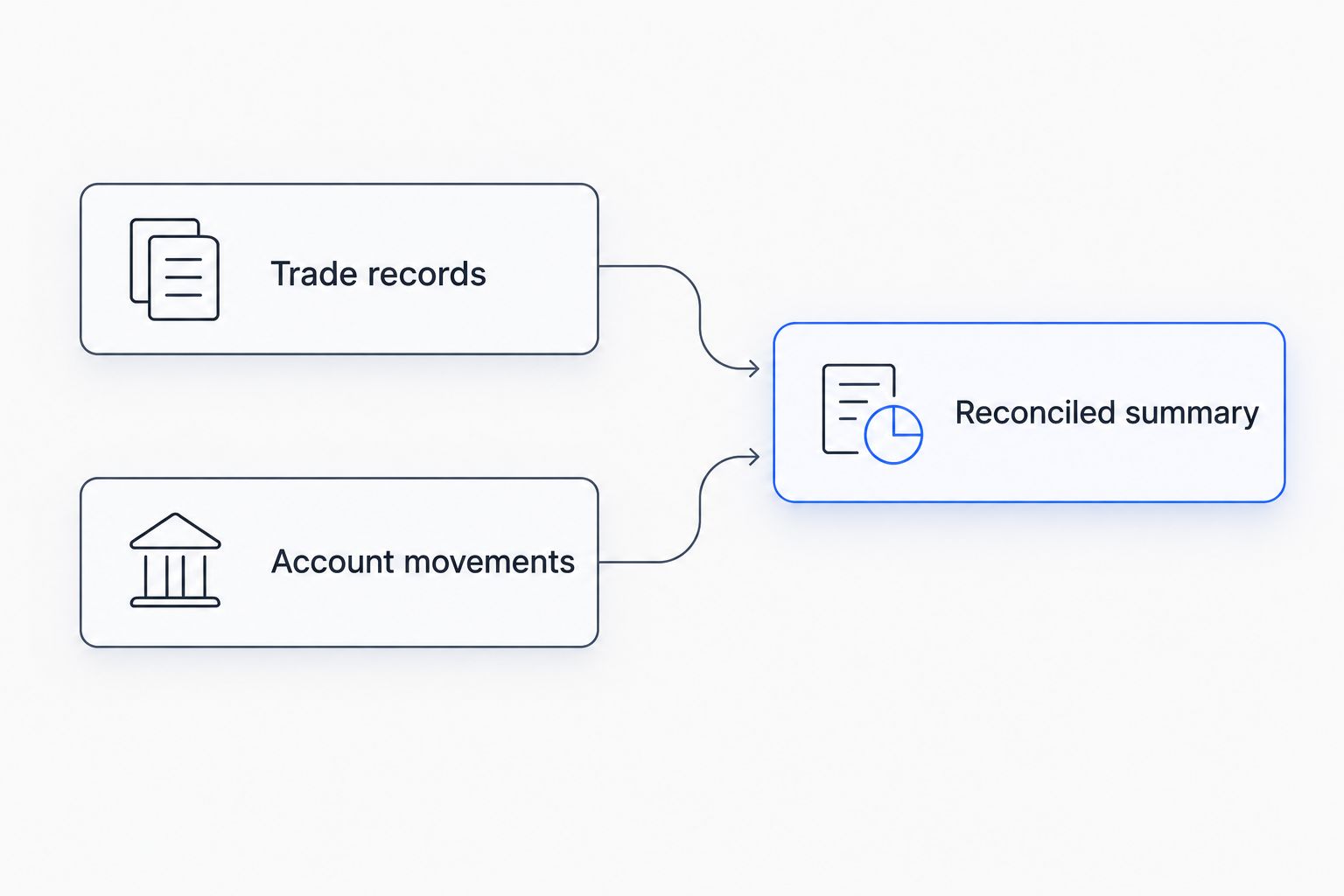
Separate account movements from trading results before interpreting the week.
Keep unrealised results on open positions outside a closed-trade total. If you also record equity, label its timestamp. Equity and balance answer different questions.
Expected result: The summary agrees with the account statement under your stated inclusion rule. Every remaining difference has a written explanation or an unresolved flag.
05
Your decision review
Read the original plan before judging the outcome. Use the same questions for profitable and losing trades. Otherwise the financial result can change the standard you apply.
- Check the entry. Compare the recorded reason with the conditions written before the trade. Mark adherence as Followed, Broken or Not assessable.
- Check position management. Compare documented changes with the original exit rules. Distinguish a planned adjustment from an undocumented decision.
- Separate observation from explanation. Record what the evidence shows. Do not label a trade emotional unless contemporaneous notes support that description.
- Choose one process action. State the behaviour, the evidence you will collect and the next review date.
A useful action is to record the entry reason before submitting an order. Its completion can be checked. A promise to trade better cannot.
For each adherence summary, show the number of assessable decisions beside the total reviewed. Do not classify missing notes as successful adherence. Do not silently exclude them either.
VCG ONE provides behavioural performance scores across eight dimensions. Use those scores to identify questions for the records. A score alone does not establish a cause or justify changing a trading strategy.
Expected result: Your weekly trading review ends with an evidence-backed observation and a checkable process action. Keep the same definitions throughout your 2026 review archive.
06
Update the review after each session
You can maintain the same workbook after each trading session. This spreads recordkeeping across the week without replacing the weekly reconciliation.
- Append new executions and account movements. Check source identifiers before importing overlapping periods.
- Attach decision notes while the context is still available. Keep the original note when adding later commentary.
- Mark current-week summaries as provisional until the weekly cutoff and reconciliation are complete.
The advantage is less reconstruction at week-end. The limitation is that changing totals can distract from the review process. Keep interpretation on the weekly schedule rather than treating every update as a new verdict.
If you change accounts during 2026, start a separate account record. Do not combine different account currencies into one monetary total without a documented conversion method.
07
Troubleshooting
- The trade count exceeds your decision count. Inspect partial fills and partial closes. Preserve execution rows. Group them under the relevant decision instead of assuming every row is a separate trade.
- The weekly total differs from the statement. Check cutoff times, duplicate imports, charge treatment and account adjustments. Compare the same result definition before changing a formula.
- A trade appears in the wrong week. Check whether you used entry time or closing time. Then check the reporting time zone. Apply the chosen rule consistently.
- Rule adherence looks complete despite missing notes. Reclassify unsupported judgments as Not assessable. Report that category separately from Followed and Broken.
- A behavioural score and your notes appear inconsistent. Confirm the account and period being compared. Retain the disagreement as a review question. Do not rewrite the original notes to match a score.
When the source remains unclear, stop at the uncertainty. Ask for clarification through your account support channel where appropriate. A clearly labelled gap is more useful than a total built on an assumption.
08
Customize your workflow
Add a review dimension only when it answers a defined question. Holding time can help examine early exits. Time-of-day grouping can show where to inspect session conditions. Neither grouping establishes causation.
Start with [trading process goals](https://vcgmarkets.com/en/blog/trading-process-goals) when turning an observation into a measurable action. Keep the action linked to evidence you can collect during ordinary recordkeeping.
The spreadsheet workflow gives you explicit control over definitions. Its limitation is manual maintenance. Behavioural scoring adds another perspective, but interpreting a score still requires context and complete records.
VCG Markets provides multi-asset access alongside VCG ONE. Keep execution records, your own notes and behavioural scores distinct. Their different roles make disagreements visible rather than hiding them inside one assessment.
Before adding more fields, check whether the current fields are consistently completed. More columns do not repair missing evidence.
FAQ
How do I start a weekly trading review?
Start by reconciling trade history and account movements for a fixed weekly period. Then compare each assessable decision with the rules recorded before entry. Finish with one checkable process action.
What should a weekly trading review include?
Include the account, review period, reporting time zone, reconciled results, rule adherence and missing-data flags. Keep original records available so each conclusion can be checked.
Should I review winning trades as well as losing trades?
Review both under the same rules. A profitable trade can break your plan, while a losing trade can follow it. Record the outcome and adherence separately.
How do I handle partial closes in my trading review?
Keep each closing execution and connect it to the relevant position or decision. State whether your summary counts positions or closing executions. Do not mix those definitions.
Can I review trades without a trading journal?
You can reconcile financial results without a journal. You cannot reliably reconstruct an undocumented entry reason. Mark unsupported process judgments as Not assessable and start recording reasons before future entries.
Can VCG ONE replace my weekly review?
VCG ONE provides behavioural performance scores across eight dimensions, but scores do not replace source records or your written plan. Use the scores to identify questions for review rather than treating them as explanations of trading results.
Does a weekly trading review improve trading returns?
A weekly trading review does not guarantee improved returns. It creates a repeatable way to check records and assess documented decisions. Trading risk remains.
One last thing
Keep the version of the plan that existed before entry. Editing the original plan after seeing the outcome removes the evidence needed to judge adherence.
For every 2026 review, preserve the original note and date any later interpretation separately. That small distinction keeps what you knew then separate from what you learned afterward.
Reconcile the records. Review the decision. Preserve the evidence.
Related guides
This article is for educational purposes only and does not constitute investment advice. Trading CFDs and other leveraged products carries a high level of risk and may not be suitable for all investors.


