Market mechanics · Futures rollover
A futures rollover price adjustment can occur when a financial instrument switches its reference from an expiring futures contract to a later contract trading at a different level. Where a broker applies an offsetting account adjustment, its purpose is to separate that contract-price difference from trading profit or loss. The calculation, timing and treatment depend on the instrument terms.
TL;DR
- A futures rollover price adjustment reflects a switch between futures contracts, not necessarily a move in the underlying market.
- An account adjustment and a chart adjustment are different records. Check both before interpreting a rollover gap.
- Long and short positions require opposite offsets when the reference contract changes.
- For VCG Markets instruments, check the relevant contract specification and rollover notice before interpreting an adjustment.
01Understand the gap
02Read the adjustment
03Check the records
01
Why this matters
A chart gap and an account debit can look like separate losses. At a rollover, they can be connected parts of the same reference change. Reading either record alone leaves out the mechanism.
For a 2026 trading record, start with the exact symbol and event time. Then establish whether you hold a dated futures contract or an instrument that changes its futures reference. VCG Markets is an international multi-asset broker. The relevant instrument specification, rather than the asset name alone, determines how a position is treated.
The distinction matters beyond rollover. A cash instrument and a futures-based instrument need not show the same level. The guide to cash index and futures prices covers that related distinction.
02
Why can futures rollover create a price adjustment?
Futures contracts have specified expiry dates. Contracts for different delivery or settlement months trade separately. Switching the reference month therefore means switching between distinct market prices.
When the later contract trades above the expiring contract, the reference switch creates an upward step. When it trades below, the switch creates a downward step. Neither step establishes that the underlying market moved by the same amount at that moment.
An account adjustment is not the same thing as replacing an exchange-traded futures position. A chart splice is different again. Establish which event occurred before interpreting the result.
| Event | What changes | What to check |
| Broker reference rollover | The contract used to quote an instrument changes. | Rollover notice and account treatment. |
| Dated futures roll | The trader closes one contract and opens another. | Execution records and expiry specifications. |
| Continuous chart adjustment | Historical chart data is joined or adjusted. | Chart settings, not just account entries. |
03
How the offset works for long and short positions
Consider an instrument whose terms provide an account adjustment for the reference switch. An upward switch increases the quoted level. In isolation, that increases a long position's unrealised result and reduces a short position's unrealised result.
The offset therefore runs in the opposite direction. The long position receives a debit for the reference difference. The short position receives a credit. A downward switch reverses those directions.
- Upward switch: the reference-change offset is a debit for a long position and a credit for a short position.
- Downward switch: the reference-change offset is a credit for a long position and a debit for a short position.
That describes the reference-gap component only. Market movement, spread effects and separately disclosed charges require separate treatment. A rollover adjustment does not guarantee that your total account value remains unchanged throughout the event.
The practical benefit is continuity of the quoted instrument. The limitation is that the resulting chart movement needs explanation. Do not classify every debit as a fee or every credit as trading income.
04
Why futures rollover adjustments vary
There is no universal rollover amount for 2026. The adjustment depends on the contract relationship and the position being adjusted. The same underlying asset can have different gaps across different contract months.
- Contract gap: the difference between the outgoing and incoming reference contracts drives the adjustment.
- Position size: more exposure changes the monetary effect of the same reference gap.
- Contract specification: contract size and point value determine how a quoted difference translates into an account amount.
- Calculation timing: the specified observation time determines which contract levels enter the calculation.
- Account currency: conversion matters when the instrument's calculation currency differs from your account currency.
The contract gap itself reflects the futures curve. Financing, storage and the value of holding the physical commodity can affect that curve. Seasonal conditions and contract-specific supply expectations also matter for relevant commodities.
Contango describes a curve where later contracts trade above nearer contracts. Backwardation describes the opposite relationship. Neither term tells you the size of your account adjustment without the position details and instrument rules.
05
How do you check a rollover adjustment?
Check a rollover adjustment by connecting the contract notice to the position record and account entry. For a 2026 review, retain the notice that applied on the event date. A current specification alone does not establish the historical treatment.
- Identify instrument. Record the full symbol. Confirm whether it is dated or uses a changing futures reference.
- Read notice. Find the rollover time, outgoing contract, incoming contract and published calculation method.
- Check position. Establish the direction and size held at the applicable cutoff.
- Reconcile entry. Compare the account adjustment with the stated reference gap and contract specification.
- Separate costs. Keep financing, execution charges and unrelated market movement outside the reference-gap calculation.
If the records do not reconcile, ask for the calculation inputs. Include the symbol, position identifier and event time. A screenshot of the chart alone cannot establish the account treatment.
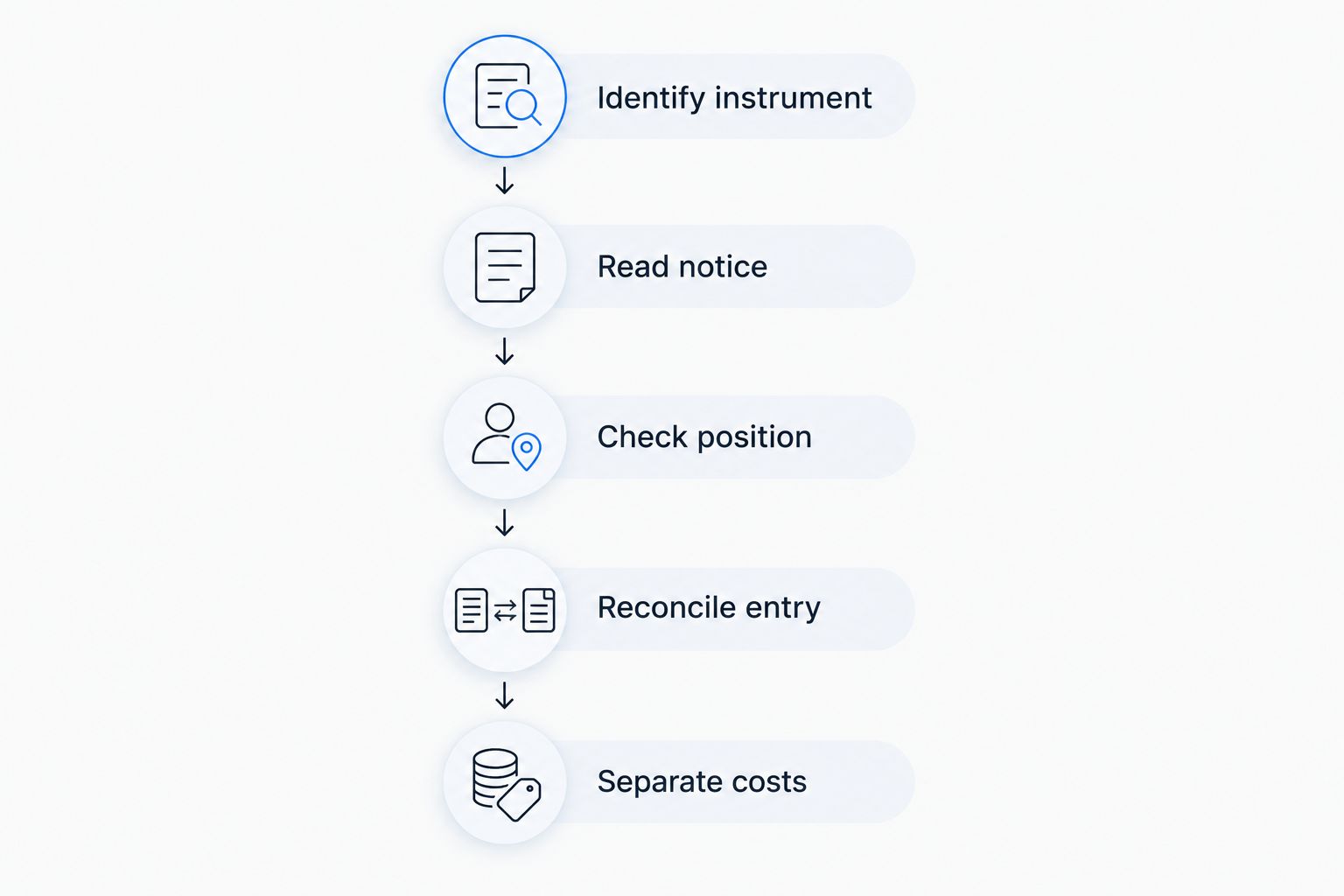
Reconcile the account entry before interpreting the chart gap.
Also check the treatment of pending orders and protective orders. Do not assume their levels shift automatically with the reference. The instrument notice and order rules determine what happens.
06
Does a rollover gap count as a market move?
A rollover gap does not by itself establish a market move. Part of the visible difference can come from switching contracts. Compare the same contract across time before attributing the whole gap to new buying or selling.
An unadjusted continuous chart preserves the visible steps between contracts. That helps you identify reference changes. Its limitation is that those steps can affect indicators and visual return comparisons.
A back-adjusted chart reduces those discontinuities by changing historical data. That supports continuous analysis. Its limitation is that adjusted historical levels need not match the levels at which the original contracts traded.
Is a rollover adjustment the same as overnight financing?
A rollover adjustment and overnight financing serve different purposes. The first addresses a reference-contract change. The second concerns holding an instrument over a financing cutoff under its applicable terms.
Does a credit mean the rollover made money?
A rollover credit does not establish a profit. It can offset an adverse change in the quoted reference level. Read the credit alongside the position valuation and any separate charges.
FAQ
What is a futures rollover price adjustment?
A futures rollover price adjustment addresses the difference between outgoing and incoming futures reference contracts. For instruments with an offsetting account adjustment, the purpose is to separate that reference change from trading profit or loss.
Why was my account debited during rollover?
A debit can offset a reference change that improves the position's quoted valuation. Check the position direction, contract gap and applicable calculation before classifying the entry as a charge.
Do long and short positions receive the same adjustment?
Long and short positions require opposite reference-gap offsets. Position size, contract specifications and currency conversion determine the corresponding account amounts.
Will a rollover adjustment keep my equity unchanged?
A rollover adjustment does not guarantee unchanged equity. The reference-gap offset is separate from market movement, spread effects and other applicable charges.
Does every futures contract roll automatically?
A dated futures contract does not automatically become a later contract. Closing the expiring contract and opening another is different from a broker changing an instrument's reference contract.
Can I calculate the adjustment from my chart?
A chart alone is insufficient to establish the account adjustment. You also need the applicable reference levels, position details, contract specification and calculation rules.
Can a continuous chart change historical levels?
A back-adjusted continuous chart changes historical data to reduce discontinuities between contracts. Those adjusted levels need not match the original traded levels.
Related guides
Conclusion
For your 2026 records, save the rollover notice alongside the account entry. A later chart can use adjusted history and no longer show the original gap. The contemporaneous records preserve the information needed to explain the event.
A contract switch changes the reference. Reconcile the adjustment before judging the result.
This article is for educational purposes only and does not constitute investment advice. Trading CFDs and other leveraged products carries a high level of risk and may not be suitable for all investors.


