Trang chủWhat happens to a stop loss when the market gaps?
What happens to a stop loss when the market gaps?
Oct 26, 2026
When the market gaps through a standard stop loss, the order normally triggers at the first qualifying price beyond your stop level. It then seeks execution at available prices under the instrument’s order rules. The stop level is a trigger, not a guaranteed exit price, so your loss can exceed the amount planned around that level.
TL;DR
- A stop loss price gap can produce an exit beyond your stop level. The trigger does not guarantee execution.
- Stop-market orders prioritise execution. Stop-limit orders restrict price but can leave your position open.
- Liquidity and slippage determine why your trigger price and execution price differ.
- VCG Markets traders should assess gap exposure before holding positions through market closures.
01. What happens to a stop loss when the market gaps?
A standard stop loss does not reserve an exit at your chosen price. When the market skips that level, the order follows its trigger and execution rules. The first available executable price can be worse than your stop.
The sequence matters:
- You set the stop level. This tells the trading system when to activate the exit instruction.
- The market gaps beyond it. No executable price is available at the stop level during the jump.
- The stop condition is met. The relevant quote or trade activates the order under the instrument’s rules.
- The exit seeks execution. Available liquidity determines the fill for a standard market-style stop.
For a long position, a downward gap can lead to a sale below the stop. For a short position, an upward gap can lead to a purchase above it. Both are adverse outcomes relative to the intended exit.
The mechanics depend on liquidity and order execution. An exit instruction cannot create a tradable price inside a gap.
For your 2026 trading plan, distinguish the stop level from the execution price. Treating them as interchangeable understates gap exposure.
02. Which stop order are you using?
The label on an order matters less than its actual instructions. Check whether crossing the stop activates a market order or a limit order. Those instructions solve different problems.
Stop-market
- Useful for: Prioritising an exit after a trigger
- What happens after a gap: Seeks execution at available market prices
- Advantage: Does not impose a limit price that blocks execution
- Limitation: The fill can be worse than the stop level
Stop-limit
- Useful for: Restricting the acceptable execution price
- What happens after a gap: Activates a limit order
- Advantage: Prevents execution outside the limit instruction
- Limitation: The order can remain unfilled while the position stays open
Stop-market: execution takes priority
A stop-market order becomes a market order when its trigger condition is met. If the market has already moved beyond the stop, the order seeks the available price rather than waiting for the original level.
That supports an exit. It does not fix its price. Trading halts, closed markets and missing liquidity can also delay execution.
A large order can receive fills at different prices if available liquidity at a single level is insufficient. Review the execution record rather than assuming the displayed stop represents the completed trade.
Stop-limit: the price restriction takes priority
A stop-limit order activates a limit instruction after the stop condition is met. A sell limit cannot execute below its limit price. A buy limit cannot execute above its limit price.
That restriction remains relevant during a gap. If available prices do not satisfy the limit, the exit stays unfilled. The position remains exposed to further movement.
A stop-limit order controls acceptable execution prices. It does not guarantee an exit. Confirm that your instrument supports this order type before including it in a plan.
For a 2026 order review, write down the priority explicitly: execution after a trigger or a restriction on price. Neither standard order type guarantees both.
03. Why stop loss gap execution varies
A gap describes the missing prices between successive trading levels. The final execution depends on what happens when the order becomes eligible to trade.
These factors explain the difference:
- Gap direction and size. An adverse jump beyond the stop puts the first available price further from the intended exit.
- Available liquidity. The volume available at executable prices determines how much of the order can fill at each level.
- Bid and ask spreads. The quote relevant to closing your position can differ from the price displayed on a chart.
- Market status. A closure or trading halt prevents execution until the relevant market or trading service resumes.
- Trigger rules. The instrument’s rules determine whether a bid, ask, last trade or another specified reference activates the order.
- Order instructions. A market-style exit and a limit-constrained exit respond differently to the same price jump.
A weekend reopening is one setting where prices can jump. A scheduled session opening is another. News can also change executable prices during an active session.
Do not assume every adverse fill is evidence that the stop failed. First establish whether the trigger worked. Then examine the prices available for execution.
That distinction separates an order-processing question from a market-liquidity question. You need both parts of the record to understand the result.
04. Why this matters: your planned loss is not a ceiling
A planned stop-based loss usually measures the distance between the entry and stop level. A gap changes the exit price used in the realised result. The original calculation no longer describes the completed trade.
Position size remains relevant. A worse exit price has a larger cash effect on a larger position, all else equal. Setting a stop does not remove that relationship.
This is why an ordinary stop should not be described as a fixed maximum loss. It sets an instruction for responding to price movement. It does not remove the possibility of missing prices or delayed execution.
Your 2026 risk review should separate these ideas:
- Planned exit. The level used when assessing the trade before entry.
- Executable exit. The price available when the order reaches the market.
- Realised result. The outcome calculated from actual fills and applicable transaction costs.
Keep the distinction visible in your trading record. Recording only the planned stop hides the difference between the original instruction and what the market allowed.
An adverse fill changes the outcome. It does not, by itself, establish whether the original trade process was followed.
05. Why does the chart look different from my stop execution?
A chart is a display of a specified price series. Your closing order executes against the relevant tradable side of the market. Those are not necessarily the same thing.
A long position generally closes by selling at the bid. A short position generally closes by buying at the ask. A chart displaying only one side does not show every price relevant to both exits.
Spreads can also widen. That can move the relevant trigger quote even when the price series you are watching appears not to have touched the stop.
Check what the chart displays before drawing a conclusion. A bid chart, an ask chart and a last-traded-price chart answer different questions.
For a disputed execution, compare:
- The instrument and exact order type.
- The recorded stop level.
- The trigger reference specified in the order rules.
- The trigger timestamp and its time zone.
- The fill timestamp, execution price and filled quantity.
A screenshot of a candle is useful context. It is not a complete execution record. Candles summarise price movement and do not necessarily display the executable quote relevant to your order.
Keep this distinction in your 2026 journal: chart evidence describes the display; execution evidence describes the trade.
06. How do you review a stop loss price gap?
Review the instruction before judging the outcome. Start with what the order was meant to do. Then compare that instruction with the recorded trigger and fill.
Use this sequence:
- Order rules. Identify the order type and the price reference that activates it.
- Market session. Check whether the gap followed a closure, reopening or trading interruption.
- Trigger record. Establish when the stop condition was met.
- Execution record. Compare the completed fill with the stop level and any limit instruction.
- Risk review. Record how the actual result differed from the planned stop-based loss.
The purpose is not to explain every difference as normal. It is to ask a precise question supported by records. If something remains unclear, request the relevant order history and execution explanation from your broker.
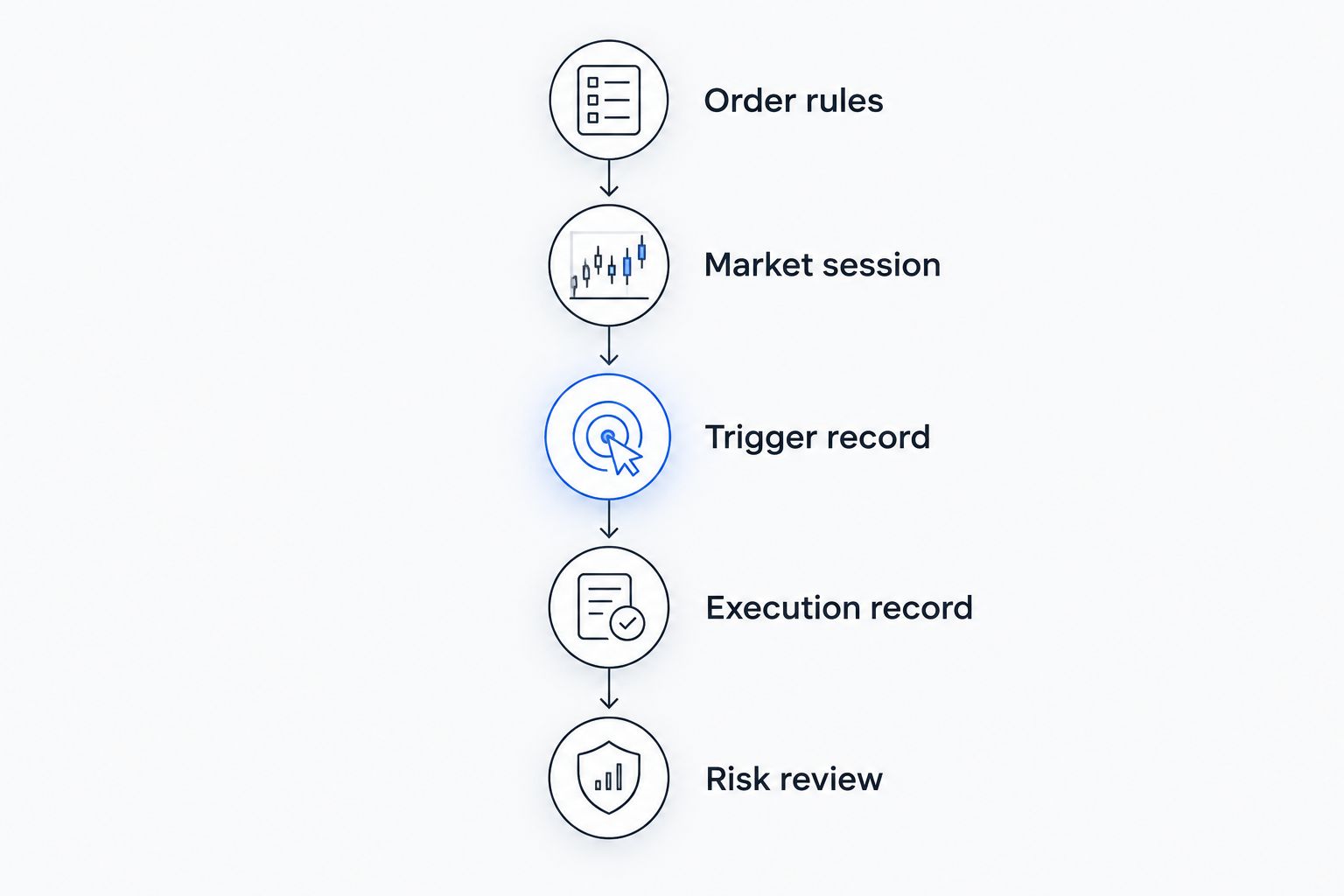
Check the order instruction before evaluating the fill.
Before holding through a closure, check the instrument’s trading schedule and execution terms. A stop order cannot provide continuous execution while the relevant market is unavailable.
07. Can a stop loss execute beyond the opening price?
Yes. The opening price does not guarantee the price available when your order executes. Quotes can move after trading resumes, and available volume can differ across price levels.
An opening price shown on a chart is therefore not enough to establish the fill your order should have received. Review the relevant quote and execution timestamps.
Can I cancel the stop after the gap?
A cancellation request does not reverse a completed execution. Whether an unfilled order can still be cancelled depends on its status and the applicable trading rules.
Check the order record before submitting another instruction. Do not assume that a delayed display means the original order remains pending.
Does a tighter stop prevent gap losses?
No. A tighter standard stop does not create liquidity at its trigger level. A market gap can pass through a nearby stop just as it can pass through a more distant one.
The distance affects the planned exit. It does not turn that exit into a guaranteed price.
The VCG Markets lens
VCG Markets traders should treat a standard stop as an exit trigger, not a guaranteed loss ceiling. That distinction applies whether you monitor positions on a phone or through a browser.
VCG Markets is an international multi-asset broker. The relevant question for this topic remains specific: what do the instrument’s terms say about stop activation and execution?
A platform display helps you monitor an instruction. It cannot make an unavailable market price executable. Keep the order terms and the completed trade record alongside the chart.
Conclusion
A stop loss price gap separates your intended exit from the price available to close. A standard market-style stop seeks execution after activation. A stop-limit instruction restricts acceptable prices but can leave the position open.
For your 2026 checklist, verify the order type, trigger reference and trading schedule before relying on a stop-based loss calculation. After a gap, assess the recorded trigger and fill separately.
At VCG Markets, as with any trading decision, understand the instruction before relying on the outcome. This is an execution principle, not a recommendation to place a trade.
FAQ
Will my stop loss close at the exact price if the market gaps?
A standard stop loss does not guarantee execution at its stop level. If the market gaps through it, the exit seeks available prices under the instrument’s execution rules.
What does a stop loss price gap mean for a long position?
A stop loss price gap below a long position’s stop can produce a sale below the planned exit. The actual fill depends on available liquidity and the order instructions.
What happens to a short position when the market gaps up?
An upward gap through a short position’s stop can produce a purchase above the stop level. That increases the loss relative to an exit at the planned price.
Is a stop-limit order safer during a market gap?
A stop-limit order restricts execution prices but can remain unfilled during a gap. It exchanges execution certainty for a price restriction rather than removing risk.
Can my stop loss trigger when the candle does not touch it?
A stop can trigger when the relevant quote meets its condition even if the displayed chart does not show that quote. Check whether the chart and trigger use the bid, ask or last-traded price.
Does setting a stop guarantee my maximum loss?
A standard stop does not guarantee a maximum loss. Gaps, unavailable liquidity and execution delays can produce an exit beyond the intended level.
One last thing
A limit on execution price is not a limit on the loss of an open position. If a stop-limit order remains unfilled, the position continues to carry market exposure.
That is the useful final check: does your order constrain the fill price, seek an exit, or provide a separate contractual protection? Read the terms. Do not infer protection from the word stop.
Related guides
This article is for educational purposes only and does not constitute investment advice. Trading CFDs and other leveraged products carries a high level of risk and may not be suitable for all investors.

Thông tin
VCG Markets Ltd là tổ chức được cấp phép và được ủy quyền cung cấp dịch vụ đầu tư. Được thành lập tại Cộng hòa Mauritius (Mã số công ty 188485) và được ủy quyền và quản lý bởi Ủy ban Dịch vụ Tài chính Mauritius theo Giấy phép số GB22200388, với văn phòng đăng ký tại The Cyberaty Lounge, Tầng trệt, The Catalyst, Silicon Avenue, 40 Cybercity, 72201 Ebene, Cộng hòa Mauritius.
VCG Markets (Seychelles) Ltd là tổ chức được cấp phép và được ủy quyền cung cấp dịch vụ Môi giới Chứng khoán (Securities Dealer). Được thành lập tại Cộng hòa Seychelles (Mã số công ty 8438443-1) và được ủy quyền và quản lý bởi Cơ quan Dịch vụ Tài chính Seychelles theo Giấy phép số SD243, với văn phòng đăng ký tại House of Francis, Room 301(B), Ile Du Port, Mahe, Cộng hòa Seychelles.
Trang web được vận hành bởi VCG Tech Limited (Mã số công ty HE452446), với văn phòng đăng ký tại Agias Fylaxeos & Zinonos Rossidi, 2, Tầng 1, 3082 Limassol, Cyprus. VCG Tech Limited hoạt động với tư cách là công ty thương mại để xử lý các khoản tiền gửi và rút tiền của khách hàng.
Giao dịch Forex và CFD ký quỹ là các sản phẩm có đòn bẩy và có thể dẫn đến thua lỗ vượt quá khoản tiền gửi của bạn. Giá trị đầu tư có thể giảm cũng như tăng, và bạn có thể nhận lại ít hơn khoản đầu tư ban đầu. Hãy đảm bảo bạn hiểu đầy đủ các rủi ro liên quan và xem xét liệu loại giao dịch này có phù hợp với bạn hay không.
Các cuộc gọi điện thoại và liên lạc điện tử có thể được ghi âm và giám sát nhằm mục đích đảm bảo chất lượng, tuân thủ và đào tạo.
Thông tin trên trang web này được cung cấp chỉ cho mục đích thông tin chung và không cấu thành lời khuyên đầu tư, khuyến nghị, hoặc lời mời tham gia vào bất kỳ hoạt động đầu tư nào.
VCG Markets không cung cấp tư vấn thuế. Luật thuế có thể thay đổi hoặc khác nhau giữa các khu vực pháp lý.
Thông tin trên trang web này không hướng đến cư dân của Hoa Kỳ, Bỉ, Canada, Singapore, hoặc bất kỳ khu vực pháp lý nào mà việc truy cập thông tin đó trái với luật pháp hoặc quy định địa phương.
VCG Markets © 2026, Inc. Bảo lưu mọi quyền.

Theo dõi chúng tôi


