Index Trading · Dividend Adjustments
An index dividend adjustment typically credits an eligible long cash-index position and debits an eligible short position when constituent shares go ex-dividend. It accounts for the dividend-related reduction in the underlying price index. The adjustment is not an extra trading gain. Your contract determines eligibility, timing and the amount booked.
TL;DR
- An index dividend adjustment typically credits eligible long cash-index positions and debits eligible shorts.
- The ex-dividend date matters more than the shareholder payment date for cash-index adjustments.
- Price indices and total-return indices treat dividends differently. Check your instrument specification.
- VCG Markets traders should check contract terms before interpreting dividend cash entries as trading performance.
01Position direction
02Adjustment timing
03Statement checks
01
How do dividend adjustments affect index positions?
For a cash-index contract with a separate dividend mechanism, position direction determines the usual cash entry. A long position receives a credit. A short position receives a debit. Both entries relate to the dividend effect in the underlying index.
The effect also depends on constituent weights. A dividend from a heavily weighted share has a different index impact from the same dividend on a lightly weighted share. Read the guide to [index weighting and market performance](https://vcgmarkets.com/en/blog/index-weighting-market-performance) for that distinction.
| Position | Usual cash entry | What it addresses |
| Eligible long | Credit | Dividend-related reduction in the price index |
| Eligible short | Debit | Dividend-related benefit to the short position |
Read the cash entry alongside the position result. Neither line gives the complete economic picture alone. The contract specification remains the reference for the actual treatment in 2026.
02
Why this matters: a credit is not extra profit
A dividend changes what a buyer receives with a share. From the ex-dividend date, a new buyer is no longer entitled to the declared distribution. All else equal, the share price adjusts downward to reflect that change.
A price index reflects constituent share prices. It does not add ordinary cash dividends back into its return calculation. When constituents go ex-dividend, their dividend-related price adjustments therefore affect the index level.
For a long cash-index position, the dividend credit addresses that mechanical effect. For a short position, the debit addresses the corresponding benefit. Neither entry removes ordinary market risk.
The observed index move will not necessarily equal the dividend adjustment. Economic releases, earnings and changes in sentiment also move constituent shares. Those influences can reinforce or outweigh the dividend effect during the same session.
Buying before an adjustment is not a guaranteed dividend-capture strategy. The credit must be considered alongside the price movement and other account entries. A larger balance after a credit does not establish a positive overall result.
03
When does an index dividend adjustment apply?
The relevant event is generally the constituent share's ex-dividend date. That differs from the payment date, when shareholders receive the distribution. A cash-index contract can therefore have an adjustment before the underlying company pays shareholders.
Your broker's cutoff determines which positions qualify. Do not substitute the company's shareholder calendar for the contract's holding requirement. The trading session, server time and booking convention also need checking.
Use this sequence when reviewing an adjustment notice in 2026:
- Identify the contract. Confirm the exact symbol and whether it tracks a cash index or a futures-based instrument.
- Check eligibility. Find the required holding cutoff and its stated time zone.
- Confirm direction. Establish whether the eligible position was long or short at that cutoff.
- Review the booking. Match the adjustment notice to the account statement and the eligible position size.
The sequence separates the market event from your account treatment. That distinction matters when a constituent's ex-dividend date and the statement's posting date are not presented identically.
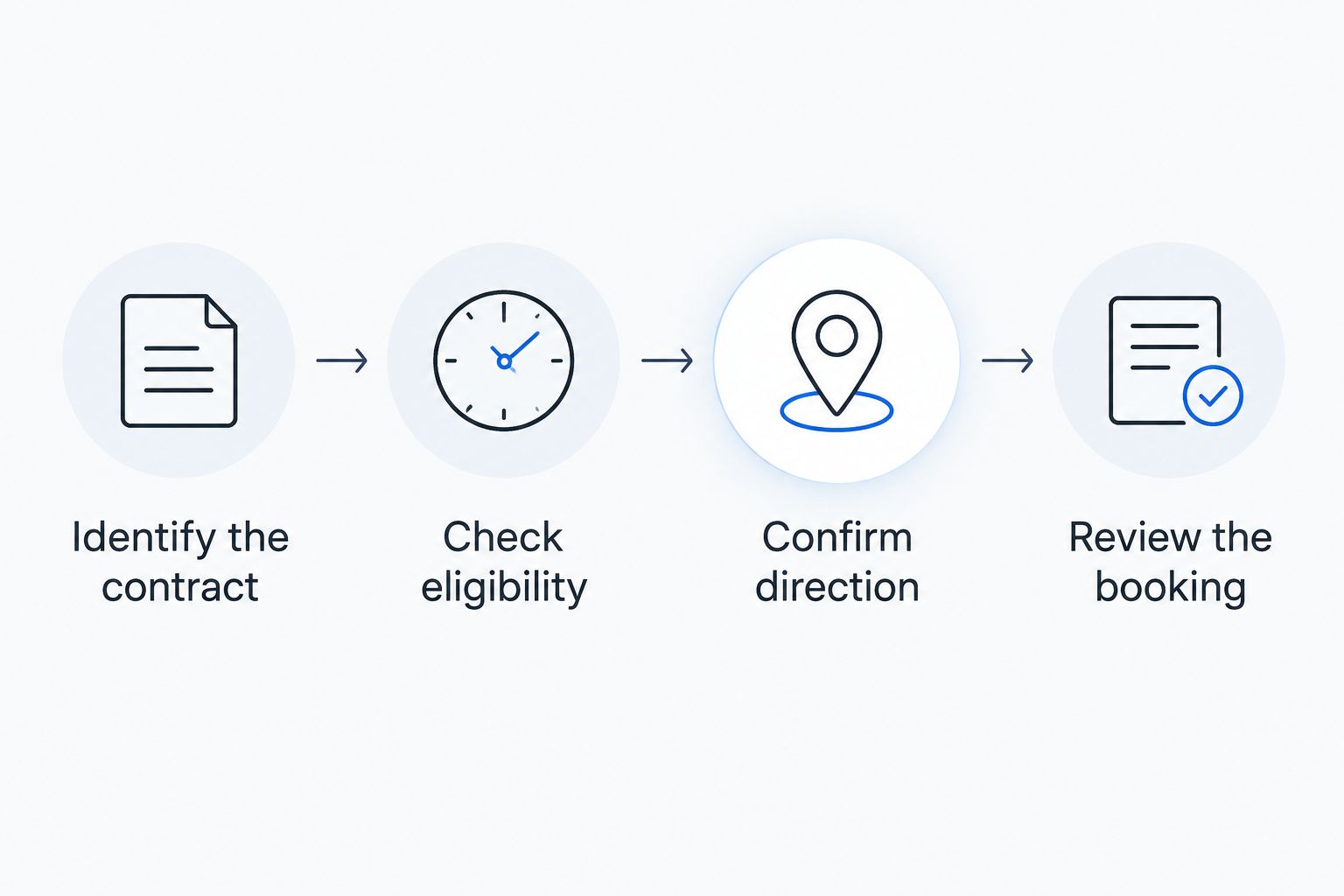
Check contract eligibility before interpreting the cash entry.
If you close before the qualifying cutoff, do not assume an earlier position creates entitlement. Apply the published contract rule. An adjustment appearing later on the statement does not itself establish when eligibility was measured.
04
Why the adjustment amount varies
The cash amount depends on the underlying dividend effect and the contract you hold. An index headline alone is not enough to calculate your account entry. Check these factors:
- Constituent distributions. The declared dividends and the shares going ex-dividend determine the underlying dividend event.
- Index methodology. Constituent weights and the index calculation method determine how share dividends translate into index points.
- Eligible position size. The qualifying exposure determines how the published adjustment scales to your position.
- Contract point value. The monetary value of an index point determines the cash equivalent for the contract size.
- Account treatment. Currency conversion and any stated withholding treatment can affect the booked amount.
For a contract quoting its adjustment in index points, the calculation generally combines adjustment points, monetary point value and eligible size. Currency conversion follows where applicable. Use the specification's units throughout.
Do not multiply by position size twice. Some point values are already expressed per contract or per lot. An amount quoted per lot is not interchangeable with an amount quoted for your entire position.
For your 2026 records, keep the original adjustment notice with the statement. That preserves the units used in the calculation. It also gives you a reference if the displayed amount differs from your expectation.
05
Does every index instrument handle dividends the same way?
No. A price-index cash contract, a futures-based contract and a total-return benchmark do not express dividends in the same way. Check the reference instrument before applying the long-credit and short-debit convention.
A cash-index contract can use a separate cash adjustment. That makes the dividend entry visible on the account statement. The limitation is that the entry must be read alongside the related price effect.
Index futures incorporate expected dividends into fair-value pricing. A futures-based product should not automatically be expected to use the same daily cash adjustment as a cash-index contract. Its own specification controls.
A total-return index incorporates dividend reinvestment under its methodology. A gross-return version and a net-return version also differ in their treatment of withholding assumptions. The benchmark name matters.
A shared index name does not establish identical dividend treatment. Before comparing performance in 2026, confirm the exact benchmark and contract structure. Otherwise, the comparison can mix a price-only return with a return that includes dividends.
06
How do I check an unexpected dividend entry?
Start with the eligible position, not the current position. You might have changed your exposure after the cutoff. The statement entry needs to match the exposure that qualified under the contract terms.
Then reconcile the symbol, direction, size, adjustment rate and currency. Keep financing entries separate. A dividend adjustment and an overnight financing entry address different parts of the position.
If the amount still does not reconcile, request the calculation basis. Include the position identifier, relevant timestamp and statement description. Ask which holding cutoff and point value were applied.
Keep the explanation with your 2026 trading journal. Record the adjustment separately from your assessment of the trade decision. This prevents a mechanical cash entry from being mistaken for evidence that the entry or exit decision worked.
FAQ
Do long index positions receive dividend adjustments?
Eligible long cash-index positions typically receive a dividend credit where the contract uses separate adjustments. The contract's holding cutoff and calculation rules determine the actual entitlement.
Why was my short index position debited?
An eligible short cash-index position typically receives a debit to account for the dividend-related reduction in the price index. The debit addresses that mechanical benefit rather than a separate trading decision.
Can I collect the adjustment and close immediately?
A dividend credit is not a guaranteed gain. The related price adjustment, ordinary market movements and other account entries must also be considered.
Is the ex-dividend date the same as the payment date?
No. The ex-dividend date determines when a new share buyer no longer receives the declared dividend. The payment date is when the distribution is paid to entitled shareholders.
Do index futures receive the same cash adjustment?
Do not assume index futures receive the same cash adjustment as cash-index contracts. Expected dividends enter futures fair-value pricing, and the product specification determines account treatment.
Does a dividend adjustment give me shareholder rights?
A cash adjustment on an index trading contract does not itself give you ownership or voting rights in constituent companies. It is an account entry governed by the contract.
What should I check when trading indices with VCG Markets?
Check the exact instrument specification and applicable dividend notice. Confirm the qualifying cutoff, position size, adjustment units and account currency before interpreting the entry.
Conclusion
One last thing: an index can rise on an ex-dividend session while a long position still receives a dividend adjustment. Other share-price movements can outweigh the dividend effect. A rising chart therefore does not prove the credit is unrelated or incorrect.
Read the price movement and the cash adjustment together.
Related guides
This article is for educational purposes only and does not constitute investment advice. Trading CFDs and other leveraged products carries a high level of risk and may not be suitable for all investors.


