Indices Trading · 2026 Guide
Indices trading for busy professionals is taking positions on stock-market benchmarks within a defined schedule. The aim is to make market participation compatible with work commitments without confusing limited screen time with limited risk.
Key points
- Indices trading for busy professionals starts with available attention, contract knowledge and a written risk plan.
- VCG Markets offers index access and behavioural review through VCG ONE. Neither removes trading risk.
- Price alerts support monitoring. They do not close positions or guarantee execution.
- Review trading decisions separately from financial results. A profitable trade can still break your rules.
01Build your schedule
02Understand your exposure
03Review your decisions
01
Why indices trading matters for busy professionals
A stock index measures a defined basket of shares using its own calculation rules. Trading an instrument linked to that index gives you exposure to benchmark movements. It does not make every constituent equally important.
For a professional with meetings and deadlines, the central constraint is attention. A position remains exposed while you are unavailable. An unexpected call does not pause market movements or an account’s margin requirements.
Start your 2026 plan with the hours you can genuinely protect. Then decide whether the monitoring demands fit. The pre-trade decision checklist provides a useful structure for recording the decision before placing an order.
VCG Markets suits professionals seeking index trading access alongside behavioural performance review. That combination supports a review process. It does not establish whether trading is suitable for your finances or guarantee improved results.
02
Build a trading routine around your work
Map your available attention
Use your calendar before using a chart. Mark periods when you can read market information without interruption. Separately mark periods when you can respond to an open position. Those are different commitments.
An illustrative routine reserves 10 minutes for preparation and 5 minutes for recording decisions. Add a 20-minute weekly review. These are planning examples, not sufficient monitoring allowances or a tested trading formula. Position management depends on the instrument and your exposure.
- Block preparation time before your working day fills.
- Mark meetings when responding is impossible.
- Write a rule for interrupted trading sessions.
- Exclude trading plans that require unavailable attention.
Read the index contract before the chart
An index name does not describe every trading condition. Check the actual instrument specification. Establish its trading hours, contract size, quotation currency and applicable financing or adjustment rules.
Cash-index instruments and futures-linked instruments are not interchangeable. Their pricing and adjustments differ. For your 2026 watchlist, record the contract details you checked rather than relying on an old screenshot or a familiar benchmark name.
A manual reference sheet is enough to start. Keep it beside the order ticket so that a busy morning does not become a memory test.
- Record the exact instrument name and contract type.
- Confirm trading hours and scheduled breaks.
- Check how a price movement affects position value.
- Identify applicable financing and dividend adjustments.
- Record when you last checked the specification.
Write your decision rules before placing orders
Begin with a notebook or spreadsheet. Write the reason for entry, the condition that invalidates it and the intended exit process. Include what you will do if a work commitment interrupts your plan.
VCG Markets provides index trading access and VCG ONE scores performance across eight behavioural dimensions in real time. Use that feedback as an additional review input rather than a substitute for your written reasoning. A score is not a market forecast.
The manual record remains useful because it captures context you must explain yourself. Record the rule before entry so that the eventual result cannot rewrite it.
- Describe the setup in plain language.
- Define the condition that cancels the trade idea.
- Record planned exposure and exit instructions.
- State your response to a work interruption.
- Keep original notes alongside later observations.
Check combined exposure and order limitations
Different index names do not guarantee independent exposure. Benchmarks can share large constituents or respond to the same economic release. Review the combined position rather than treating each order as an isolated decision.
Order instructions also have limits. A standard stop order does not guarantee its execution price during a market gap. A stop-limit order introduces a different trade-off: execution is not assured if the market moves beyond its limit.
Check account equity and margin requirements before stepping away. A protective order does not remove the need to understand the exposure that remains.
- List all open index positions together.
- Check shared constituents and directional exposure.
- Read the selected order type’s execution conditions.
- Check equity and margin before work commitments.
- Account for gaps in the written risk assessment.
Separate alerts from execution instructions
A price alert draws your attention to a condition. It is not an instruction to close a position. This distinction matters when a notification arrives during a presentation and you cannot act.
Use a manually maintained event calendar first. Add platform alerts where available and check notification permissions. Do not build a plan around receiving or answering every message immediately.
For a 2026 routine, write separate rules for a market alert and a work interruption. A notification is information. The response still needs a defined decision process.
- Record relevant scheduled economic releases.
- Distinguish notifications from submitted orders.
- Check device permissions and connectivity.
- Define what happens when an alert goes unread.
Review decisions separately from results
Export or manually record completed trades. Compare actual actions with the plan written before entry. A profitable rule breach remains a rule breach. A losing trade alone does not establish that the process was wrong.
Use four headings for the review cycle: Prepare, Check, Record and Review. Preparation defines the plan. Checking covers exposure and instructions. Recording preserves the decision. Reviewing compares intention with action.
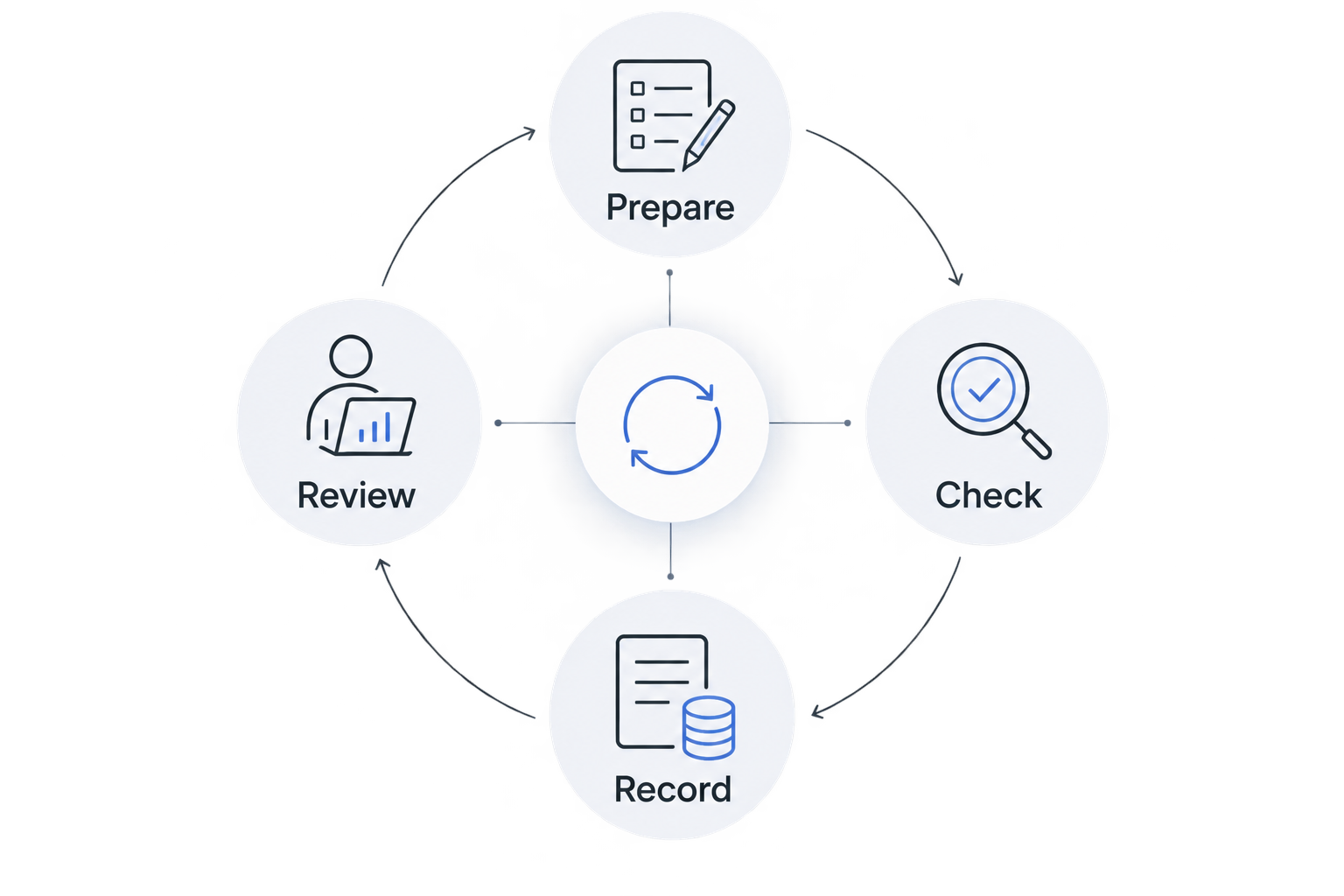
Record the original plan before judging the result.
Keep the 2026 journal consistent enough to compare like with like. Tag interrupted sessions separately. Treat a small collection of trades as observations rather than proof of a lasting advantage.
- Preserve the original entry and exit reasoning.
- Tag work interruptions and unplanned changes.
- Separate financial results from rule adherence.
- Record costs and adjustments alongside trade results.
- Choose one process change for the next review.
03
Compare ways to organise your routine
Choose support according to the task. A journal preserves reasoning. Alerts flag conditions. Behavioural analysis adds another view of your actions. None replaces understanding the instrument or deciding whether the exposure fits your circumstances.
| Option | Suitable for | Key limitation |
| Manual journal Preserves written context. | Professionals building a decision record. | Requires consistent entry and checking. |
| Calendar and alerts Organise scheduled checks. | Professionals coordinating market checks with work. | Notifications do not execute decisions. |
| VCG Markets with VCG ONE Combines index access with behavioural scoring. | Professionals seeking behavioural feedback alongside trading access. | Scores need context. They do not predict returns or remove risk. |
These approaches can work together. Keep the written plan even when using behavioural analysis. It gives you a record against which to question the interpretation rather than accepting a score without context.
04
Common mistakes to check in a busy schedule
Treating a work break as an entry signal
A free moment means you can check your plan. It does not establish a trading opportunity. Compare the market with the conditions you wrote before the break. Record no trade when those conditions are absent.
Extending a trade because a meeting ran over
A calendar delay is not a market thesis. Record whether the position remained open because the plan allowed it or because you were unavailable. That distinction belongs in the review even when the result was profitable.
Confusing benchmark breadth with low account risk
An index contains multiple shares. Your account exposure still depends on position size and instrument terms. Check combined directional exposure before adding another benchmark with overlapping constituents.
Judging the routine only by its latest result
One result cannot separate process quality from chance. Review whether the schedule was workable and whether you followed the written rules. Keep financial outcomes visible without letting them erase execution errors.
Frequently asked questions
Can I trade indices while working full time?
Full-time work does not remove the monitoring and financial demands of indices trading. Assess your availability, contract terms and capacity for loss before deciding whether participation fits your circumstances.
How much screen time does indices trading require?
There is no fixed screen-time requirement that makes indices trading safe. Monitoring needs depend on the instrument, open exposure, order instructions and market conditions.
Are price alerts enough when I am in meetings?
Price alerts are not a substitute for position-management instructions. An unread notification does not change an open position or protect its execution price.
Is holding an index position overnight simpler than intraday trading?
Overnight holding changes the risks rather than removing them. Check gap exposure, applicable financing, adjustments and the instrument’s trading schedule.
Does a stop order guarantee my planned loss?
A standard stop order does not guarantee its execution price. A market gap or slippage can make the realised loss different from the planned loss.
What does VCG ONE add to an indices trading review?
VCG ONE scores trading performance across eight behavioural dimensions in real time. Use those scores alongside written context and actual trade records. The scores do not guarantee future performance.
What should I record when work interrupts a trade?
Record the interruption, the planned action and what actually happened. Keep that information separate from the trade’s financial result so you can assess rule adherence.
Conclusion
Keep a record of the trades you declined because work made the plan unmanageable. Include the reason known at the time. Do not judge that decision only by where the market moved afterwards.
Your 2026 review should show whether trading fits your actual calendar. A routine that depends on uninterrupted attention you do not have needs revision before another position is added.
Fit the trading plan to your available attention. Do not assume the market will fit your calendar.
Related guides
- Read contract specifications
- Understand stop orders during a market gap
- Build a weekly trading review workflow
This article is for educational purposes only and does not constitute investment advice. Trading CFDs and other leveraged products carries a high level of risk and may not be suitable for all investors.


