Market Education · Oil
Oil reacts differently to supply and demand news because a disruption threatens available barrels while a demand outlook changes expectations about consumption. Neither headline determines direction alone. The reaction depends on what was already expected, how long the change lasts and whether inventories can absorb it.
TL;DR
- Oil supply disruption demand outlook analysis starts with available barrels versus expected consumption.
- A supply disruption does not guarantee rising oil prices; inventories, replacement supply and expectations matter.
- A weaker demand outlook can offset supply concerns when expected consumption falls.
- VCG Markets offers oil market access; market access does not remove trading risk.
This 2026 guide from VCG Markets separates the physical oil balance from the expectations reflected in market pricing. The distinction helps you read a headline without treating it as a trading instruction.
01Available barrels
02Expected consumption
03Market expectations
01. Why oil prices react differently to supply and demand news
Supply news and demand news change different sides of the oil balance. A production outage concerns barrels reaching the market. A weaker consumption forecast concerns how many barrels buyers will need.
The distinction matters because immediate physical shortages and future consumption estimates operate on different timelines. An outage can interrupt deliveries before buyers can arrange alternatives. A forecast revision changes expectations before the consumption change appears in physical data.
| News type | What changes | What limits the signal |
| Supply disruption | Available barrels or delivery timing | Stocks or replacement supply can offset the loss. |
| Demand outlook | Expected consumption | Forecasts remain estimates rather than realised demand. |
| Inventory report | Oil held in storage | Imports, exports and refinery activity also affect stocks. |
The relevant question is not whether the headline sounds positive or negative. It is whether the expected oil balance has changed. A reported outage and a weaker demand forecast can therefore pull prices in opposite directions during the same session.
02. Supply disruption: lost barrels and replacement options
A supply disruption matters when it reduces oil reaching buyers or delays delivery. Its significance depends on the affected volume, the expected duration and the availability of substitutes. A dramatic description does not establish those facts.
Separate production from transport. A production shutdown removes output while it lasts. A blocked route can delay delivery without stopping production. Both can tighten immediate availability, but they do not necessarily change total supply in the same way.
Replacement barrels also need to be usable. Crude grades differ in their characteristics. Refinery requirements and transport connections affect whether an alternative cargo solves the original problem.
For a 2026 supply headline, check what has actually stopped. Then check whether the report describes confirmed losses or a threat to future operations. A threatened interruption and an operating shutdown are different pieces of information.
Supply news offers a direct connection to physical availability. Its limitation is uncertainty about recovery. A short interruption followed by resumed operations has different implications from a loss that persists across delivery periods.
03. Demand outlook: expected consumption is not current consumption
A demand outlook describes expected oil use over a stated period. It can change because assumptions about economic activity, transport or industrial consumption change. That makes the forecast relevant before the underlying consumption appears in reported data.
Slower demand growth is not the same as falling demand. Consumption can still rise even when a forecast predicts a smaller increase than before. Read the direction of the revision and the level of expected consumption separately.
The comparison period matters too. A monthly estimate and an annual forecast do not answer the same question. A softer near-term reading does not automatically establish a lasting change in consumption.
When reading a 2026 demand revision, identify the earlier forecast. Then identify the revised assumption and the period it covers. Without that comparison, a headline about stronger or weaker demand leaves the actual change unclear.
Demand forecasts help organise expectations across a longer horizon. Their limitation is that assumptions can change. A forecast is evidence about an expected balance, not proof that buyers have already consumed more or less oil.
04. Why the market reaction varies
The same category of news can produce different reactions. The market compares new information with existing expectations and the available physical buffer.
- Surprise: A widely expected interruption adds less new information than an unexpected loss of supply. Confirmation can also reduce uncertainty about an event.
- Duration: An interruption with a clear restart differs from one with no established recovery date. The delivery periods affected matter.
- Inventories: Accessible stocks can cover a temporary shortfall. Their usefulness depends on location, crude characteristics and transport access.
- Replacement supply: Alternative output matters only when it can reach the affected buyers. Spare production capacity is not the same as delivered oil.
- Demand conditions: Weaker expected consumption can offset lost supply. Stronger expected consumption can make an existing supply constraint more consequential.
For oil supply disruption demand outlook analysis in 2026, keep these factors together. Reading only the supply side leaves out consumption. Reading only the demand side leaves out the barrels and stocks available to meet it.
05. Why this matters: read the change before the chart
A price move tells you that market pricing changed. It does not establish which headline caused the move or whether the physical balance changed by the same degree. Separate the evidence from the explanation attached to it.
Use this sequence when supply and demand headlines arrive together. It creates a consistent reading process without turning the news into a buy or sell signal.
- Classify the news. Identify a supply event, demand revision or inventory release. Do not treat them as interchangeable.
- Check the evidence. Distinguish an announced risk from an observed interruption. Separate a forecast from recorded consumption.
- Match the horizon. Compare information covering the same delivery period. Avoid setting an immediate outage against an unrelated annual estimate.
- Check the offset. Look for accessible inventories, replacement supply or a simultaneous change in consumption expectations.
- Compare expectations. Establish what was already anticipated. New information matters relative to that starting point.
A useful reading note states what changed and what remains uncertain. Keep those statements separate. That makes it easier to recognise when a later update changes the original interpretation.
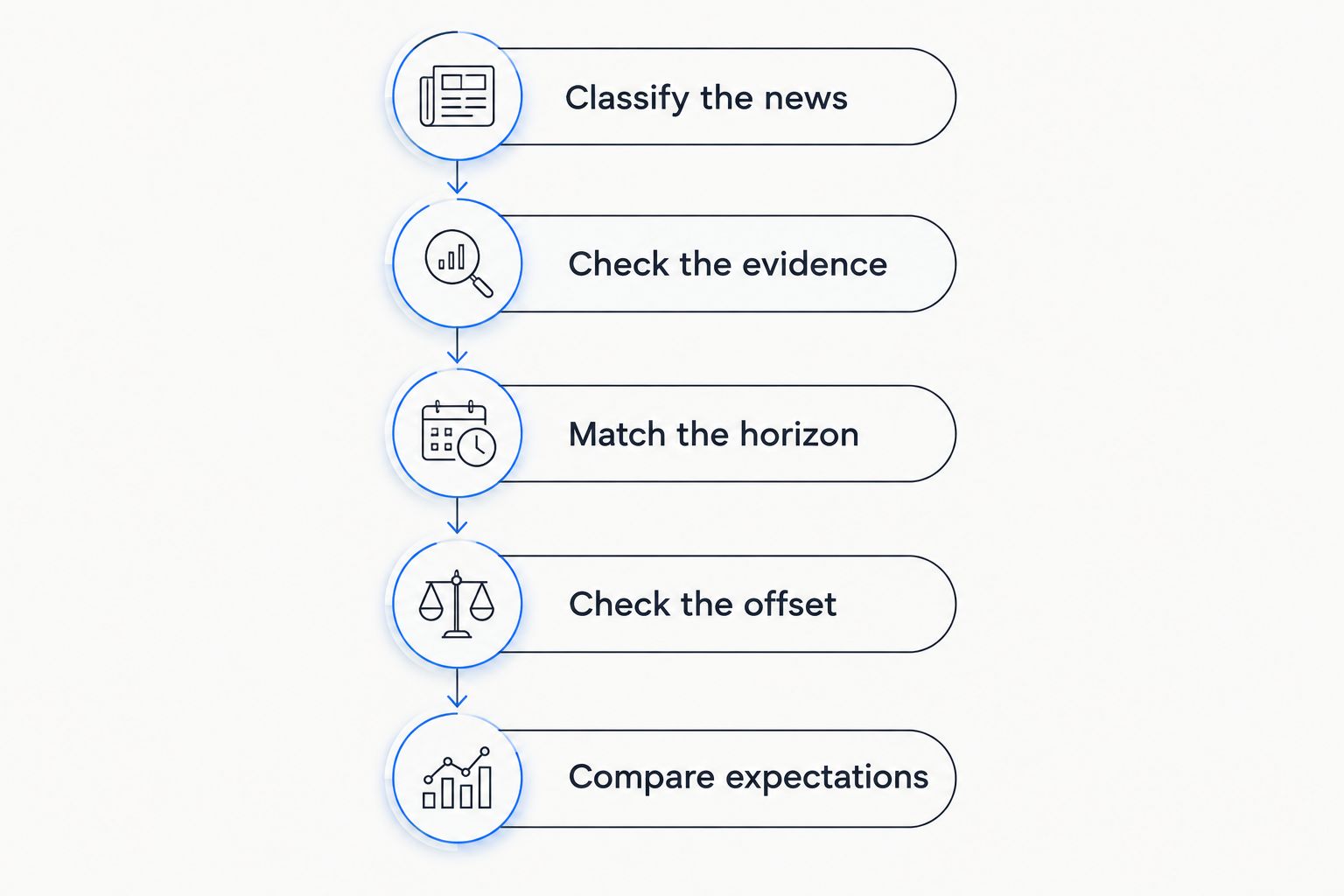
Assess the evidence and its timing before interpreting the market reaction.
A shipping interruption illustrates the distinction. Start with whether deliveries are delayed or barrels are unavailable altogether. Then ask whether stored oil or another route can cover the gap. The headline alone does not answer either question.
06. Can oil fall during a supply disruption?
Oil can fall during a supply disruption when other information reduces the expected tightness of the market. A weaker demand outlook or a smaller loss than anticipated can outweigh the interruption.
There is no contradiction. Price reflects the combined assessment rather than a separate vote on each headline. Check whether the disruption was already expected before treating a decline as an unexplained reaction.
Does an inventory draw prove demand is stronger?
An inventory draw does not prove demand is stronger. Stocks also change with production, imports, exports and refinery activity.
Refineries consume crude to produce fuels. A crude stock draw can therefore coincide with an increase in fuel inventories. Read the related balances before assigning the entire change to end-user consumption.
Why does the first price move reverse?
The first price move can reverse when later details change the initial interpretation. A disruption can prove shorter than feared. A forecast revision can contain a different message from its headline.
For your 2026 news-reading process, preserve the original report and the update. Comparing them shows whether the evidence changed rather than merely whether the chart changed direction.
FAQ
What is the difference between an oil supply disruption and a demand outlook?
An oil supply disruption affects available barrels or delivery timing. A demand outlook estimates future consumption. Their price effects depend on the combined balance and what the market already expected.
Does a supply disruption always push oil higher?
A supply disruption does not always push oil higher. Replacement supply, accessible inventories or weaker consumption expectations can offset the lost barrels.
Does slower demand growth mean oil demand is falling?
Slower demand growth does not mean oil demand is falling. Consumption can still increase while growing less than previously forecast.
Why do oil inventory reports matter?
Oil inventory reports show changes in stored oil. Those changes help assess the physical balance but also reflect production, trade flows and refinery activity.
Should I compare a supply outage with an annual demand forecast?
Compare their time horizons before drawing a conclusion. An immediate delivery interruption and an annual consumption forecast describe different periods and do not automatically offset each other.
Can I use oil news alone to decide on a trade?
Oil news alone does not establish a trading decision. A headline does not specify your exposure, execution conditions or ability to absorb a loss.
08. One last thing: check which inventory fell
Crude oil inventories and finished-fuel inventories are not interchangeable. A refinery moves material between those categories as it processes crude. That distinction can change the meaning of an apparently straightforward stock draw.
Before accepting a demand explanation, check whether the report concerns crude or refined products. Then check the reporting period. A precise description is more useful than a confident interpretation built on the wrong category.
Supply, demand and inventories belong in the same assessment.
Related guides
This article is for educational purposes only and does not constitute investment advice. Trading CFDs and other leveraged products carries a high level of risk and may not be suitable for all investors.