首页Can slippage improve your execution price as well as worsen it?
Can slippage improve your execution price as well as worsen it?
Oct 21, 2026
Yes. Slippage improves your execution price when you buy below your reference price or sell above it. It worsens execution when you buy above that reference or sell below it. Positive vs negative slippage describes the direction of the price difference, not whether the trade ultimately makes money.
TL;DR
- Positive vs negative slippage depends on trade direction: lower buys and higher sells are favourable.
- Market orders prioritise execution. Limit orders set a price boundary but do not guarantee a fill.
- Compare the correct bid or ask with your actual fill before judging execution quality.
- VCG Markets traders should assess individual execution records, not treat aggregate trading volume as proof of favourable fills.
01 · Price direction | 02 · Order instructions | 03 · Execution review
01. Can slippage improve your execution price as well as worsen it?
Slippage works in both directions. Positive slippage means your order executes at a more favourable price than the relevant reference. Negative slippage means it executes at a less favourable price.
The direction of the trade decides what favourable means. A buyer benefits from a lower entry price. A seller benefits from a higher selling price. The same logic applies when closing a position: selling closes a long position and buying closes a short position.
Positive slippage
- Buy order: Fill below the reference
- Sell order: Fill above the reference
- Meaning: More favourable execution price
Negative slippage
- Buy order: Fill above the reference
- Sell order: Fill below the reference
- Meaning: Less favourable execution price
No slippage
- Buy order: Fill matches the reference
- Sell order: Fill matches the reference
- Meaning: No difference against that reference
Use a reference that matches the question you are asking. For an execution review, that might be the executable quote when you submitted the order. For a triggered order, the trigger price is another reference. These comparisons measure different things. Record which one you use.
Why this matters
A favourable fill does not make a trade profitable. The market can move against the position after execution. Equally, an unfavourable fill does not determine the eventual result.
Keep execution quality separate from market exposure. The guide to correlated pairs and hidden exposure covers a different risk: positions that move together. Neither a favourable fill nor several separate orders removes that exposure.
For your 2026 trading journal, record execution and trade outcome in separate fields. Otherwise, a profitable trade can hide an unfavourable fill. A losing trade can also obscure a favourable one.
02. How does order type change slippage?
Order instructions determine the balance between execution and price control. They do not make the market stand still. Before comparing fills, identify what the order actually instructed the platform to do.
The distinction matters most when you compare market orders with limit orders. A market order seeks execution at available prices. A limit order restricts the acceptable execution price. That restriction creates a different risk: the order might not execute.
Market order
- Suitable purpose: Seeking immediate execution
- Price treatment: Executes against available prices
- Main limitation: Displayed price is not a guaranteed fill
Limit order
- Suitable purpose: Setting a price boundary
- Price treatment: Buy at the limit or lower; sell at the limit or higher
- Main limitation: Execution is not guaranteed
Stop order that becomes a market order
- Suitable purpose: Activating an order at a trigger
- Price treatment: Seeks execution after activation
- Main limitation: Trigger price is not a guaranteed fill
Stop-limit order
- Suitable purpose: Combining a trigger with a price boundary
- Price treatment: Becomes a limit order after activation
- Main limitation: Can remain unfilled after triggering
Market orders: execution without a fixed price boundary
A market order prioritises execution rather than a particular price. If available prices change between submission and execution, the resulting fill can improve or worsen against your reference.
Available quantity matters too. An order can receive partial fills at different prices. In that case, review the individual fills and the quantity-weighted average execution price. A single headline fill can conceal how the order was completed.
Limit orders: price control without execution certainty
A buy limit sets the highest acceptable purchase price. A sell limit sets the lowest acceptable selling price. Execution at a more favourable price is possible, but price improvement is not promised.
A chart touching your limit does not establish that your order should have filled. The relevant bid or ask, available quantity and execution rules all matter. A chart can show a different price stream from the one required to execute your order.
Stop orders: activation is not execution
A stop order that becomes a market order separates the trigger from the fill. Reaching the trigger activates the execution instruction. It does not reserve liquidity at that exact price.
This distinction matters during gaps. The next available executable price can be beyond the trigger. A stop-limit instruction adds a price boundary, but the resulting order can remain unfilled while the market continues moving.
03. Why does slippage vary?
Slippage varies because executable prices and available quantity change. Your order instructions determine which of those prices the order can accept. Review the following factors together rather than treating every price difference as the same event.
- Price movement. Quotes can change between order submission and execution. The change can favour either the buyer or the seller.
- Available liquidity. The quantity available at a quoted price determines how much can execute there. Remaining quantity needs another executable price.
- Order size. An order that exceeds the available quantity at a price can fill across several price levels.
- Processing time. Transmission, processing and routing take time. Prices can change during that interval.
- Order conditions. A market instruction accepts available execution prices. A limit instruction restricts them. Trigger conditions also affect when execution begins.
Scheduled announcements deserve attention in an execution review. Record whether an order coincided with a release rather than assuming that every adverse fill had the same cause. A timestamp gives you something concrete to investigate.
Your 2026 review should also distinguish a gap from continuous price movement. A gap means your chart or quote history jumps between observed prices. Do not assume that every price between those observations was available for execution.
04. How do you check positive vs negative slippage?
Start with the trade direction, the reference quote and the execution record. You need all three to classify the result correctly. A screenshot of a chart alone does not establish the price available to your order.
- Trade direction. Identify whether the executed transaction was a buy or a sell. Do this for closing orders too.
- Reference quote. Record the comparison price and its timestamp. For standard bid-ask pricing, buys execute against the ask and sells against the bid.
- Order details. Record the order type, requested quantity and any trigger or limit instruction.
- Execution record. Check the fill price, executed quantity and timestamp. Include partial fills rather than treating them as separate unrelated events.
- Review context. Note the market session, relevant announcements and whether a gap occurred. Keep observations separate from conclusions.
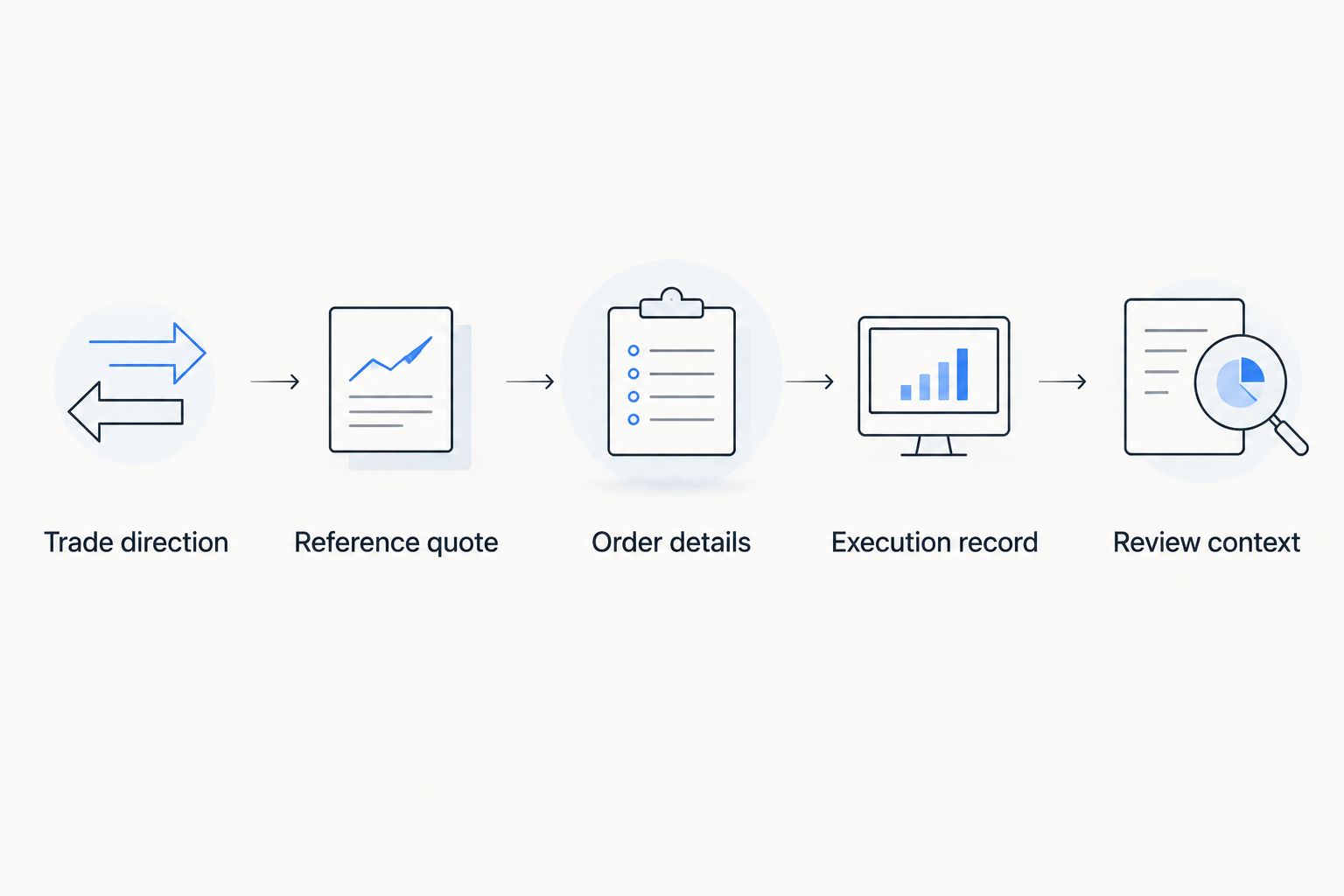
The reference quote must match the transaction direction before you classify the fill.
For a buy, a fill below the reference is positive slippage. A fill above it is negative slippage. For a sell, reverse that comparison.
Keep the measurement unit consistent. Comparing price differences across instruments without accounting for their quotation conventions produces misleading totals. If you calculate the monetary effect, use the instrument's contract specifications and the executed position size.
For a 2026 execution log, preserve the original records alongside your summary. That lets you revisit an apparent anomaly without relying on memory. It also gives support a specific order to investigate.
Keep spread and slippage separate
The spread is the difference between the bid and ask at a particular moment. Slippage is the difference between the execution price and your chosen reference. They are not interchangeable.
Comparing a buy fill with a bid-only chart can make the spread look like slippage. Confirm what the chart displays before drawing a conclusion. Also keep commissions and financing charges separate from the execution-price comparison.
05. Does positive slippage mean your trade made money?
Positive slippage means a more favourable fill, not a profitable trade. The position's later price movement and applicable charges still affect the result. Execution is one part of the trade record.
This separation works in both directions. A profitable position can have negative slippage at entry or exit. A losing position can receive positive slippage on either transaction.
Review the opening and closing transactions separately. A position does not have just one execution event. Combining both fills into the final profit or loss hides where the price differences occurred.
06. Can you avoid negative slippage completely?
No order instruction guarantees both immediate execution and a fixed acceptable price in every market condition. A limit order controls the permitted price. It does not guarantee that someone will transact at that price for your required quantity.
A stop-limit order presents the same trade-off after activation. It restricts the execution price, but an unfilled order leaves the underlying position or intended transaction unresolved. Price protection and execution certainty are different objectives.
Before submitting an order, understand which objective the instruction prioritises. Check the platform's order definitions and execution terms. Do not assume that similarly named order types have identical handling across every instrument.
07. Is negative slippage proof of poor execution?
One adverse fill does not establish an execution pattern. It needs a reference quote, an order record and market context. The same standard applies to one favourable fill.
For your 2026 review, examine favourable, unfavourable and unchanged fills. Group comparable orders together. Mixing different instruments, order types and market conditions makes the result harder to interpret.
If you raise an execution query, provide the order identifier and timestamps. State the comparison price you used. Ask for an explanation of that execution rather than presenting a chart observation as a complete finding.
The VCG Markets lens
VCG Markets is relevant to multi-asset traders who want market access alongside behavioural performance review. VCG ONE scores performance across eight behavioural dimensions in real time. Behavioural feedback and execution-price analysis answer different questions.
VCG Markets reports 10M+ trades executed, $2T+ in trading volume and access across 80+ countries. These are aggregate activity figures. They do not establish the slippage on an individual order or predict a future fill.
Use VCG Markets to review the available platform information and trading terms. Your execution assessment still needs the order-level evidence described above. Neither aggregate scale nor a behavioural score substitutes for that record.
Conclusion
Positive vs negative slippage is a directional comparison. Lower is favourable when buying. Higher is favourable when selling. Order instructions decide whether execution speed or a price boundary takes priority.
One practical addition to your 2026 journal is a reference-price field. Include its timestamp and whether it is a bid or ask. Without that detail, a precise-looking slippage calculation can measure the wrong comparison.
Takeaway: judge the fill against the right quote, then judge the trade separately.
FAQ
Can slippage work in my favour?
Yes. Slippage is favourable when you buy below your reference price or sell above it. This improves the execution price but does not guarantee a profitable trade.
What's the difference between positive and negative slippage?
Positive slippage is a more favourable execution price than your reference. Negative slippage is a less favourable execution price. Trade direction determines which price movement is favourable.
Does a limit order prevent negative slippage?
A limit order sets the least favourable permitted execution price. A buy limit executes at the limit or lower and a sell limit at the limit or higher, but execution is not guaranteed.
Can a stop-loss order execute beyond its trigger?
A stop-loss instruction that becomes a market order can execute beyond its trigger price. The trigger activates the order rather than guaranteeing the execution price.
Is slippage the same thing as the spread?
No. The spread is the difference between the bid and ask. Slippage compares an execution price with a specified reference price.
Which price should I compare with a buy order?
For standard bid-ask pricing, compare a buy execution with the relevant ask quote. Record the quote timestamp and confirm whether the chart displays bid, ask or another price.
Does positive slippage prove that execution is consistently favourable?
No. Positive slippage describes that execution against that reference. Assess a broader set of comparable order records before drawing conclusions about an execution pattern.
Related guides
This article is for educational purposes only and does not constitute investment advice. Trading CFDs and other leveraged products carries a high level of risk and may not be suitable for all investors.

信息
VCG Markets Ltd 是获准提供投资服务的持牌实体。公司注册于毛里求斯共和国(公司编号 188485),并由毛里求斯金融服务委员会依据第 GB22200388 号牌照授权和监管,注册办事处位于 The Cyberaty Lounge, Ground Floor, The Catalyst, Silicon Avenue, 40 Cybercity, 72201 Ebene, Republic of Mauritius。
VCG Markets (Seychelles) Ltd 是获准提供证券交易商服务的持牌实体。公司注册于塞舌尔共和国(公司编号 8438443-1),并由塞舌尔金融服务管理局依据第 SD243 号牌照授权和监管,注册办事处位于 House of Francis, Room 301(B), Ile Du Port, Mahe, Republic of Seychelles。
本网站由 VCG Tech Limited(公司编号 HE452446)运营,注册办事处位于 Agias Fylaxeos & Zinonos Rossidi, 2, 1st Floor, 3082 Limassol, Cyprus。VCG Tech Limited 作为商户公司处理客户的入金与出金。
保证金外汇和差价合约交易属于杠杆产品,可能导致损失超过您的存入资金。投资价值可升可跌,您收回的金额可能少于最初投资额。请确保您充分理解所涉风险,并考虑此类交易是否适合您。
为保证服务质量、合规及培训目的,电话通话与电子通讯可能被录音和监控。
本网站信息仅供一般参考,不构成投资建议、推荐或从事任何投资活动的要约。
VCG Markets 不提供税务建议。税法可能变更,且各司法管辖区之间可能存在差异。
本网站信息不面向美国、比利时、加拿大、新加坡居民,或任何访问此类信息将违反当地法律或法规的司法管辖区。
VCG Markets © 2026, Inc. 保留所有权利。


