Trading Review · 2026
Review trade holding time by matching each position’s elapsed duration with its net result and original exit plan. Compare similar trades rather than treating every short or long hold as equivalent. Duration alone does not show whether an exit was well judged.
Key takeaways
- Trade holding time analysis connects elapsed duration with net results, exit reasons and trading-rule adherence.
- Compare similar setups. A longer holding period is not evidence of a better decision.
- Separate closed trades from open positions to avoid excluding unresolved exposure.
- VCG Markets supports behavioural review through VCG ONE. Performance scores do not replace trade-level evidence.
01Measure consistently
02Compare similar trades
03Review exit decisions
01
Why holding time matters
A profitable trade can still depart from its exit plan. A losing trade can follow that plan exactly. Holding time adds context to the result by showing how long exposure remained open.
For your 2026 review, connect duration to a recorded decision. Trading process goals help frame that distinction: assess what you controlled separately from what the market delivered.
The useful question is not whether you held longer. It is whether the holding period matched the reason for staying in the trade.
02
How do you review trade holding time alongside your results?
Use the same recording method throughout the review. Changing how you define a trade halfway through makes the comparison inconsistent.
- Define the position. Decide whether you are reviewing individual executions or the complete position. Keep that choice consistent.
- Calculate elapsed duration. Subtract the opening timestamp from the closing timestamp. Check that both use the same time zone.
- Match the result. Record the realised result and identify which charges or adjustments it includes.
- Group comparable trades. Separate different setups and instruments before comparing duration patterns.
- Check the exit reason. Compare the recorded reason with the rule written before entry.
- Record the finding. Describe the pattern and its limits. Do not convert an association into a trading instruction.
Use minutes or hours consistently within each comparison. Keep the underlying timestamps too. A duration field alone cannot show whether a position crossed a session boundary or a contract-specific charging time.
If a position closes in parts, preserve each exit timestamp and quantity. The final close measures the full exposure window. It does not describe how long every part of the original position remained open.
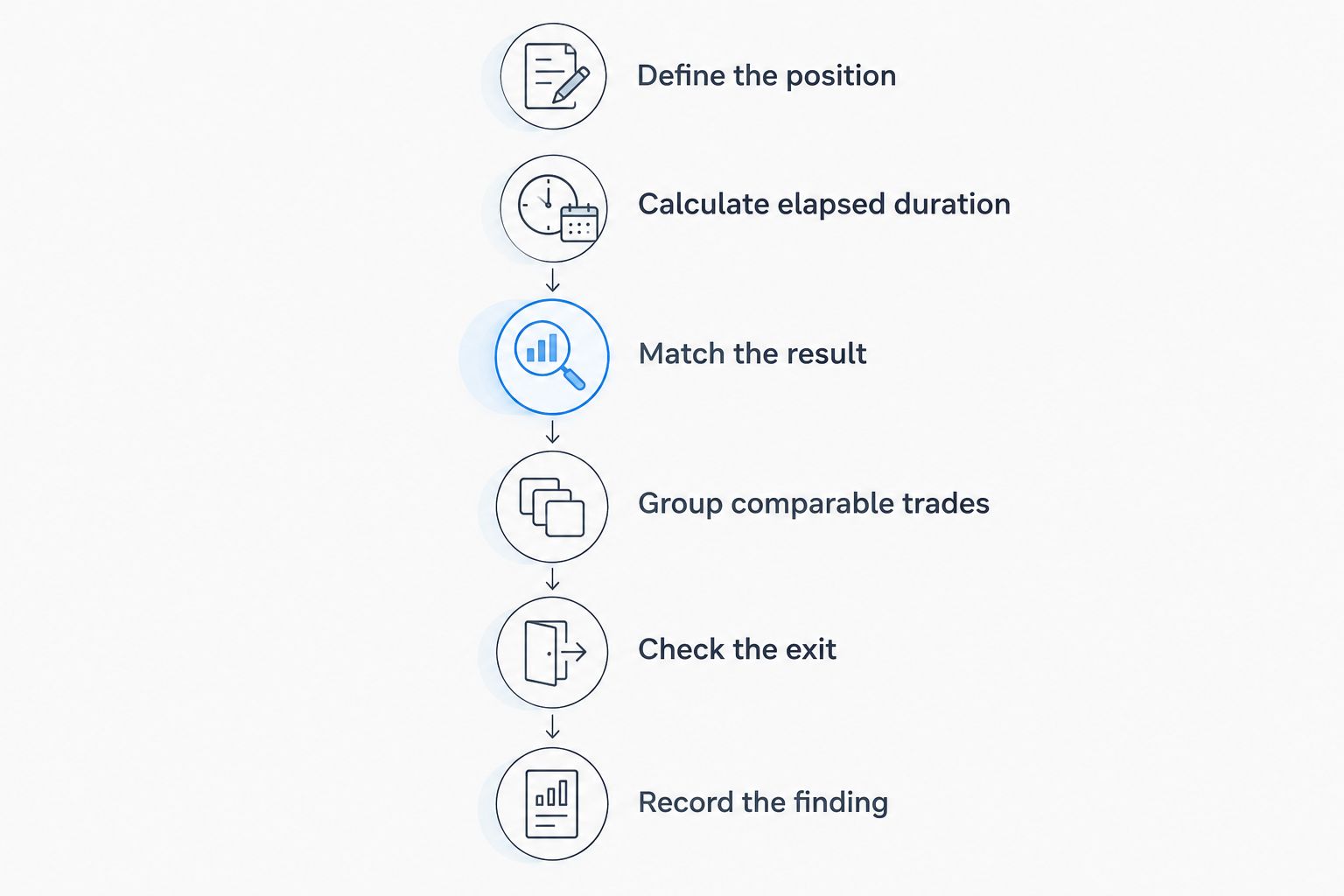
Measure duration consistently before interpreting its relationship with results.
03
Choose a review method that fits the question
Start with a comparison inside the same setup. Then inspect the individual trades behind the summary. Each method answers a different question and has a different limitation.
| Review method | Useful for | Limitation |
| Duration groups | Comparing shorter and longer holds within a setup. | Group boundaries can change the apparent pattern. |
| Winners and losers | Checking whether losing positions remain open longer. | Result categories do not explain the exit decision. |
| Plan adherence | Checking whether exits followed recorded rules. | Requires a plan recorded before the outcome. |
For duration groups, set the boundaries before examining which group earned more. Base them on your strategy’s intended horizon. Keep those boundaries fixed for the comparison rather than moving trades between groups to strengthen a result.
Compare trade counts alongside average and median duration. The average reflects every observation. The median identifies the middle observation when durations are ordered. An unusually long hold affects the average more directly.
Also check result size and position size. A duration group with larger positions can produce larger cash gains or losses without demonstrating a stronger relationship between holding time and performance.
04
Why trade holding time varies
Different durations are not automatically inconsistent behaviour. Before interpreting your 2026 results, separate differences in strategy from differences in execution.
- Strategy horizon. A setup intended to capture an intraday move differs from one intended to span sessions.
- Exit conditions. A price-based exit and a time-based exit respond to different triggers.
- Market movement. Price reaches the same exit condition at different speeds in different trades.
- Trading sessions. Scheduled closures affect when execution is possible.
- Position management. Partial exits and later additions change the relationship between a position’s age and its remaining exposure.
- Decision changes. An exit-rule change after entry needs its own record and explanation.
Record the relevant contract terms beside the trade. Financing and adjustments depend on the instrument and applicable conditions. Do not assume that every overnight hold receives the same treatment.
Keep these explanations attached to individual records. A general note about volatile markets does not establish why a particular position stayed open.
05
Separate evidence from interpretation
Suppose your longer-held trades show weaker net results. That is a relationship in the records. It does not establish that closing those trades earlier would have improved them.
Longer duration might identify a different setup or a different market condition. Inspect those differences before drawing a conclusion. Avoid selecting an earlier exit using price information that was unavailable at the time.
Write separate observations for outcome and conduct. For outcome, describe the duration pattern in the selected sample. For conduct, record whether the original exit condition remained valid and whether you followed it.
Do not label a long losing trade as emotional from duration alone. Check the pre-entry plan and contemporaneous notes. A concern about sunk-cost bias in open trades requires evidence about the decision to remain exposed.
Describe what the records show before explaining why it happened. That distinction keeps a 2026 review grounded in evidence rather than hindsight.
06
Check what the closed-trade sample leaves out
A closed-trade report excludes positions that remain open at the review cutoff. That matters when the unresolved trades have different durations from the closed sample.
Keep a separate open-position register. Record elapsed time as of the cutoff and label it unfinished. Do not combine that duration with completed holding periods as though every exit has happened.
State how you selected the review period. Trades opened during a period and trades closed during that period are different samples. Use the same selection rule when comparing successive reviews.
Preserve missing fields as missing. An absent exit reason is not evidence of a planned exit. Record the gap and improve the next entry rather than reconstructing certainty from memory.
FAQ
How do I calculate a trade’s holding time?
Subtract the opening timestamp from the closing timestamp using the same time zone. For partial exits, preserve each exit’s time and quantity alongside the final closing time.
Does holding a trade longer improve the result?
A longer holding period does not establish a better result. Compare similar setups and examine the exit conditions before attributing performance to duration.
Should I compare holding times for winners and losers?
Compare holding times for winners and losers within similar setups. Keep the trade counts and exit reasons visible because the result category alone does not explain the decision.
Should I use average or median holding time?
Use average and median holding time together. The average reflects every duration, while the median identifies the middle observation and helps you see when unusually long holds affect the summary.
Do open positions belong in trade holding time analysis?
Open positions belong in a separate part of trade holding time analysis. Their elapsed duration is unfinished and must not be treated as a completed holding period.
How often should I review trade holding time?
Use a consistent review schedule that fits your trading process. Keep the sample-selection rule unchanged and avoid changing exit rules in response to an isolated result.
What should I do if longer-held trades lose more?
Check whether the longer-held trades differ in setup, position size, market conditions or exit-rule adherence. The pattern is a reason to investigate, not proof that an earlier exit would improve future results.
Conclusion
For your next 2026 review, preserve the exit rule before assessing the outcome. Then connect holding time to comparable results and the actual reason for closing.
One final check: look at what is still open. A closed-trade summary cannot describe the full duration of exposure that has not ended.
Review the time, the result and the decision together.
Related guides
This article is for educational purposes only and does not constitute investment advice. Trading CFDs and other leveraged products carries a high level of risk and may not be suitable for all investors.


