Multi-asset trading · Account essentials
Yes. You can trade crypto and forex from one account when that account supports both markets. A shared login does not necessarily mean a shared trading balance. Check the account permissions and instrument terms before treating the markets as one portfolio.
Key points
- Can you trade crypto and forex from one account? Yes, when the account supports both markets.
- VCG Markets offers forex and crypto trading as an international multi-asset broker.
- One login does not confirm shared equity, shared margin or identical trading hours.
- Check instrument terms and combined exposure before placing orders across both markets.
01Account structure
02Instrument terms
03Combined exposure
Start with the [guide to reading contract specifications](https://vcgmarkets.com/en/blog/read-contract-specifications). It explains the instrument-level details to inspect when reviewing a multi-asset account in 2026.
01
Can you trade crypto and forex from one account?
You can when both instrument groups are enabled within the same trading account. The deciding detail is the account configuration. A platform that displays both markets does not establish that your particular account can trade them.
Confirm this through the account documentation and instrument list. Then inspect the order ticket for each market. A symbol on a watchlist is not enough if trading permissions are restricted.
- Confirm that forex and crypto instruments are enabled for your account.
- Check whether both use the same trading balance and equity calculation.
- Read the contract terms for the instruments you intend to trade.
- Confirm how open positions affect available margin across the account.
Keep registration separate from trading access. A customer profile can contain several trading accounts. Moving between them inside one application does not make their balances interchangeable.
One account is an administrative arrangement. It does not make different instruments behave alike. Use the current account terms for your 2026 review rather than assuming that a familiar platform has identical permissions everywhere.
02
Why this matters
A shared account can put positions and account equity in one view. That makes combined exposure easier to inspect. The limitation is equally important: when positions share equity, a loss in one market affects the funds supporting the account.
Separate watchlist folders do not separate financial risk. A crypto position and a currency position can sit under different headings while drawing on the same pool of funds.
Separate accounts provide distinct account records. They also require you to assemble a combined view yourself. Neither arrangement removes the need to review open positions together.
The practical question is not just whether both order tickets open. It is whether you understand what happens to account equity when either position moves against you. That distinction matters before placing the second trade.
Make the same distinction in your journal. Record the instrument and account identifier alongside each decision. A combined statement helps with oversight, but market-level records are still needed to understand where gains and losses originate.
03
What changes between crypto and forex?
The account holds the positions. Each instrument retains its own specifications. Do not transfer an order size or trading schedule from one market to another without checking what it means.
| Check | Forex | Crypto |
| Underlying exposure | One currency relative to another | A cryptoasset relative to its quoted currency or asset |
| Trading schedule | Check the currency instrument’s sessions and breaks | Check the broker’s schedule rather than assuming continuous access |
| Position sizing | Read contract size and price-movement value | Read contract size and price-movement value independently |
| Ownership | Do not assume a trading position delivers spendable currency | Do not assume a trading position delivers withdrawable coins |
In your 2026 instrument review, distinguish price exposure from ownership. Trading a crypto-linked instrument does not itself establish that you can transfer coins to a wallet. The agreement must explicitly provide that function.
Also check the currency used to report results. An instrument’s quote currency and your account currency are not necessarily identical. Conversion can affect the amount recorded in the account.
04
Why account access and trading conditions vary
A multi-asset label describes the scope of an offering. Your agreement establishes the actual permissions. Check these details for the account you hold rather than relying on a general list of markets.
- Account permissions. Confirm which instrument groups are enabled.
- Contract type. Establish whether the position provides price exposure or ownership.
- Margin terms. Check the funds required to open and maintain each position.
- Trading sessions. Read dealing hours and scheduled breaks for each symbol.
- Account currency. Check how results in another currency are converted.
- Legal agreement. Identify the contracting entity and the terms applying to your account.
Save the relevant specifications with your trading records. Include the review date. When terms change, a dated record helps distinguish the conditions you reviewed from those currently displayed.
For a 2026 account review, use current documents. An old screenshot can explain an earlier decision. It does not confirm today’s trading permissions or margin requirements.
05
How does shared margin affect both markets?
Shared margin connects positions through account equity. If a crypto position loses value, available funds for a forex position can fall when both use the same equity pool. The reverse also applies.
A closed market does not freeze the rest of the account. An open position elsewhere can continue changing equity. Read the account’s margin and close-out rules before relying on funds that support several positions.
Use the [guide to reading margin level](https://vcgmarkets.com/en/blog/read-margin-level) to distinguish the account measure from the profit or loss on an individual trade. Balance alone does not show the effect of open positions.
Different market names do not guarantee diversification. Positions can respond to common changes in sentiment or funding conditions. Review their combined direction and exposure without assuming that a past relationship will remain stable.
Check shared equity before adding exposure. Then check each position separately. An account-level total can conceal a large loss in one market behind a gain in another.
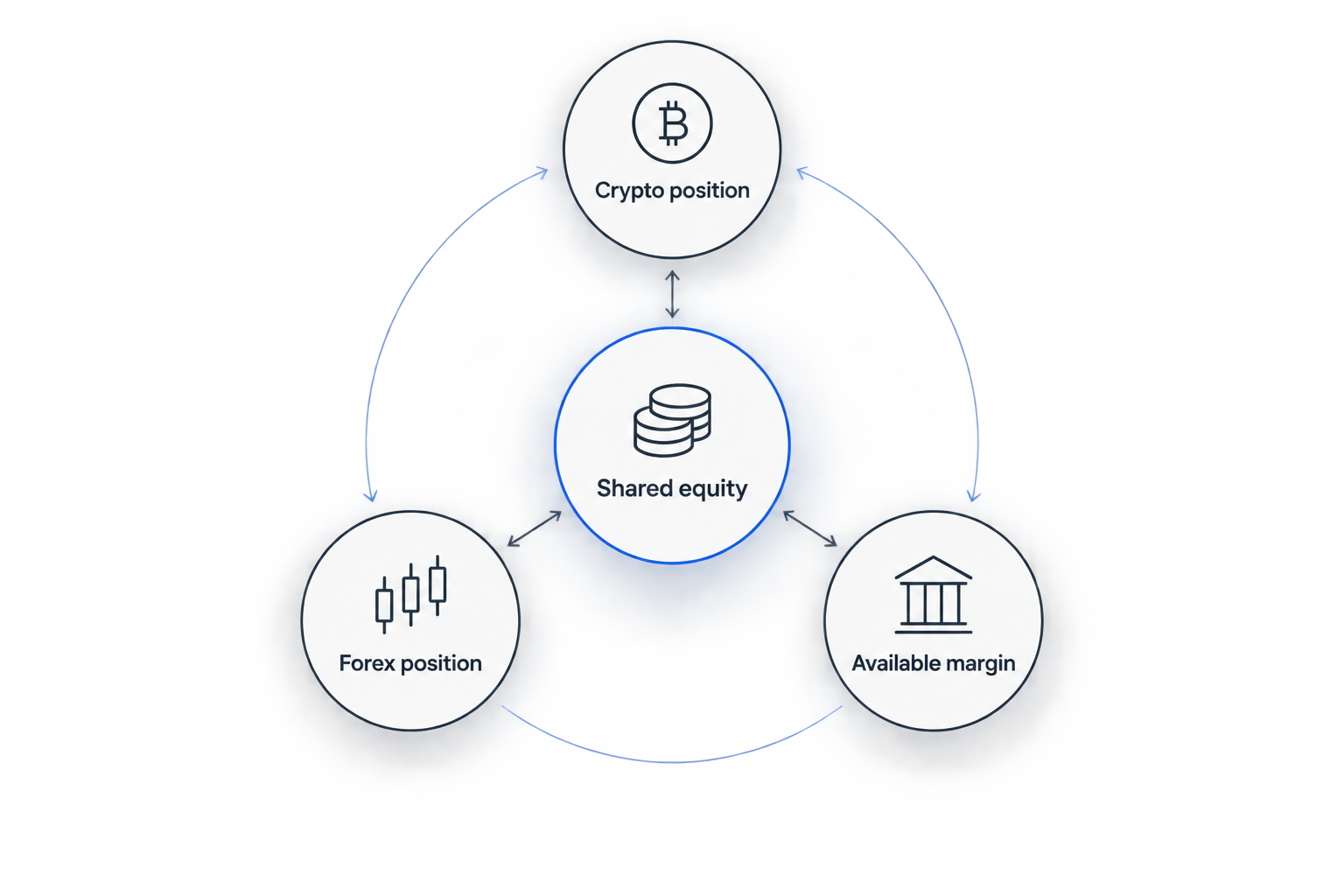
Separate market positions can draw on the same account equity.
06
Does one platform mean one trading account?
No. A platform is the interface. The trading account determines the balance, permissions and positions associated with a particular account identifier.
When switching between browser and mobile, verify the account identifier. Check the open-position list and pending orders before submitting another instruction. A familiar chart does not confirm that the intended account is selected.
Does one account mean you own cryptocurrency?
No. Account consolidation does not determine ownership. Read the instrument agreement to establish whether you hold the asset or trade its price movement.
Can one account replace separate performance reviews?
No. A combined account shows the overall result. Separate market records help you identify which instruments and decisions produced it.
Use consistent journal fields across both markets. Record the reason for entry, planned exit and actual execution. Keep instrument-specific details alongside those common fields rather than forcing unlike contracts into an identical sizing assumption.
Frequently asked questions
Can I trade crypto and forex with the same balance?
Yes, if both instrument groups belong to an account with a shared balance and equity pool. Confirm the account structure rather than inferring it from a shared login.
Does a multi-asset account let me withdraw cryptocurrency?
A multi-asset account does not automatically provide cryptocurrency withdrawals. The instrument agreement must establish asset ownership and transfer rights.
Can I trade both markets from a mobile application?
Yes, when the application and selected trading account support both markets. Check the account identifier and instrument permissions before submitting orders.
Do crypto and forex have the same trading hours?
Do not assume crypto and forex instruments have the same trading hours. Check each symbol’s dealing schedule and maintenance breaks.
Can a crypto loss affect my forex positions?
Yes, when both positions depend on shared account equity. A loss can reduce available margin and affect the account’s margin position.
Does VCG Markets offer forex and crypto trading?
VCG Markets offers forex and crypto trading within its multi-asset offering. Confirm which instruments and account permissions apply to your trading account.
Conclusion
You can trade crypto and forex from one account when both markets are enabled. Before using that arrangement in 2026, confirm the equity pool, instrument terms and margin rules. Keep the convenience of one interface separate from the risk of the positions inside it.
One final check: inspect pending orders as well as open positions. An unfilled order is not current exposure. If it executes, it can add exposure and change margin use while another market position remains open.
One account can simplify oversight. Each instrument still needs its own checks.
Related guides
- Correlated pairs and hidden exposure
- Moving from MT5 browser to the mobile application
- Understanding trading balance and equity
This article is for educational purposes only and does not constitute investment advice. Trading CFDs and other leveraged products carries a high level of risk and may not be suitable for all investors.