Commodities · Retirement planning
Commodities trading for retirees is taking positions linked to raw-material prices with the aim of pursuing trading returns outside essential retirement spending. It is not pension income. This 2026 guide explains exposure choices, contract checks and review habits without treating age as a measure of trading experience.
Key takeaways
- Commodities trading for retirees requires separating essential spending from money exposed to trading losses.
- VCG Markets offers commodity trading access; access does not establish suitability for retirement needs.
- Physical gold, exchange-traded funds and margin-based contracts create different ownership and operational responsibilities.
- Review contract terms, total exposure and execution risks before interpreting a trading result.
01Protect spending boundaries
02Understand the instrument
03Review decisions
Start with the instrument rather than the chart. The guide to reading contract specifications explains the terms to examine.
01
Why commodities trading matters for retirees
Retirement changes the purpose of capital. Money used for household withdrawals has a different job from money exposed to uncertain trading results. A commodity position does not become suitable because the underlying material is familiar.
Gold does not pay interest simply because you hold it. Oil exposure does not create a pension payment. Selling a position to fund spending depends on its value and the conditions for closing it.
Separate long-term investment planning from short-term price speculation. The relevant questions concern withdrawal needs, capacity for loss and monitoring time. Your retirement status alone answers none of them.
The central distinction: understanding a commodity is different from understanding the financial instrument used to trade it.
02
Build a documented trading process
Separate retirement spending
Start with a household budget and a separate trading ledger. Record which money supports essential spending. Do not count an unrealised trading gain as money already available for withdrawals.
Write down what happens after a loss. A plan that requires replenishing the account from essential savings has not separated the purposes of the money. Discuss retirement allocation questions with a qualified financial adviser.
- List essential expenses separately from discretionary spending.
- Identify money already committed to upcoming withdrawals.
- Document the source of any trading deposit.
- Exclude expected trading profits from the household budget.
Read contract terms
Read the contract specification before selecting an order size. A gold label does not tell you whether you own metal, fund shares or a price-linked contract. The instrument determines your rights and obligations.
For a 2026 review, use the current documents. Check settlement arrangements and any expiry or rollover provisions. An old screenshot is not a substitute for the terms applying to your position.
- Identify the underlying commodity and instrument structure.
- Record the contract size and account currency.
- Check margin requirements and account close-out rules.
- Read holding-charge, expiry and rollover provisions.
- Confirm trading hours and scheduled closures.
Record total exposure
Use a spreadsheet to record every open position. Include the instrument, direction, size and currency. Group positions that depend on similar price drivers instead of treating every trade as independent.
Margin is collateral, not the full economic exposure. Calculate exposure from the instrument’s contract terms. Keep that calculation separate from the amount initially required to open the position.
For commodity trading, VCG Markets provides access to gold, oil and other commodities. The platform does not replace your exposure calculation. Review the applicable documents before using any instrument.
- Record exposure rather than margin alone.
- Group positions with shared commodity drivers.
- Include account-currency conversion in the review.
- Check combined exposure before adding another position.
Plan order execution
Write the entry, exit and monitoring conditions before placing an order. Include what you will do when you cannot watch the market. Retirement does not require an all-day trading schedule.
A stop order is not a guaranteed exit price. Gaps and execution conditions can produce a different fill. A limit order controls the acceptable price but does not guarantee execution.
- State the reason for entering the position.
- Record the condition that invalidates that reason.
- Check how each selected order type works.
- Plan around periods when you cannot monitor positions.
Review trading behaviour
Begin with a written journal. Compare the planned action with the actual action after each closed position. Separate a rule-following loss from an execution mistake. Profit alone does not describe decision quality.
VCG ONE adds real-time scoring across eight behavioural dimensions. It offers another input for reviewing trading behaviour. A score is not a return forecast or an assessment of retirement suitability.
- Record the original decision before the outcome is known.
- Compare planned and actual entry and exit conditions.
- Tag changes made without a documented reason.
- Read behavioural scores alongside the underlying records.
Set review boundaries
Choose review times that fit your responsibilities. Keep research separate from placing orders. A market headline is information to assess, not an instruction to act.
Keep your 2026 review focused on documented decisions. Revisit the process when your spending needs or monitoring capacity change. Do not increase activity simply to create more journal entries.
- Schedule reviews separately from trading decisions.
- Record reasons for pausing as well as participating.
- Recheck spending boundaries after a material personal change.
- Keep a written record of process changes.
The process starts with spending boundaries. Contract checks and exposure records follow. Behavioural review comes after the decision record, not instead of it.
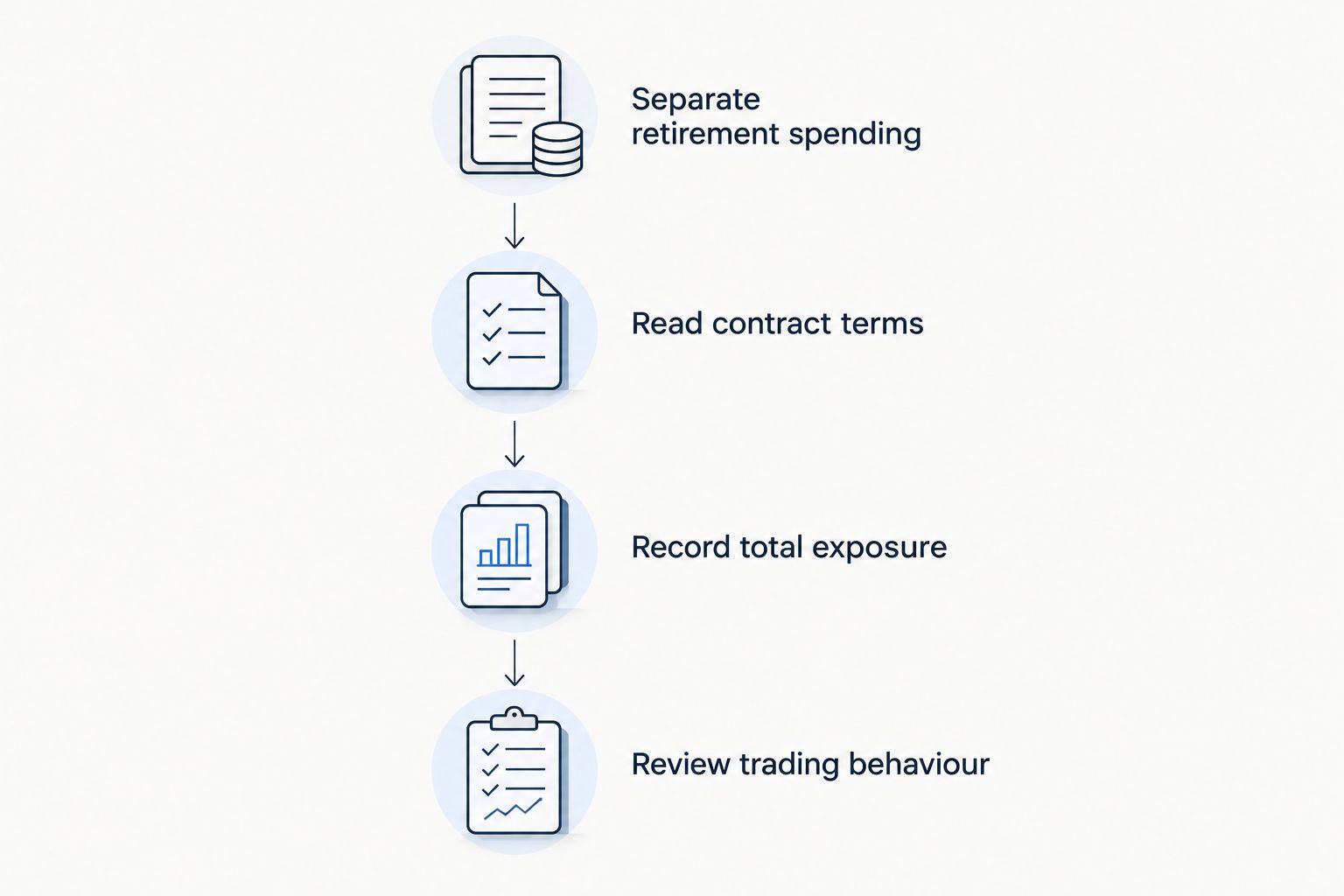
Check the spending boundary before the trade mechanics.
03
Compare ways to hold commodity exposure
Choose the structure before comparing market views. Physical ownership, fund ownership and margin-based trading are different activities. None establishes suitability from retirement status alone.
| Option | Suited to | Useful distinction | Key limitation |
| Physical bullion | People seeking direct metal ownership | Ownership of the metal itself | Requires storage and authenticity checks; produces no interest |
| Commodity exchange-traded funds | People seeking fund-based exposure | Exposure through fund shares | Structure and tracking differ; read the fund documents |
| Margin-based commodity contracts | Active traders who understand margin obligations | Price exposure without storing the commodity | Leverage magnifies losses; holding and close-out terms apply |
For any 2026 comparison, verify the exact instrument. A fund holding futures differs from a fund holding physical metal. A commodity producer’s shares also introduce company-specific risks.
04
Mistakes to avoid in retirement
Treating trading as a scheduled pension payment
Trading results do not follow a household withdrawal calendar. Keep essential spending independent of a required trading result. A monthly profit target does not make the underlying return predictable.
Confusing a gold narrative with capital protection
Gold exposure can lose value. Margin-based gold exposure also introduces contract and execution risks. Familiarity with gold as a store of value does not establish the safety of a particular position.
Planning withdrawals around unrealised gains
An open-position gain can change before you close the trade. Account withdrawal conditions also matter. Keep retirement spending records separate from a live trading balance.
Choosing a monitoring burden that does not fit
Travel, appointments and caring responsibilities belong in the trading plan. Define when you cannot monitor exposure. Do not assume a mobile notification removes the need to understand an open position.
Learn more about VCG Markets before assessing whether its instruments fit your requirements.
FAQ
Is commodities trading suitable for retirees?
Retirement status alone does not establish suitability. Assess essential spending, capacity for loss, contract knowledge and monitoring responsibilities with a qualified financial adviser.
Can commodity trading replace pension income?
Commodity trading does not provide predictable pension income. Trading results can be negative and do not follow a household withdrawal schedule.
Is trading gold the same as owning gold?
Trading gold is not necessarily the same as owning physical metal. The instrument determines whether you hold bullion, fund shares or a price-linked contract.
Do stop orders protect all my retirement money?
A stop order does not guarantee an exit price or protect an entire retirement portfolio. Market gaps and execution conditions can produce a different fill from the stop level.
What should I check before holding a commodity trade overnight?
Check holding charges, trading hours, margin requirements and any expiry or rollover provisions. Also review whether you can monitor the position when trading resumes.
Can a behavioural performance score tell me how much retirement money to trade?
A behavioural performance score does not determine a suitable retirement allocation. Review the underlying records and keep allocation decisions separate from a platform score.
Conclusion
One final check for your 2026 plan: write down the consequence of not trading. If essential spending still depends on opening a position, revisit the spending boundary before the market view. Choosing not to trade requires no prediction.
Keep essential retirement spending separate from uncertain trading results.
Related guides
This article is for educational purposes only and does not constitute investment advice. Trading CFDs and other leveraged products carries a high level of risk and may not be suitable for all investors.


