Trading psychology · Research discipline
You recognise confirmation bias in market research when you favour evidence that supports your view and apply tougher standards to evidence against it. Check what you search for, what you dismiss and whether your reasons change after contradictory information appears. Agreement across several sources is not independent confirmation when those sources repeat the same underlying claim.
Key takeaways
- Confirmation bias trading patterns include leading searches, selective evidence and changing standards after contradictory information appears.
- Separate observations from interpretations before deciding whether research supports your market view.
- VCG Markets suits traders seeking multi-asset access and ownership of their trading data.
- A profitable outcome does not establish that the research process was balanced.
Start with a written research question. The pre-trade decision checklist provides a related framework for recording decisions before an outcome changes how you remember them.
01Recognise selective evidence
02Test the opposing case
03Review the process
01
How to recognise confirmation bias in market research
Compare how you treat supporting and opposing evidence. The warning sign is not having a view. It is changing your standard of proof depending on whether information agrees with that view.
- Write the claim. State the market view you are researching. Keep the observation separate from the explanation you attach to it.
- Inspect the search. Replace a question that assumes a direction with one that examines competing explanations.
- Trace the evidence. Identify the original release, announcement or price observation behind each supporting article.
- Find the contradiction. Record evidence that challenges the claim. Explain why it matters before deciding whether it changes your assessment.
- Check the revision. Ask whether you would have accepted the same explanation before seeing the contradictory information.
For example, a search about why gold must rise already contains a preferred answer. A question about which conditions support or weaken gold leaves room for opposing evidence. Neither question determines the market outcome. The second makes the research assumption visible.
For a 2026 research journal, save the original question alongside the conclusion. Without that record, you cannot reliably distinguish a reasoned update from an explanation written after the event.
02
What selective research looks like
Confirmation bias appears in selection and interpretation. You can collect accurate information yet build an unbalanced argument by excluding relevant facts. You can also include contradictory evidence but dismiss it without applying the same scrutiny to supporting evidence.
| Research stage | Selective approach | Evidence-led approach |
| Search | Ask why the preferred direction is correct. | Ask what supports and challenges the direction. |
| Sources | Count repeated commentary as separate confirmation. | Trace commentary to its underlying evidence. |
| Interpretation | Treat agreement as fact and disagreement as noise. | Apply the same relevance and quality checks. |
| Review | Use profit as proof that the reasoning was sound. | Review the recorded reasoning separately from the result. |
A disagreement is not automatically useful evidence. An unsupported opposing opinion deserves scrutiny too. Balanced research means consistent standards, not equal space for every claim.
An evidence-led approach requires more work than collecting agreement. Its limitation is also clear: a careful process cannot remove uncertainty or guarantee that a market view is correct.
03
Why confirmation bias varies between research tasks
The same habit takes different forms across research tasks. A directional chart review invites different selective choices from reading a company announcement. Check where your process gives you discretion to include, exclude or reinterpret information.
- Question wording. A question that assumes the answer narrows what you look for.
- Source selection. Several summaries can depend on the same announcement. Repetition does not make their evidence independent.
- Chart selection. Changing the observation window can change the pattern you see. Record why the chosen window fits the research question.
- Existing commitment. Holding a position gives the research a personal consequence. Check whether that changes your treatment of opposing information.
- Evidence timing. A valid older observation does not necessarily describe present conditions. Check the observation date as well as the publication date.
In a 2026 review, an older release remains historical evidence. It is not current evidence merely because a new article repeats it. Keep the date attached to the fact when you move it into your notes.
These checks identify weak points in a process. They do not establish that a particular trader is biased or that a particular market view is wrong.
04
Build a research record you can challenge
Use 3 columns in your research notes: Supporting evidence, Contradictory evidence and Unresolved questions. This is a suggested recording method, not a trading signal. Each entry should identify the observation and explain its relevance.
Supporting evidenceWhat directly supports the claim? Separate the original observation from commentary about it.
Contradictory evidenceWhat weakens the claim? Record its significance before deciding whether your explanation addresses it.
Unresolved questionsWhat remains unknown? Leave missing information visible instead of filling the gap with an assumption.
Do not decide by counting entries. A directly relevant observation can matter more than several weak opinions. The columns expose your reasoning; they do not assign equal weight to everything you collect.
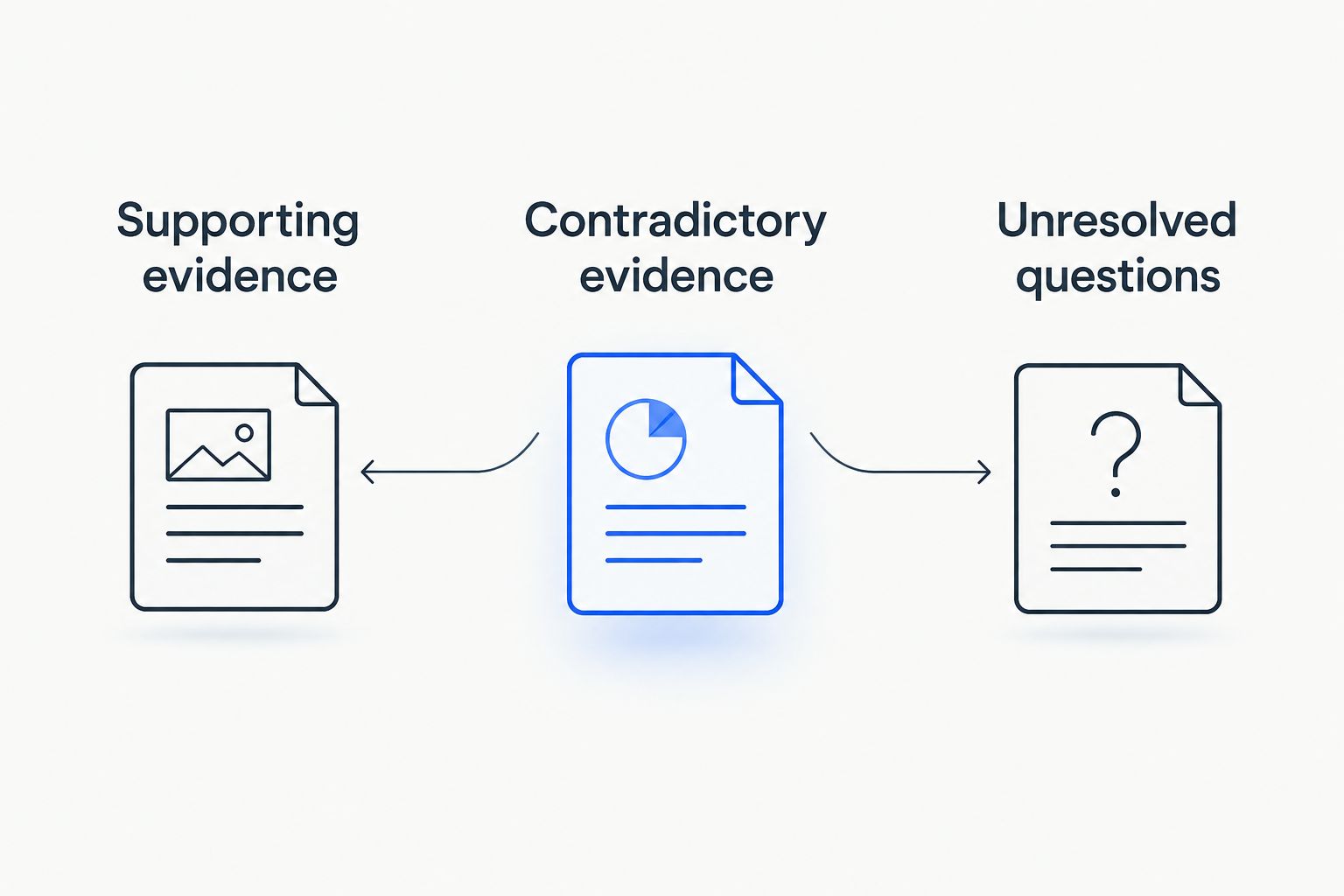
Separate the evidence before deciding how much weight each observation deserves.
Review the record in 2 passes. First check accuracy, dates and source independence. Then check whether your interpretation follows from those observations. Separating those tasks prevents an appealing explanation from substituting for a verified fact.
For your 2026 research template, add a field for what would change your assessment. Make that condition observable. A general promise to stay open-minded is harder to check than a written condition tied to the claim.
05
Ask these questions before accepting the conclusion
Use 4 questions to examine the standard behind your conclusion. Answer them from the recorded evidence rather than from how confident the explanation feels.
- Would I accept this source if it supported the opposite direction?
- Am I applying the same date and relevance checks to every claim?
- Have I explained the strongest contradiction without changing the original question?
- Can I distinguish what I observed from what I inferred?
Does finding opposing evidence mean my market view is wrong?
Opposing evidence does not automatically invalidate your market view. Its importance depends on relevance, reliability and the claim being tested. The task is to explain its weight without inventing a new standard that protects your original conclusion.
Can a profitable trade still involve confirmation bias?
A profitable trade can still involve confirmation bias. The result does not reveal which information you ignored before the decision. Keep the original research record intact when completing your 2026 review, then assess the reasoning separately from the outcome.
FAQ
What does confirmation bias look like in trading research?
Confirmation bias appears when you favour supporting information and scrutinise contradictory information more harshly. Leading searches, selective chart windows and repeated commentary treated as independent evidence are warning signs.
How can I check whether my research question is leading?
Check whether your question assumes the direction or conclusion you want to establish. Rewrite it to ask what supports the view and what would weaken it.
Do several agreeing articles confirm a market view?
Several agreeing articles do not establish independent confirmation. Trace their claims to the underlying evidence and check whether they all rely on the same release or commentary.
Should I give supporting and opposing evidence equal weight?
Supporting and opposing evidence do not automatically deserve equal weight. Apply consistent checks for relevance, reliability and timing before judging their significance.
Does a winning trade prove my research was unbiased?
A winning trade does not prove your research was unbiased. Review what you recorded before the decision rather than using the outcome to validate the reasoning.
Can performance feedback replace checking market sources?
Performance feedback cannot replace checking market sources. VCG Markets provides behavioural performance scoring through VCG ONE, but a market claim still requires source verification.
Conclusion
Before your next 2026 market review, write down the evidence that would weaken your preferred explanation. Do this before searching for further support. You then have a visible standard against which to check later revisions.
One final distinction matters: changing your mind is not evidence that the original research failed. Refusing to update is not evidence of discipline either. The relevant question is whether the change follows from information assessed under consistent standards.
Keep unresolved questions visible. An unanswered question is more useful to a research review than an unsupported answer recorded as fact.
Test the evidence against your view with the same care you give the evidence supporting it.
Related guides
This article is for educational purposes only and does not constitute investment advice. Trading CFDs and other leveraged products carries a high level of risk and may not be suitable for all investors.


