Trading mechanics
Currency conversion changes reported trading profit or loss when the result is calculated in a different currency from your account currency. The reported amount depends on the exchange rate used to translate that result. Separate conversion charges and other trading costs also affect the final amount credited or debited.
Key points
- Currency conversion trading profit loss: separate the instrument result from its account-currency translation.
- The conversion rate changes the reported amount without changing the original result in its calculation currency.
- VCG Markets traders should reconcile the result currency, conversion rate and separately booked charges.
- A closed trade and a retained foreign-currency balance have different sources of exchange-rate exposure.
01Identify the currencies
02Check the conversion
03Reconcile the statement
For traders using VCG Markets, the starting point is the same: identify what currency each statement figure represents. Do not compare a result in the instrument’s calculation currency with an account balance movement until both use the same currency basis.
01
How does currency conversion affect reported trading results?
Conversion translates a trading result into another unit of account. It does not change the entry price or exit price that produced the original result. Your contract specifies the calculation currency and the applicable conversion method.
Converted result = original result × account-currency units per unit of result currency. This formula assumes the exchange rate is expressed in that direction. If the rate is quoted the other way round, division replaces multiplication.
Read the currency labels before calculating. A rate without its direction is incomplete. Reversing the quotation produces the wrong translated amount even when the original trading result is correct.
Why this matters
Your trading record and account statement can describe the same transaction in different currencies. A mismatch between their figures does not by itself establish an execution error. First separate the market result from its translation and any additional charges.
02
Separate the currencies before comparing results
Start with the currency used to calculate the instrument’s profit or loss. Then identify the currency used to display your account balance. A reporting currency can be different again if you prepare a separate performance report.
Each serves a different purpose. Keep those labels beside the figures throughout your review rather than relying on an unlabelled currency symbol.
| Currency role | What it shows | What it does not show |
| Result currency | The original trading result | Its translated account value |
| Account currency | The account-denominated result | The conversion method by itself |
| Reporting currency | A common basis for analysis | Proof that funds were exchanged |
A reporting conversion can be purely presentational. An actual currency exchange changes the currency you hold. Do not treat those events as interchangeable when explaining a balance movement.
03
Why the converted result varies
The same result-currency amount translates differently at different exchange rates. A stronger result currency increases the account-currency magnitude of both a profit and a loss. A weaker result currency reduces that magnitude.
- Rate direction. Multiplication and division depend on how the currency pair is quoted.
- Conversion time. The applicable rate depends on the conversion event specified in the account terms.
- Rate source. A reference rate displayed elsewhere is not necessarily the rate applied to your transaction.
- Conversion terms. A spread or separate charge affects the amount exchanged where the terms provide for it.
- Rounding. Rounding individual entries can create differences from converting an aggregated total.
An ordinary positive exchange rate preserves the sign of a result. Translation alone does not turn a positive original result into a negative one. Charges or other account entries are a separate part of that reconciliation.
04
Reconcile a converted trading result
Work from the transaction record towards the account balance. Reconstructing the steps keeps a conversion difference separate from an execution difference.
- Original result. Identify the result in its calculation currency. Check whether it already includes any costs.
- Conversion rate. Find the applicable rate and its quotation direction. Match it to the relevant booking event.
- Converted result. Apply the rate using multiplication or division as appropriate. Follow the stated rounding method.
- Separate charges. Reconcile commissions, financing and conversion charges where applicable. Do not deduct a cost twice.
- Account entry. Compare the reconstructed amount with the booked credit or debit. Review unrelated balance entries separately.
Keep the transaction identifier with the calculation. If a difference remains, ask for the rate, timestamp, quotation direction and charge breakdown associated with that entry. A general exchange-rate screenshot cannot establish which rate the account terms required.
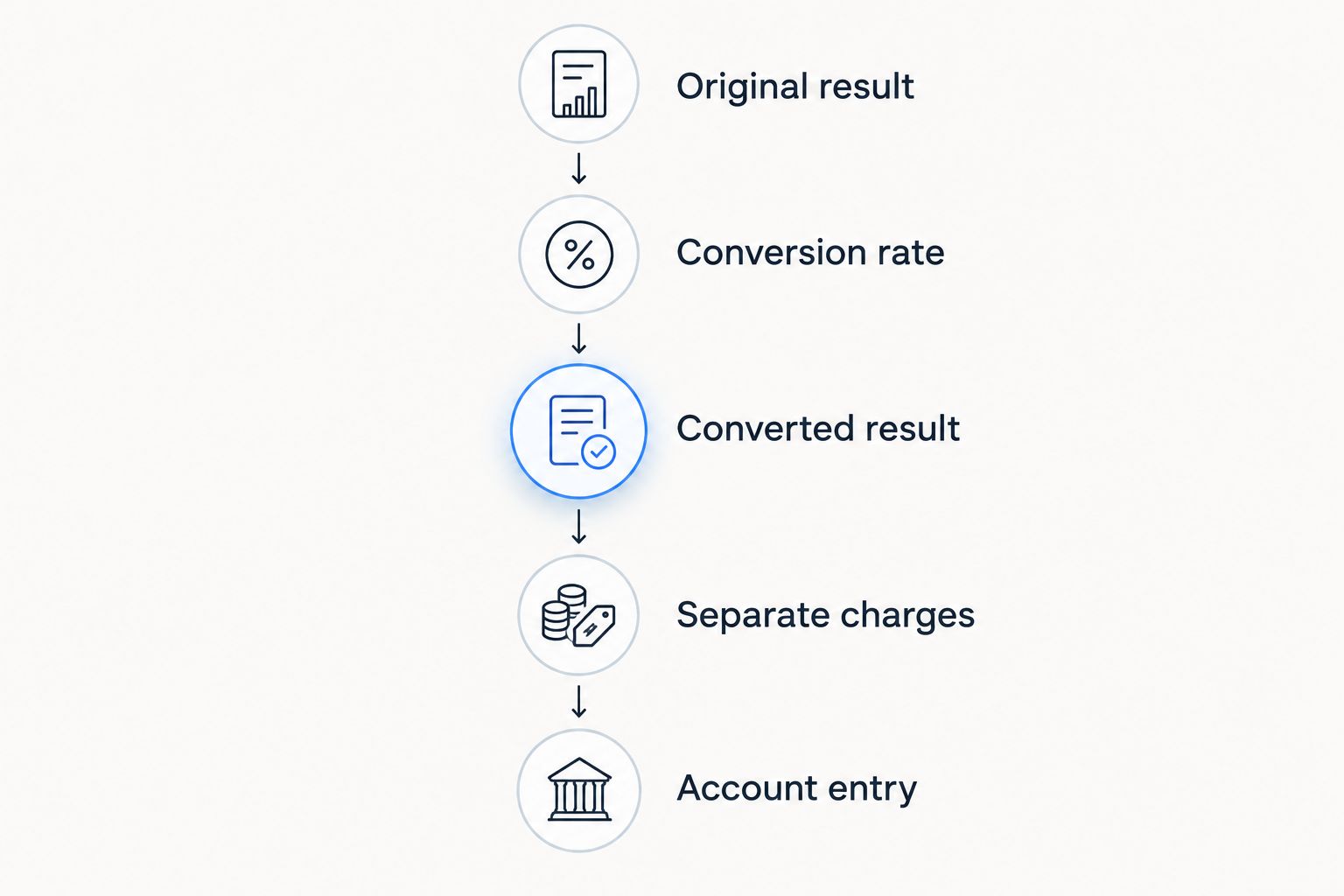
Reconcile the conversion before comparing the result with the booked account entry.
Preserve the original statement alongside your working calculation. Changing a spreadsheet’s currency format changes the label or display. It does not perform an exchange-rate conversion.
05
Can a closed trade still leave currency exposure?
A closed trade can leave currency exposure if its proceeds remain in a foreign-currency balance. The instrument position has ended. The retained balance still changes in value against another reporting currency.
Holding separate balances through multi-currency accounts separates holding a currency from exchanging it. That distinction matters when explaining a later conversion. A change in the translated value of retained funds is not a revision to the closed trade’s original calculation.
The distinction also has a practical limit. A foreign-currency balance preserves exposure to that currency rather than removing it. Whether funds remain in their original currency depends on the account structure and settlement terms.
For an open position, the displayed account-currency result can reflect both the instrument move and the conversion rate. Read an unrealised figure as a valuation at that point. Do not assume it is the final amount that will be booked on closure.
06
Why does a monthly total differ from individual trades?
A monthly total can differ when individual trades use their own conversion rates but the summary translates the combined result at another rate. These are different calculation methods. Check the report’s basis before comparing them.
Adding results that were converted when booked is not equivalent to adding original-currency results and translating the total later. The exchange rates used along the way matter. So do the treatment of charges and the reporting cut-off.
Use a consistent method when reviewing performance across periods. Label realised results, unrealised valuations and currency translation separately. Deposits and withdrawals also change the balance without being trading performance.
Compare like with like: the same currency, period, conversion basis and treatment of costs. A larger account-currency profit does not by itself establish a better instrument-level result.
FAQ
Does currency conversion change my original trading profit?
Currency conversion changes the translated amount rather than the original result in its calculation currency. Separate charges affect the final net account entry where applicable.
Can currency conversion alone turn a profit into a loss?
Translation at a positive exchange rate does not turn a positive result into a negative result. Charges or other account entries must be examined separately if the net amount is negative.
Why does my open profit change when the instrument price is unchanged?
An open profit displayed in your account currency can change when its conversion rate changes. This applies when the result currency differs from the account currency.
Which exchange rate should I use to check a trading result?
Use the rate applicable under the account terms for the relevant conversion event. Confirm its timestamp and quotation direction rather than substituting an unrelated reference rate.
Does closing a trade remove all currency exposure?
Closing a trade does not remove currency exposure from proceeds retained in a foreign currency. Those funds still change in translated value against another reporting currency.
Why does my spreadsheet total differ from my statement?
Different conversion timing, rounding or treatment of costs can produce different totals. Reconcile each booked entry using the statement’s currency basis before comparing the aggregate.
Conclusion
Keep a separate column for the exchange rate used on each converted entry. A single rate applied to an entire statement cannot reproduce transaction-level conversions when those rates differ. That distinction can explain a mismatch without changing any original trade result.
Separate the trading result, its currency translation and the costs booked against it.
Related guides
- How correlated currency pairs create hidden exposure
- Chart price and execution price
- How dividend adjustments affect index positions
This article is for educational purposes only and does not constitute investment advice. Trading CFDs and other leveraged products carries a high level of risk and may not be suitable for all investors.


