Research verification · 2026
Fact-check generated market summaries by tracing each material claim to its original source. Confirm the instrument, reporting period and timestamp. Recalculate numerical claims independently. Keep unsupported explanations separate from verified facts, even when the summary includes citations.
Key takeaways
- For VCG Markets readers researching AI hallucinations financial research, verify original sources before accepting market summaries.
- Match market data to the correct instrument, reporting period and publication time.
- A valid citation supports a claim only when its source actually contains the stated evidence.
- Recalculate numerical claims. Label causal explanations as interpretations unless the evidence establishes the connection.
01Trace the evidence
02Check the context
03Record the verdict
Why verification matters
A fluent explanation is not evidence. A summary can reproduce a genuine figure while assigning it to the wrong period. It can also describe a market reaction accurately and attach an explanation that the underlying source never established.
For readers of VCG Markets, the useful distinction is between what happened and what someone believes caused it. Verify those claims separately. A confirmed market move does not automatically confirm the explanation beside it.
Your aim is not to reject every generated summary. Use summaries to organise research. Keep the original documents responsible for the facts, and keep your own verification record responsible for what you accept.
01
How do you fact-check generated market summaries?
Start with individual claims rather than the paragraph as a whole. A sentence about an earnings release can contain a reported result, a comparison and a causal explanation. Each needs its own evidence.
- Claim: Copy the exact statement. Identify whether it reports a fact, calculation, forecast or interpretation.
- Original source: Open the underlying release, filing, exchange notice or official data table. Locate the supporting passage.
- Time check: Match the publication time, observation period and market session. Check whether the source was later revised.
- Recalculation: Reproduce the arithmetic using matching units and comparison periods.
- Verdict: Mark the claim verified, corrected or unverified. Save the evidence beside that decision.
Verify decision-relevant claims before background detail. Instrument identity, announcement timing and the meaning of a reported change deserve attention before descriptive language. A polished introduction cannot repair a mistaken input.
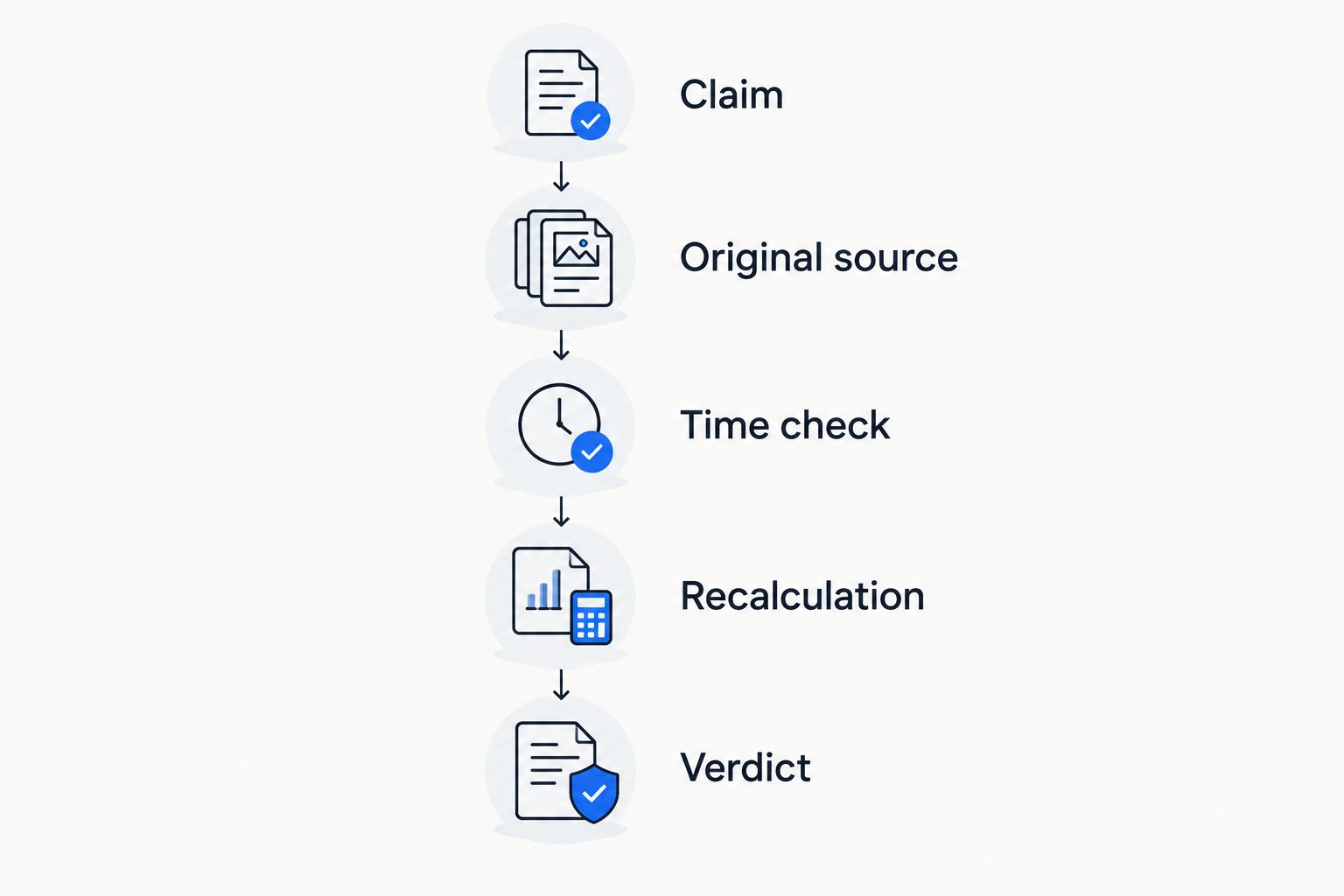
Check each claim separately before accepting the summary as a whole.
Keep corrections local. If a numerical statement fails verification, remove or correct that statement. Do not assume that finding an error proves every other sentence wrong, or that confirming one sentence validates the rest.
02
Choose evidence that matches the claim
Different sources answer different questions. Use a company filing to check reported financial results. Use an exchange notice to check an instrument specification. Neither automatically establishes why traders reacted to the information.
Follow a citation all the way to the relevant passage. A source title that sounds appropriate is not enough. Confirm that the document contains the claimed fact and that the summary preserves its qualifications.
| Evidence type | Useful for | Limit |
| Original release or filing | Reported facts and definitions | Does not establish every market interpretation |
| Exchange or instrument documentation | Contract terms and measurement conventions | Must match the exact instrument |
| Market commentary | Attributed explanations and context | Interpretation is not proof of causation |
When checking a filing published in 2026, distinguish its publication date from its reporting period. The document can describe an earlier period. Carry that period into your notes rather than replacing it with the year of publication.
If an original document is inaccessible, leave the claim unverified. Another summary repeating the statement does not fill the evidence gap.
03
Check time, instrument and scope
Correct information can still be unsuitable for the summary. A forecast is not a released result. A cash index is not its futures contract. A company announcement does not describe every business in its sector.
For a market summary dated 2026, record the full date and stated time zone. Separate the publication timestamp from the time of the market observation. Avoid calling information current simply because the page was updated recently.
- Instrument: Match the symbol, venue and contract where relevant. Similar names are not sufficient.
- Period: Match the quarter, month or trading session being discussed.
- Status: Distinguish preliminary, revised and final releases.
- Scope: Check whether the evidence concerns one company, an index or a wider market.
Use contract documentation when a statement depends on trading terms. The guide to reading contract specifications provides related context for that check.
Preserve the information available at the time when reviewing an older summary. Later revisions can change the historical record without showing that the earlier writer invented the original release.
04
Recalculate before accepting numerical claims
Return to the inputs rather than checking only the final result. Confirm the starting value, ending value and unit. For percentage change, divide the change by the starting value before expressing it as a percentage.
Check the denominator. A percentage-point change describes the difference between percentages. A percentage change describes a relative movement. Treating those measures as interchangeable changes the meaning of the result.
For a 2026 company-results summary, check whether the comparison uses reported or adjusted figures. Confirm the currency and whether the amounts are stated in thousands or millions. Apply the same checks to both periods.
- Keep the source precision during the calculation.
- Round only the final displayed result.
- Match the direction of change to the arithmetic.
- Separate a reported figure from a calculation you performed.
Do not fill missing inputs with plausible values. Mark the calculation incomplete. A clearly identified gap is more useful than a precise-looking answer whose inputs cannot be recovered.
05
Why verification difficulty varies
The work depends on the claim and its evidence. Checking a clearly labelled release is different from checking a narrative about market sentiment. Use these factors to decide where the summary needs closer examination.
- Source access: An available original document allows direct checking. An inaccessible citation leaves an unresolved gap.
- Time sensitivity: Statements about a live session require timestamps that static background descriptions do not.
- Instrument detail: Contract-specific statements require the corresponding specifications.
- Calculation steps: Derived results require both accurate inputs and correct arithmetic.
- Interpretation: Claims about motives or causes need different evidence from claims about released figures.
- Revisions: Updated data require a record of which version the summary used.
Do not turn this checklist into an invented accuracy score. Record the actual outcome of each check. A summary with unresolved material claims remains incomplete, regardless of how many minor details you confirmed.
06
Does a working citation prove the claim?
A working citation proves only that a destination opens. Read the relevant passage and compare it with the exact claim. The source must support the wording, period and scope attributed to it.
Can a summary explain why a market moved?
A summary can report an attributed explanation without establishing causation. Separate the observed move from the proposed driver. Record whose interpretation it is and what evidence supports it.
What should I save after checking?
Save the original claim, source title, relevant passage and access date. Add the calculation inputs where needed. Keep the verdict beside the evidence so another reader can reproduce the check without reconstructing your research.
FAQ
What are hallucinations in generated financial research?
Hallucinations are generated statements presented as factual without adequate grounding. In market research, check for invented citations, unsupported figures and claims that the cited document does not contain.
How do I check a market summary quickly?
Start with claims that affect the summary's meaning: the instrument, event, reporting period and numerical result. Trace those claims to original sources before checking background detail.
Should I ask the same system to check its own answer?
A self-check is not independent verification. Use it to identify claims requiring attention, then open the original documents and reproduce the calculations yourself.
Does agreement between several summaries confirm a fact?
Agreement between summaries does not establish independent confirmation. Trace each account to its underlying evidence and check whether they repeat the same source.
What if the citation is real but the figure is wrong?
Correct or reject the figure based on the original source. A genuine citation does not validate a number that was copied incorrectly or assigned to the wrong period.
How should I handle an explanation without evidence?
Label the explanation unverified rather than presenting it as fact. If you retain an attributed interpretation, identify it clearly and keep it separate from confirmed observations.
Can a verified market summary tell me what trade to make?
Verification establishes whether the checked statements are supported. It does not establish a suitable trade or guarantee an outcome. A factual summary is not personalised investment advice.
Conclusion
For your 2026 research record, preserve the version you checked. A corrected source or edited summary can otherwise make a later review difficult to reconstruct. Save the relevant passage and the date alongside your verdict.
One useful final check is to remove every causal explanation temporarily. Read only the verified observations. If the central conclusion disappears, it depends on interpretation and needs to be labelled accordingly.
Keep the claim, its evidence and its limits together.
Related guides
- Automation bias in trading decisions
- Missing data in a trading review
- Context for performance scores
This article is for educational purposes only and does not constitute investment advice. Trading CFDs and other leveraged products carries a high level of risk and may not be suitable for all investors.


